
Also: Town leaders renew call to save lives at Applegate Corners
by Robert Lynch; June 16, 2026
When the Enfield Town Board convened to conduct its monthly business June 10, none of its five members knew that they’d be spending more than $200,000 that night to buy a big, new dump truck. But that’s what they did.
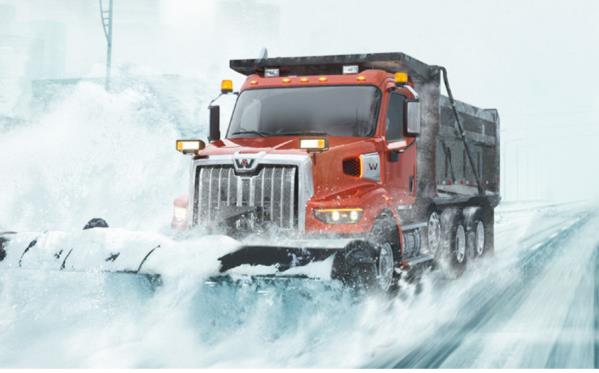
In a sudden move that prompted on-the-fly budget math, a desperate call to the town bookkeeper, and a pointed dissent from one board member, Enfield leaders last Wednesday accelerated by a full year their planned purchase of the 10-wheeler, all because Enfield Highway Superintendent Barry “Buddy” Rollins said he wanted it.
In most any newsroom, the purchase of a dump truck—even by a smaller community where such spending can strangle a budget—prompts rolled eyes and open-mouthed yawns from editors. “Who cares?” they’d ask.
Some may posit the same question here. But in Enfield, last week’s action opens a window into how today’s Town Board majority conducts business, especially when addressing impromptu spending appeals by the Highway Superintendent, a man Town Supervisor Stephanie Redmond bends over backwards to please.
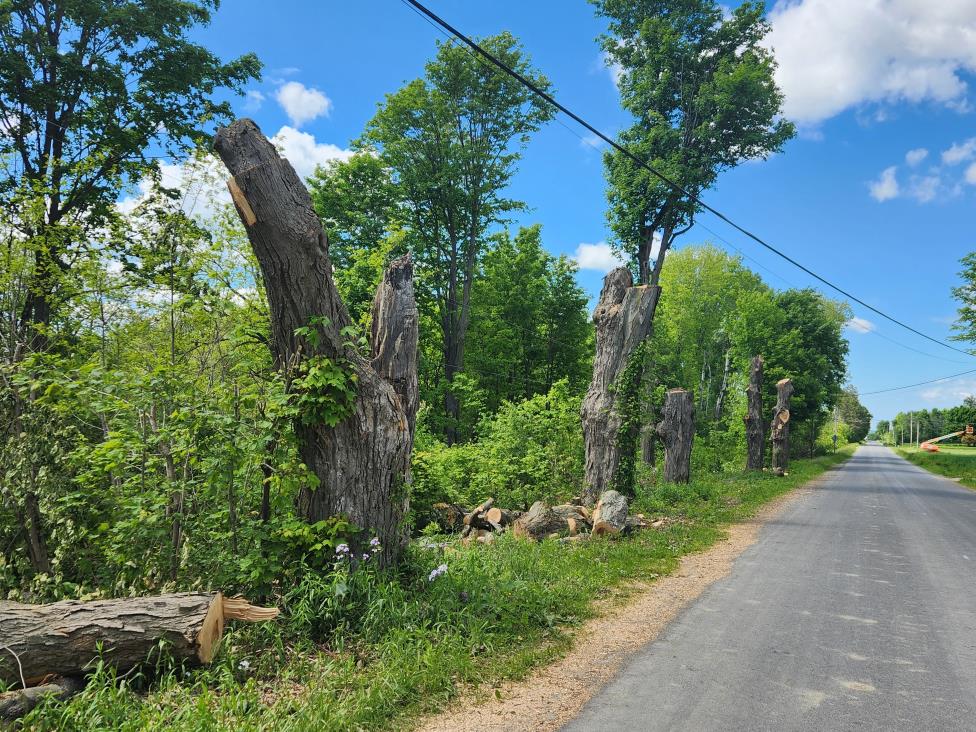
At meeting’s start June 10, Redmond closed off attempts to read into the record a constituent’s correspondence critical of Rollins’ department’s ditch management practices on Tucker Road. Also that night, she deflected criticism of the superintendents’ latest tree-cutting dispute, this time involving a resident complaint on Buck Hill Road.
Two months ago, the Supervisor had defended Rollins and peeved an Enfield Center resident in the process when that person and her partner came to allege that the Highway Superintendent’s inaction had worsened damage to their property during a March 31 flash flood. Rollins had exited the April 8 meeting early and angry.
“You’re off base. You’re wrong, both of you. You’re out of line,” Rollins had blurted out to the complainants, defensively denouncing their allegations of supposed inaction.
“I totally appreciate all the work that you did,” Supervisor Redmond complimented Rollins after the fiery exchange, speaking as she also cut off the accusers and sought to restore order. “I appreciate the work that you were doing. Thank you so much,” the Supervisor repeated to Rollins moments before he left.
Barry Rollins never stayed around to give his own departmental report to the Town Board that April night. In May, Redmond said Rollins had been excused from attending for reasons never explained.
So by the June 10 meeting, the Highway Superintendent had business to transact. For him, perhaps, it was a request long overdue. But for board members, it came as a complete surprise.
“One thing I wanted to bring up,” Rollins stated during his Superintendent’s report, 47 minutes into the June 10 meeting. “We’re supposed to replace another ten-wheeler in 2028. And they’re telling me trucks are two years out to build,” he said. “So I’m wantin’ to ask about buying a truck this year.”
“And how that works now,” Rollins explained, “is you’ve got to buy the cab and chassis and pay for that, but the equipment you don’t have to pay for it until it’s put on the truck.”
Eighteen minutes after Barry Rollins said those words, the Town Board, voting four to one, bought the cab and chassis. A formal resolution was never written. A precise dollar figure was never assigned, although a range of $190,000 to $220,000 was tossed around at one point. Even the exact model number of the Western Star frame was based on the Superintendent’s best recollection.
“I cannot vote for it tonight because it’s hasty decision making,” Councilperson Robert Lynch (this writer) stated before casting the board’s lone dissent. “I can’t spend $200,000 with only maybe five-to-ten minutes’ discussion. That’s not responsible budgeting, so I will be voting no.”
“You should be supporting me instead of fighting me,” Rollins later told Lynch, rebuking him when the topic later turned to Lynch’s reporting the Buck Hill Road constituent’s complaint about tree cutting. “Don’t criticize me for doing my job. You should be thanking us for doing our job,” Rollins insisted.
Between the Highway Superintendents appeal for purchasing authority and the Town Board’s final vote, Supervisor Redmond went out of her way to accommodate Rollins’ sudden request.
To be clear, the Town of Enfield intended to buy the ten-wheeler eventually, starting next year. The Town’s Capital Plan, renewed annually, most recently last fall, called for a $200,000 down payment to be made in 2027, with three, annual $73,442 loan payments thereafter. Budget math puts the truck’s total projected cost at $420,336, principal plus interest.
Monthly financial records before the Town Board June 10 suggested a $404,572 balance in equipment reserves, more than enough to speed up a purchase that hadn’t been planned for yet another year. The custodian of those records, Town Bookkeeper Blixy Taetzsch, wasn’t in the room that night. So Redmond texted her at home, invited her into the meeting remotely, and she joined.
“I would say, yes, go for it,” Taetzsch advised the board after giving the balance sheet an ever-so-quick inspection. “If you don’t do this now, you’re not going to have it (the truck) in service when you need it,” she reasoned. “And I do think there’s enough money in the reserves.”
Yet the review was hurried and more than a little unsettling, especially given the magnitude of the outlay. Why Rollins could not have anticipated the supply chain logjam and approached the Town Board a month or two earlier never arose in the discussions.
Two factors drove Superintendent Rollins to seek accelerated purchase of the ten-wheeler, a machine that won’t make its way to the Enfield highway barn for two more years.
First, there’s the business divide between the company that manufactures the truck and the firm that later attaches the needed add-ons like the box and snow plow. The cab and chassis manufacturer finishes the basics within a few months of order, but then the unit sits idle for up to two years awaiting the rest of what’s needed.
Nonetheless, the truck’s manufacturer wants its money up-front. And yes, there’s a waiting list.
Rollins told the board that one truck maker, Freightliner, is already booked for the year. A second manufacturer, Western Star, as of meeting night, had only 19 openings left for the year. By waiting another month, Rollins predicted, those slots would be filled by other buyers.
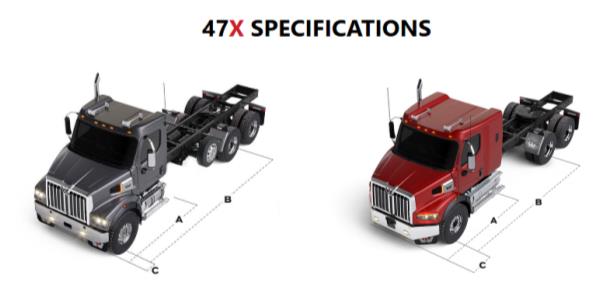
As for the second reason, Rollins prefers to purchase a current year’s model, not a 2027 truck. Governmental rules will impose new and costly emissions standards next year, he warned. They’d add $20,000 to $30,000 to a truck’s price, he predicted. And untested, they could pose problems.
“I move we postpone this decision for at least a week,” Lynch proposed when the purchase resolution (such as it was) reached the floor. His postponement effort died for lack of a second.
Having failed to give the purchase some breathing room, Lynch then moved to fund the acquisition in part by delaying a budgeted $165,000 mower tractor’s purchase until next year. Buying that tractor has proven controversial in its own right. Again, the motion received no second.
And yet what happened June 10 served as a telling example of how Enfield Highway Department equipment often gets bought. Decisions often arrive with minimal deliberative forethought and seat-of-the-pants snap judgments. Whether it should be that way really doesn’t matter. That’s the way it’s done.
****
Far less contentious, although with an outcome less predictable, the Enfield Town Board June 10 sent a renewed appeal to the New York State Department of Transportation (NYSDOT) seeking an updated traffic study into what’s probably Enfield’s most dangerous intersection, the crossing of Applegate Road with Mecklenburg Road, NY Route 79.
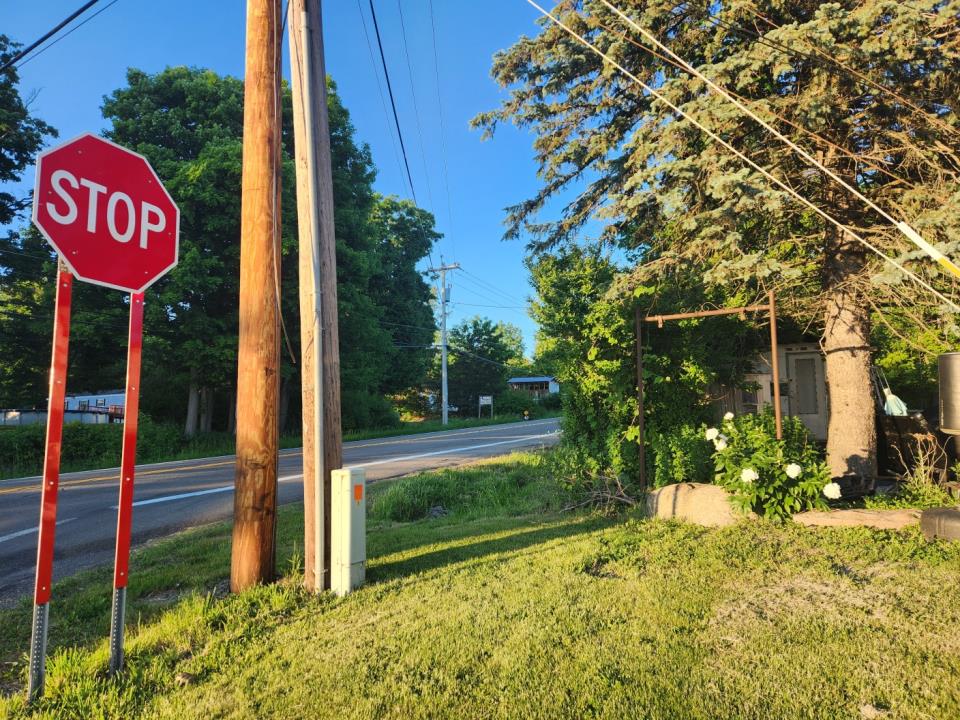
NYSDOT last studied “Applegate Corners” in 2024. State review followed numerous accidents and a December 2023 Enfield Town Board request that state and county traffic engineers” consider any and all improvements that would enhance traffic safety at that intersection.” Suggested remedies then included “upgraded signage, pavement modifications, and/or the installation of new traffic control devices, such as an overhead blinker.”
New York undertook the study. The Department of Transportation, of course, never installed the blinker. Nor did it approve another Enfield request to lower the speed limit on Route 79 east of the intersection to below 55 Miles per Hour. (The limit is 45 MPH west of the crossroads.) But by November of 2024, Scott Bates, the agency’s Regional Traffic Engineer, had promised installation of “low-cost improvements,” primarily new signage, which he determined to be “feasible.” They were later installed.
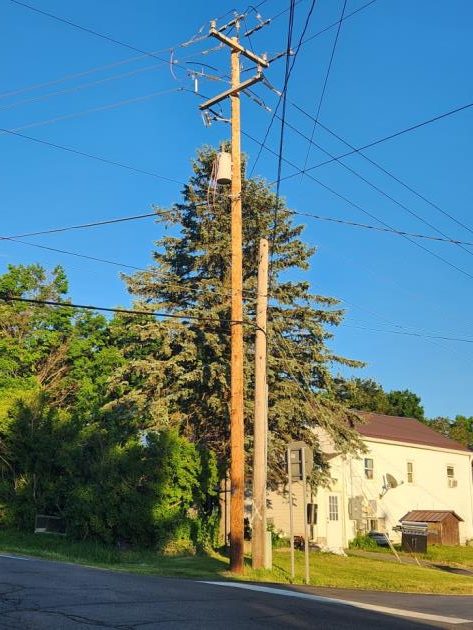
The Town Board’s most recent attention has turned to a new problem. It’s a recently-set electrical pole at the intersections’ southeast corner, a pole that blocks driver visibility of cross-traffic. It’s worse because the pole that it was supposed to replace has yet to be removed.
“It is the most dangerous intersection in Enfield,” Councilperson Lynch, sponsor of this latest Resolution, told Board members. “It’s a dangerous, terrible intersection.” Lynch continued. “It’s not really a question right now of people being able to stop. It is a question of people not being able to see.”
“That pole is very obstructive,” Lynch told the Town Board. And when driving Applegate Road it’s often impossible to see Route 79 traffic until you’re actually in another vehicle’s path. “People have died there already,” Lynch said. “Something has to be done. I don’t know what it is. I’m not a traffic engineer. But we really need to make that intersection safer.”
The “Resolution Requesting an Updated Traffic Study” at Applegate Corners passed the Town Board unanimously. It asks state and county agencies “to address the need for additional improvements, including but not limited to traffic control devices, foliage removal within the state- or county-maintained right-of-way, and/or the directing of New York State Electric and Gas Corporation to relocate its recently-installed electrical transmission pole to a location posing less of a safety hazard.”
Other Enfield Town Board business handled June 10:
- Tax Cap: By a four-to-one vote, the Town Board set a Public Hearing for July 8 to consider overriding New York State’s tax cap on next year’s tax levy. The hearing’s scheduling comes even though planning of the 2027 Budget has yet to begin and the tax cap for Enfield has yet to be set.
“What’s wrong with doing it in October when we’ve got a budget?” Councilperson Lynch asked.
“Because it kind of pushes everything really tight,” Supervisor Redmond explained. Holding the hearing early, Redmond argued, assures “we have all of our i’s dotted and t’s crossed.” And we don’t “have to push it up against the deadline” or “clog up our meetings” should the need for other hearings arise, Redmond asserted.
“Let’s just do it and get it out of the way,” the Supervisor concluded.
“This is basically thumbing the nose at the taxpayer,” Lynch answered. “We don’t know what the tax cap is. We don’t know what the budget is. We don’t know how much the levy’s going to increase because the budget hasn’t been written yet. So why override the tax cap? It’s kind of a cavalier action. I can’t vote for it.” He didn’t.
- Highway Department Wastewater: Taking parallel action to resolve an ongoing problem that could quickly prove costly, the Town Board approved a lone bid by a Schenectady firm, Precision Industrial Maintenance, to haul away drain wastewater from the Enfield Highway Garage. It’s waste water accumulated mostly from washing down trucks. And it’s water the Ithaca Area Wastewater Treatment Facility (IAWWTF) has refused to accept since late last year.
The hauling contract is pricey: $2,725 per service call—generally once per month— plus 25 cents per gallon of water disposed. The fluid goes all the way to Schenectady. When the IAWWTF had accepted the Drainwater, a monthly pumping generally cost about $900.
Meanwhile, the Town Board authorized a Cortland-based laboratory, Microbac, to test of the drain water. Testing could enable Enfield to eventually obtain a permit and resume using the Ithaca disposal plant. Authorization to pay Microbac its more than $2,300 testing fee awaits final approval of testing procedures by IAWWTF officials.
- FLAIR Powerline Project: The Town Board endorsed a recently submitted “Joint Proposal” by New York State Electric and Gas Corporation, the New York State Public Service Commission and other state agencies toward resolving citizen complaints over the “FLAIR” electrical line reconstruction near the Newfield-Enfield border. Enfield’s adopted Resolution describes the Joint Proposal as a “compromise” that advances both the utility’s interests and Enfield residents’ demands for “economic well-being, health, and community enjoyment.” (See separate reporting.)
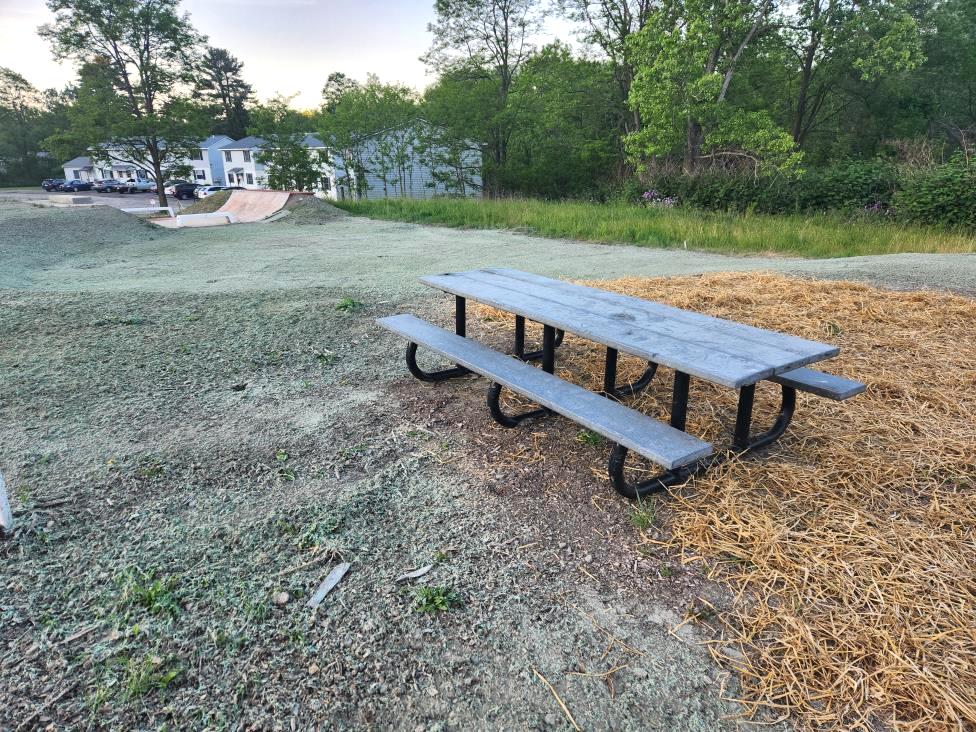
- SkateGarden: And on the heels of a $5,000 anonymous gift, accepted May 26, the Town Board appropriated $500 from that fund toward purchasing trees and possibly playground equipment to expand opportunities at Enfield SkateGarden, across from the Town Hall, and make it more than just a skateboard rink. As it took that action, the Board tabled until its July meeting a broader Resolution that would accept and adopt the Cornell Design Connect student recommendations as the “conceptual design model to guide future improvements” at SkateGarden. The tabled measure would also ensure that “all substantial improvements” at the skate park occur only with Town Board consent.
###