
NYSEG “FLAIR” redo brings shorter poles, familiar design
by Robert Lynch; June 15, 2026
“I was shocked that they were so thoughtful.”
Newfield Town Board member Christine Seamon, reacting to NYSEG’s sudden redesign, June 11.
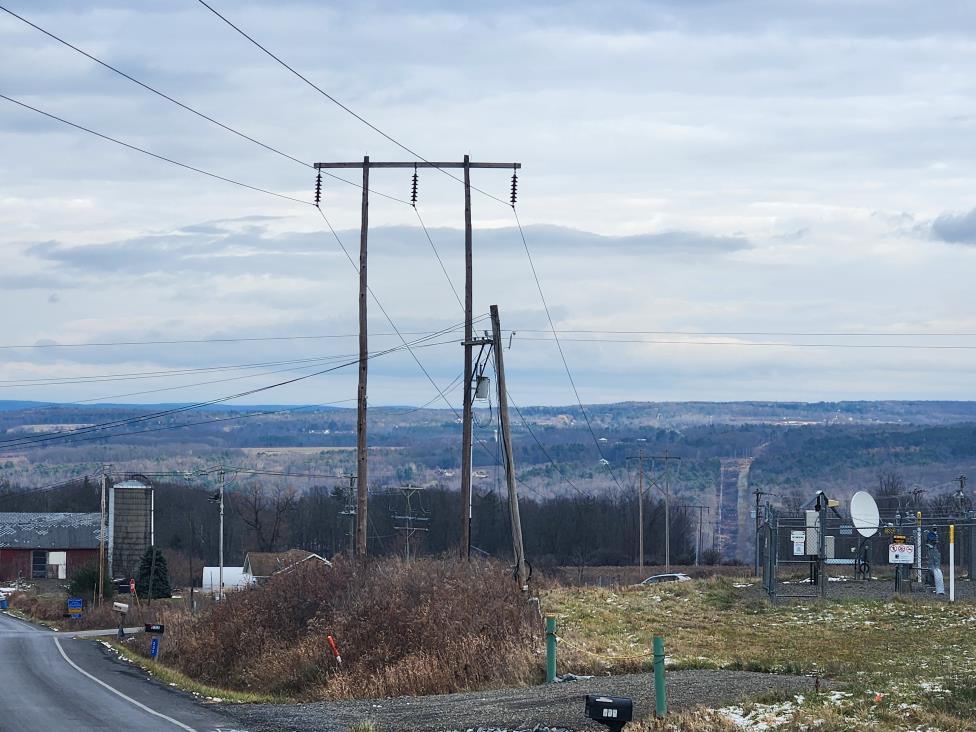
When New York State Electric and Gas Corporation (NYSEG) rebuilds the high-tension electrical line we drive under near Teet’s scrap yard on Enfield’s Black Oak Road or across Millard Hill Road in Newfield, it’s likely to look nearly the same going forward as it’s always looked for nearly the past century.
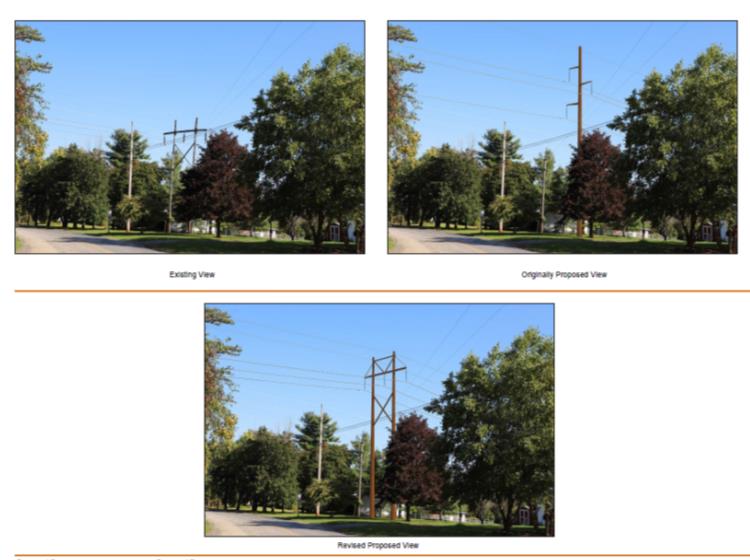
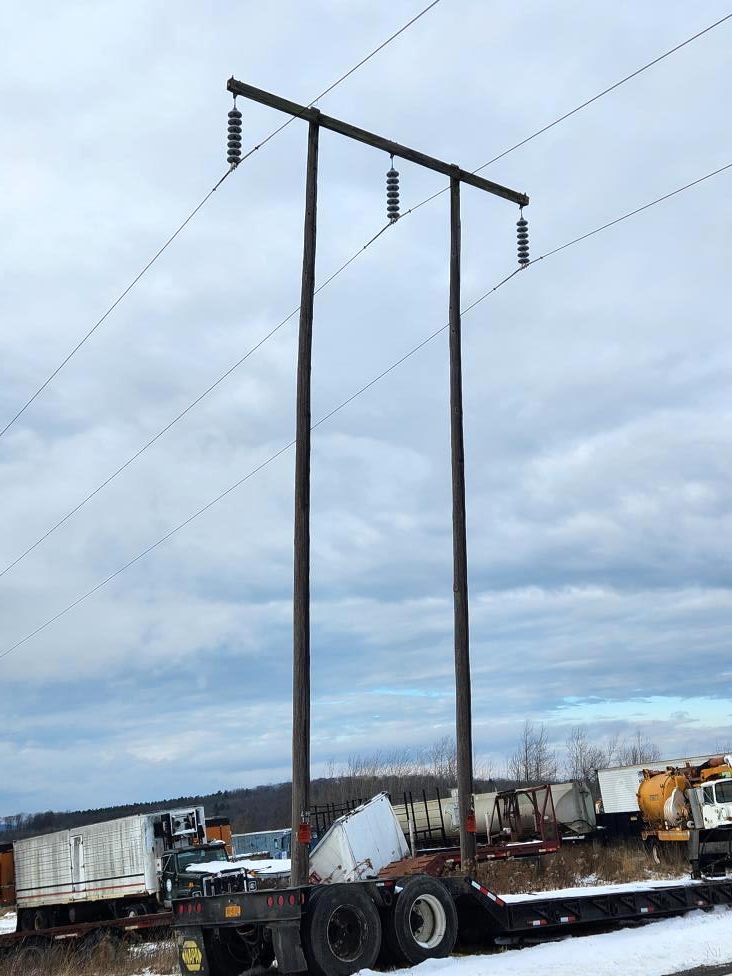
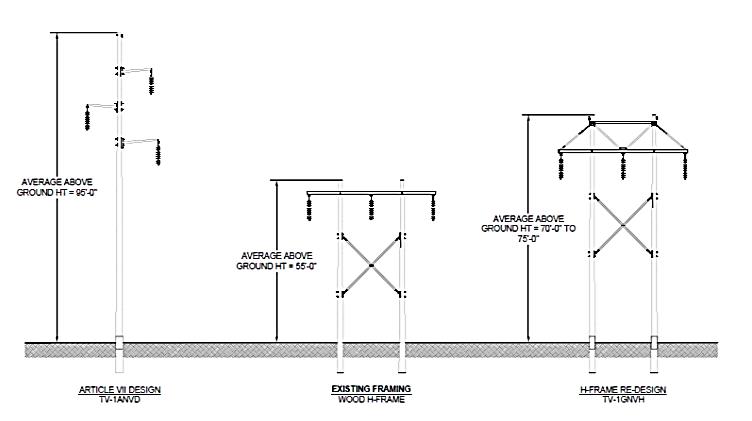
In a sudden about-face move that’s surprised just about everybody, NYSEG late last month revised plans for its 21-mile “FLAIR” powerline reconstruction. The change would dramatically reduce the height of the project’s replacement poles from those first proposed and revert to the familiar, twin-pole “H-frame” support configuration that the current line utilizes.
The utility’s change, conveyed in a “Joint Proposal,” filed with the New York State Public Service Commission (PSC) by NYSEG and staff attorneys for various state agencies May 28, has or will likely quell public and governmental opposition to the project. The company had initially planned to replace the long-familiar, parallel-draping H-frames with much taller steel monopoles, structures that some residents complained would destroy their scenic views and devalue their properties.
Yes, the adage, “Everything old is new again” applies here.
“I was shocked that they were so thoughtful,” Newfield Councilperson Christine Seamon remarked at her Town Board’s June 11 meeting. “If you bought this property with a pole there, there’s going to be a pole there,” Seamon acknowledged. Still, that said, the situation would become no worse than it’s ever been.
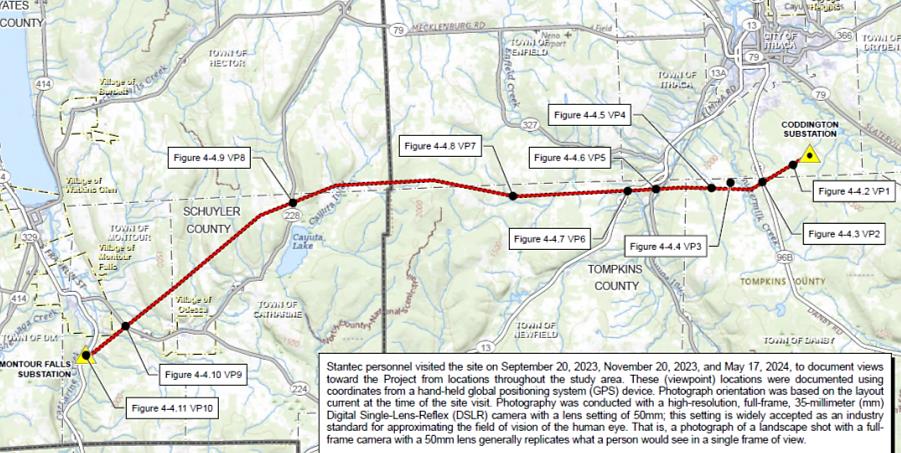
“FLAIR,” an acronym for “Finger Lakes Area Infrastructure Reliability” Project, was advanced by NYSEG to the Public Service Commission in December 2024. FLAIR would rebuild a 20.6 mile-long, 115 kilovolt transmission line, so-called Line 982, on the utility’s existing 100-foot wide right-of-way (ROW) and connect a substation in the Town of Montour, Schuyler County to the Coddington Substation south of Ithaca. The right-of way slices through Enfield’s southwestern corner and across a longer swath of northern Newfield.
NYSEG documents state that the wooden-pole, H-frame line was first built around 1930. It’s stood largely undisturbed ever since. What NYSEG seeks now from the PSC is a “Certificate of Environmental Compatibility and Public Need.” The certificate represents an official agency determination that the reconstruction would inflict little environmental or aesthetic harm and also serve the public good.
Both the Newfield and Enfield Town Boards in January submitted formal comments in the proceeding, each local government critical of the original “monopole” design that NYSEG had proposed.
The monopoles, which stack the three transmission wires essentially on top of one another, rather than hang them side-by-side, would have elevated support structural height to an average 95 feet above ground, compared to the 55-foot high wooden H-frame supports that exist now. The amended, H-frame poles, now advanced in the “Joint Proposal,” would stand only an average 75 feet in height. They’d be taller than what’s there now, yet still an average 20-25 feet shorter than the monopoles.
“It’s good news,” Enfield Councilperson Robert Lynch (this story’s author) advised Enfield Town Board colleagues as the board met June 10. “It might be a little more intrusive than it is at present,” he admitted, “but it’s far less intrusive than the 95 foot metal monopoles.”
By a unanimous vote June 10, the Enfield Town Board adopted a Resolution, written by Lynch as Board liaison to the PSC’s FLAIR proceedings. The Resolution affirmed the Town Board’s support for the NYSEG and agency Joint Proposal and for the amended reconstruction design it advanced.
“Resolved, that the Enfield Town Board hereby endorses the Joint Proposal … and urges the New York State Public Service Commission to grant an Article VII Certificate of Environmental Compatibility and Public Need for the Finger Lakes Area Infrastructure Reliability (FLAIR) Project, conditioned on NYSEG’s adherence to the revised specifications embodied in the Joint Proposal,” Enfield’s adopted Resolution states.
“This Town Board believes the Joint Proposal… stands as a fair compromise between NYSEG’s needs to meet increased electrical demand and the public interests of Enfield residents to protect their economic well-being, health, and community enjoyment and to minimize the FLAIR proposal’s earlier-identified adverse impacts,” Enfield’s Resolution stated.
Town Clerk Mary Cornell promptly filed Enfield’s adopted Resolution with the New York State Public Service Commission.
One night later, Newfield Supervisor Michael Allinger advised his own Town Board of the May 28 NYSEG revision. Allinger’s announcement prompted brief Town Board discussion. The Newfield Board took no further action.
A “Ruling Regarding Process and Procedure,” issued by the Public Service Commission June 5, allows any interested party until Wednesday, June 17 to file statements in support or opposition to the May 28 Joint Proposal. Parties also have until June 29 to submit replies to those statements.
Signatories to the Joint Proposal include NYSEG, and staff attorneys for the New York State Department of Public Service, the New York State Department of Environmental Conservation, and the New York State Department of Agriculture and Markets.

In a video conference convened June 4 by James Costello, the PSC’s designated Administrative Law Judge in the FLAIR proceeding, a conference in which Enfield’s liaison, Councilperson Lynch, was its only municipal participant, agency and municipal representatives expressed general support for the changes NYSEG had made. No known opposition surfaced then or has thereafter.
Should the Commission grant a Certificate of Environmental Compatibility and Public Need after this month’s comment period has closed, NYSEG’s timetable, at least as originally advanced, calls for line reconstruction to begin early in 2027. Work would finish and the new line energized by the end of 2029.
As part of its 2024 original filing, the utility’s application figures initially redacted, but subsequently made public in part, NYSEG projected the FLAIR reconstruction would cost just over $88 Million. The estimate had been based on monopole construction. Revised cost projections did not issue with the May 28th changes. Nonetheless, the Joint Proposal states that “the Settlement Revisions are not anticipated to materially increase Project cost above that set (previously).”
For nearly a year after NYSEG’s initial filing, the FLAIR project hung only in the shadows. It received little attention despite NYSEG’s mandated outreach efforts. It took a family from Newfield to elevate FLAIR to the point of controversy.
And it was Shaun Brown, a young Bishop Road resident turned community activist, who along with his mother, Ann, went house-to-house in northern Newfield last fall alerting neighbors of what NYSEG had proposed. Shaun Brown also alerted Enfield officials. Both mother and son attended an Enfield Town Board meeting last November. They also spoke before a larger gathering of Newfield residents at a Newfield Town Board meeting November 20.
Shawn Brown told Newfield’s November meeting, “In their application, NYSEG (has written) the project will not interfere with the policies and plan outlined in the Town of Newfield’s Comprehensive Plan. This is a gross misrepresentation, and is demonstratively false,” Brown alleged.
More than a dozen Newfield residents spoke before the Newfield Town Board that November night. Many were angry at the utility and worried that the tall, ugly, steel monopoles, would scar the scenic views to which they’d become accustomed.
“My whole life, I’ve dreamed of having my house on a hill with a scenic view,” Kirsten Hamburg of Douglas Road told the Newfield Town Board that night. “These aged poles were a concession for me, but I was fine with it because it blends in with the tree line,” Hamburg said of what had become familiar. Yet of the proposed monopoles, she said, “I cannot handle a ginormous pole in my backyard.”
With very few now aware of the utility’s November 28 sudden about-face, widespread community reaction of this latest design change has yet to surface. But tellingly, prior to the administrative law judge’s video conference June 4th, Shawn Brown suddenly withdrew his active participation in the FLAIR proceeding. Brown opted instead to remain listed only as a “passive party.”
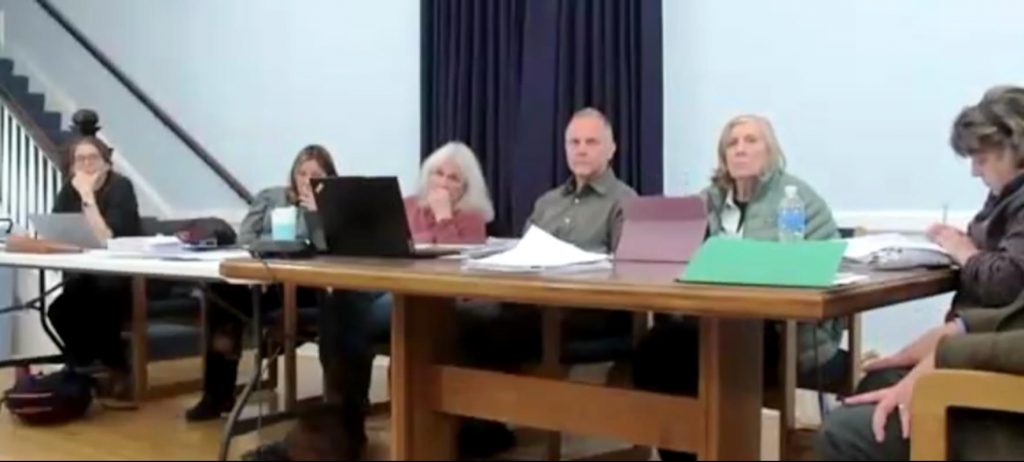
“I take a position of non-opposition regarding the Joint Proposal and the redesigned project,” Brown emailed Judge Costello the day of the conference. “I will not be a signatory to the Joint Proposal, nor do I intend to file testimony, briefs, or objections against its adoption by the Commission,” Brown wrote the administrative law judge.
That said, it was probably Brown’s activism, that of his mother, the resistance of numerous other residents, along with the—strikingly similar—critiques by the Newfield and Enfield Town Boards that brought from NYSEG the concessions that surprised those in and out of local government.
“I hope that we in the Town of Enfield and some in the community, mostly in Newfield, made some progress and did some good,” Councilperson Lynch told the Town Board June 10, the night the Town Board’s resolution of support was adopted.
“The Joint Proposal includes certain revisions to the Application, which the Signatory Parties agree improve the Project with respect to constructability and potential visual impact,” the PSC released in a four-page summary of the Joint proposal June 2. “This design change proposed in the Joint Proposal allows the Project to meet modern reliability and safety standards while minimizing changes to the landscape and maintaining consistency with existing infrastructure…” the summary continued.
The original December 2024 FLAIR proposal would have used 159 separate steel monopoles to carry electricity from Montour Falls to Ithaca. The revised design would reduce that number of monopoles to four, each of them to be used in Newfield, but only to cross Cayuga Inlet.
“Although the four steel monopole structures proposed for the area of the Project ROW near Cayuga Inlet will be greater in height than the H-frame structures proposed elsewhere along the ROW, the use of monopoles in this segment will help to avoid areas subject to high erosion rates, as well as wetland, stream, and significant natural community resources,” the Joint Proposal’s text states.
But of the final design—the totality of the changes NYSEG has made with its submission of May 28—the Joint Proposal states: “Based on a review of the Evidentiary Record, including the Settlement Revisions, the Signatory Parties have determined that visual impacts from the Project will be minimal and therefore no mitigation is necessary.”
****
And the moral to this story may be this: Whether you’re a private citizen or a backwater town board, sometimes raising a ruckus brings results, even in convincing the big, rich, and powerful to change their plans. Indeed, sometimes the results may even surprise you.
###