

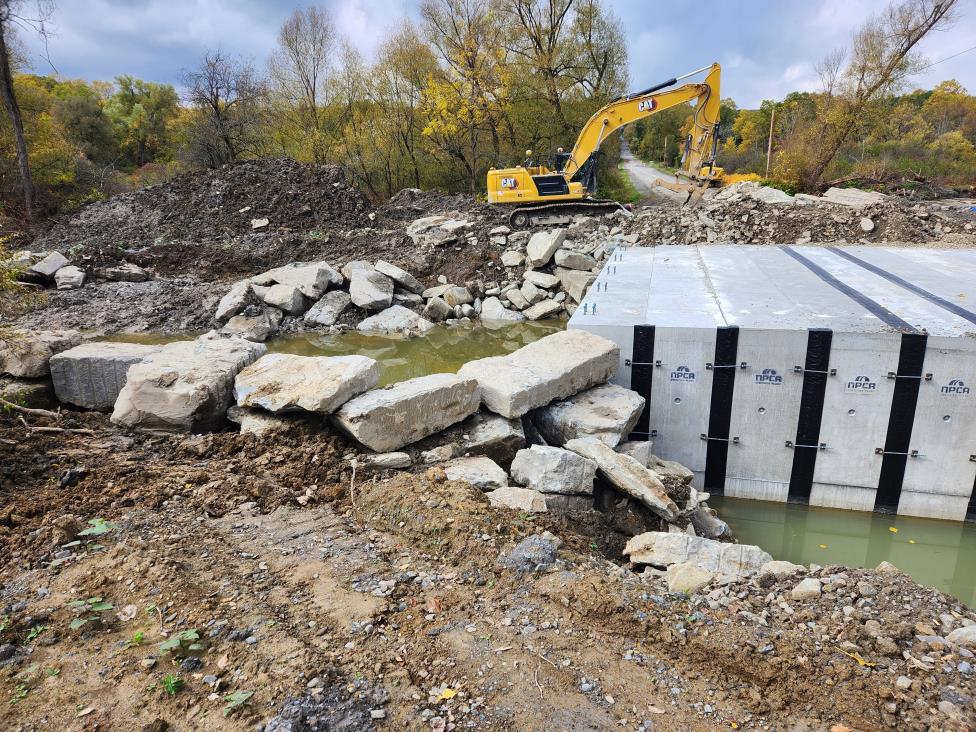
To this website’s readers: What’s dominated Enfield Government’s attention this past a month is a story difficult to report. It entails alleged defects in the giant concrete box culvert that our town has placed in Enfield Creek beneath Bostwick Road. We’ve undertaken diagnostic and remedial steps to address the matter. The problem appears less serious than was first feared.
For reasons that now hold little importance, multiple members of the Enfield Town Board—in no uncertain terms—have these recent weeks dissuaded me from reporting on this story. They’ve urged that I confine my reporting to nothing more than generalized statements; in most instances explanations endorsed by the Town Board as a whole. Even verbatim recitation of public statements made at Town Board meetings has been discouraged.
Therefore, I and all of us in Enfield welcome Jaime Cone Hughes and Tompkins Weekly’s independent reporting of this important local story. Based on my knowledge as an insider, what Ms. Hughes’ reports stands comprehensive, fully objective, and true to the facts. Her story follows in its entirety (with my photographs added).
We move forward.
Robert Lynch, Enfield Councilperson
****
New Enfield Culvert can remain after cracks discovered, engineers find
Engineering reviews found Enfield’s cracked Bostwick Road culvert is structurally sound, allowing repairs and waterproofing to proceed as the town targets an end-of-October opening
by Jaime Cone Hughes; Tompkins Weekly
October 13, 2026
The new concrete culvert on Bostwick Road can remain in place despite cracking and concrete spalling discovered shortly after installation, according to engineering reviews commissioned by the Town of Enfield.
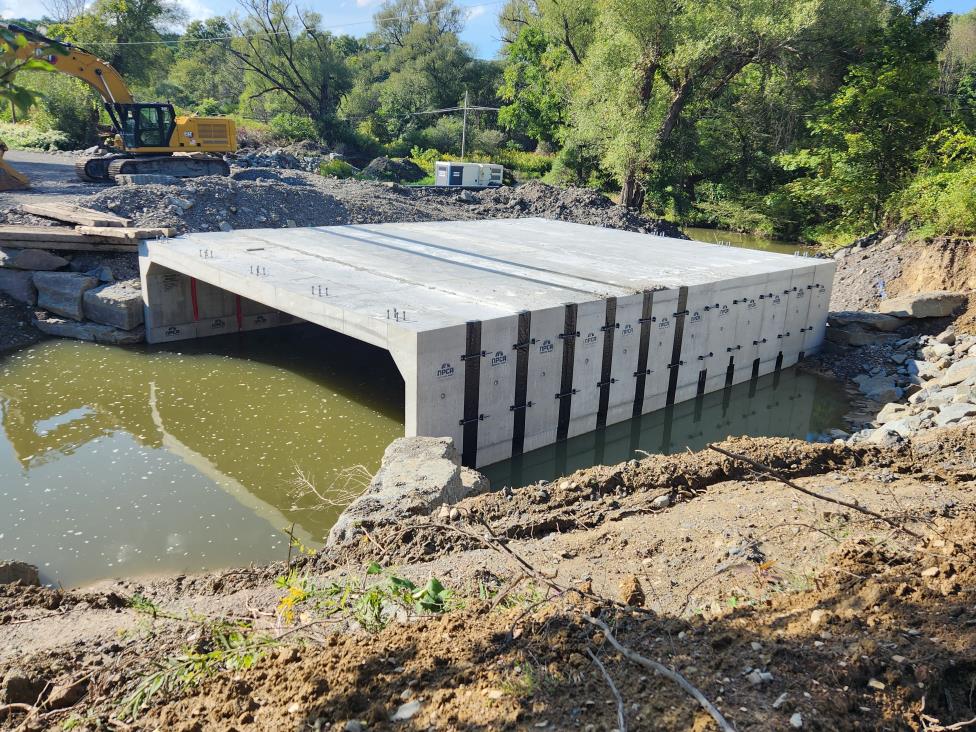
The findings offer a path toward completing the delayed Enfield Creek crossing, though Bostwick Road remains closed between South Applegate Road and Route 327 while repairs and additional waterproofing are completed.
Highway Superintendent Barry “Buddy” Rollins said the own hopes to reopen the road by the end of October, dependent in part on weather. The town’s Sept. 14 notice said the closure would continue “until further notice,” and the Town Board’s public statement did not give a reopening date.
“We just wanted to make sure that the product that we got was the product that we paid for,” Rollins said.
Testing finds shallow cracks, repairable concrete damage:
The project halted in September after Brian Reaser, a professional engineer with the Tioga County Soil and Water Conservation District, who serves as the town’s engineering consultant, reported “large cracks forming in the bottom of the top section on the box” during the Sept. 9 Town Board meeting. At that point, Reaser said he was concerned the culvert could be structurally unsound and urged the town to obtain independent testing.
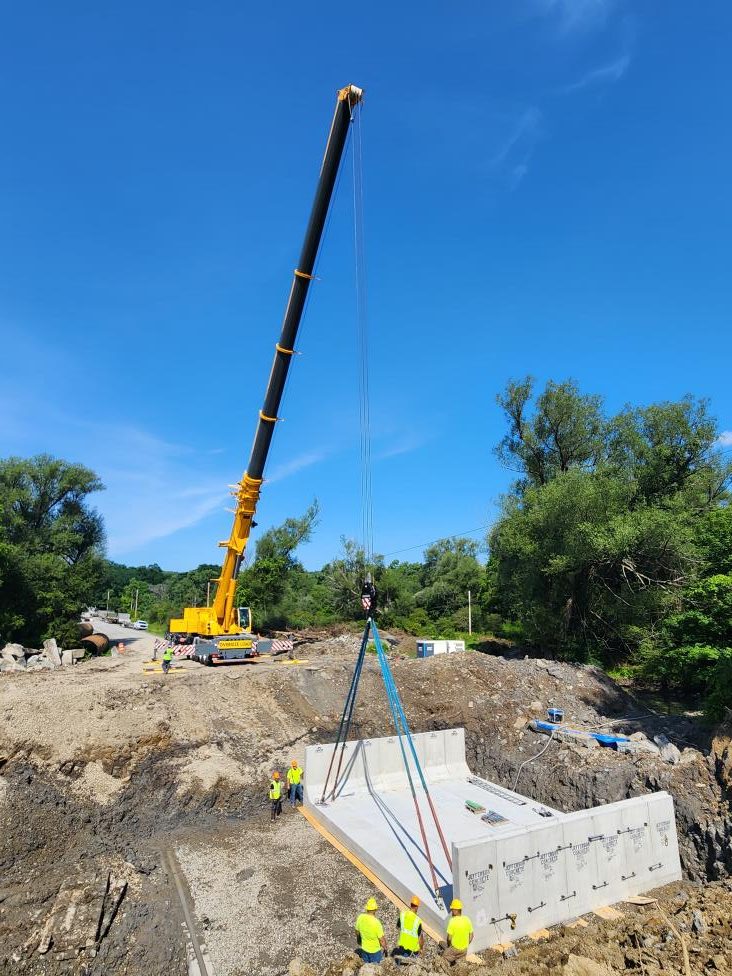
The board authorized $3,765 for Atlantic Testing Laboratories, or ATL, to conduct a visual assessment and ground-penetrating radar investigation. It also retained Fisher Associates, the firm that designed the culvert, for a separate review.
ATL inspected the culvert Sept. 24. Its report found that the fine cracks on the underside of the top concrete sections were shallow shrinkage cracks, commonly known as crazing, rather than indications of a structural failure, according to a report obtained by Tompkins Weekly.
The cracks generally measured between 0.004 and 0.006 inches wide, ATL reported. The testing firm found no similar cracking on the top surfaces of the upper culvert sections or on the tops of the lower sections where sediment could be cleared for inspection.
ATL also documented concrete spalls and delamination on the vertical legs of some culvert pieces, including areas of exposed reinforcing steel. Its ground-penetrating radar scans found less than an inch of concrete cover over reinforcing steel in some damaged areas.
The report categorized the cracks and spalls as structurally insignificant but said they could compromise the structure’s long-term durability if moisture reaches and corrodes reinforcing steel.
Fisher Associates likewise concluded the culvert pieces could remain in use, provided the town conducts repairs, including a full sounding inspection of the inside surfaces, repair of all spalled and delaminated concrete, waterproofing below the top slab, and installation of a sheet-applied waterproof membrane over the culvert before stone and asphalt are placed.
In a Sept. 25 email to town officials, Reaser wrote, “The box is structurally sound and can be used as is.” He said Jefferson Concrete, the Watertown supplier of the precast culvert, agreed to repair damaged concrete and apply protective treatments at no cost to the town.
Rollins said the precautionary reviews were appropriate after the cracking appeared.
“It was just a precaution, more than anything,” he said. “It was all cosmetic, but we weren’t sure.”
In a Sept. 25 email obtained by Tompkins Weekly, Reaser told Enfield Town Supervisor Stephanie Redmond that the previous day’s inspection had brought “the best possible news”: the culvert was structurally sound and could remain in place.
But Reaser also cautioned that the damage could shorten the structure’s life. “The lifespan of the structure will most likely be reduced, but to what extent it’s hard to say,” he wrote, estimating that instead of lasting 75 years, the culvert might last 60. “This is just a guess because so many variables go into it,” he added.
Neither Atlantic Testing Laboratories’ Sept. 28 report nor Fisher Associates’ Oct. 1 assessment quantified a potential reduction in the culvert’s lifespan.
ATL did warn that cracks and damaged concrete could affect the structure’s long-term durability if moisture reaches the reinforcing steel and causes corrosion. Fisher recommended repairs and additional waterproofing to help protect the culvert.
Waterproofing recommendation to add cost:
Fisher recommended covering the entire top of the culvert with a waterproof membrane.
At a special meeting Oct. 3, the Town Board approved a resolution stating that the town approves a change order for the installation of a waterproof membrane on the top of the box culvert at a cost not to exceed $50,000.
The Town’s earlier public statement said final costs remained subject to change. Rollins said the expenses for the engineering reviews are coming from the town’s bridge reserve account.
“When we got the grant, we knew we were going to have to put money into [the project], even to match the grant,” Rollins said.
The project is budgeted at $1.1 million, including $693,866 from a New York state Water Quality Improvement Projects grant awarded in February 2024. The town awarded a $471,600 contract to Jefferson Concrete for the box culvert and a $351,300 installation contract to JB’s Excavation Services of Apalachin.
The culvert replacement is intended to address flooding and erosion at Enfield Creek, a protected trout stream. The old crossing consisted of two 6-foot pipes that could collect debris during high water, Rollins said.
“Now it’s a pipe that limbs and trees and brush can pass through,” he said.
The new box culvert is designed with a 36-foot-wide interior and a 12-foot, 9-inch interior height, according to ATL’s report. Construction also includes streambank stabilization and rock protection intended to prevent water from undermining the road and nearby private property.
Rollins said residents on the closed section of Bostwick Road have generally accepted the closure, while through traffic faces a roughly 1-mile detour. The town considered a temporary one-lane bypass at the crossing, offered by the contractor at no cost, but Rollins expressed concerns about its safety and has not adopted the option.
Questions about the road closure can be directed to Rollins at 607-272-6490.
###