Lawmakers huddle and ponder how to escape 17% levy hike
Reporting and Analysis by Robert Lynch; May 23, 2026
There was pizza. Lawmakers dressed down. Minutes weren’t taken; votes not recorded; cameras never rolled. And likely the only reason the meeting was kept public was because state law demands that it must. Not that it really mattered. Members of the Ithaca press corps were found nowhere in the room. Year after year, they never come.
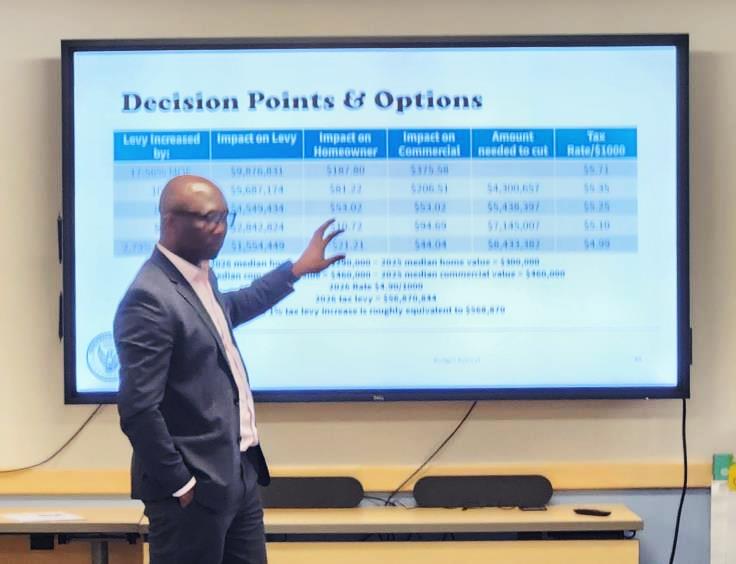
On Tuesday, May 12, the Tompkins County Legislature held its annual Budget Retreat. It’s convened far away from legislative chambers, held again this year at the Whole Health Department near the airport. The retreat accords County Administration its first opportunity to sketch for lawmakers an initial outline of a next year’s county budget, a document legislators won’t adopt until November.
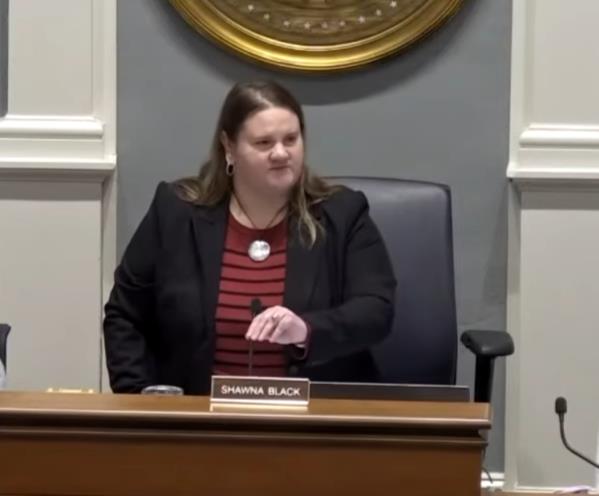
And if you’d hoped for firm word as to how much money leaders will spend or how much they’ll tax you, the session provided little guidance. When Legislature Chair Shawna Black called for an impromptu straw vote on whether the tax levy should rise by more than five percent or by 4.9 percent or less, members tied seven-seven. The retreat adjourned. Legislators went home.
Welcome to the birth of the 2027 Tompkins County Budget. And if the budget retreat’s collective temperament points the way, the coming months will bring as much of a challenge as had occurred last year. Estimated spending increases stand too high. And, painful cuts will be needed to bring property taxes down to what one legislator termed a “swallowable” increase.
“Our current projections indicate about a 17 percent proposed tax levy increase above the 2026 adopted levy to fund service at the current level,” County Administrator Korsah Akumfi stated, May 19, one week after the retreat, speaking when legislators next convened for their regular twice-monthly meeting. County Administration will recommend a budget with a levy increase well below 17 percent, Akumfi assured lawmakers.
Neither Akumfi nor legislators May 19 mentioned the retreat’s 7-7 straw poll split. Remember, Ithaca reporters never attended that earlier conclave.
Tompkins County’s 2027 Budget isn’t adopted until fall. Past practice calls for County Administration to meet with department heads over the summer, receive departmental requests, reduce them as needed, and then present an administrative recommendation to the Legislature just after Labor Day.
What follows is a seemingly endless round of exhaustive meetings. Legislators convene as a committee-of-the-whole. They listen to department heads, re-examine appeals, and subtract from—yet more often, add to—the Administrator’s numbers. Legislators hold hearings, jigger tax rates, and then adopt a final budget a week or two before Thanksgiving.
Yes, the Tompkins County Legislature makes the budget process more complicated than needed. But in the modern era, that’s the way it’s always been. The May 12 Budget Retreat served as the starting point.
The seven-seven split on taxes was more than symbolic; it was substantive. It reflected a philosophical divide among lawmakers, as many as half of whom were newly-elected last fall. The Legislature is two members larger now. If leading politicians is like herding cats, Tompkins County’s clowder has now become even harder to corral.
Moreover, wise minds from the past have now exited. Former Budget Committee (and Legislature) Chair Mike Lane, a fixture for much of the past three decades, retired last December. Lane’s time-tested wisdom was sorely missed the night of the retreat.
Example: Could Tompkins County impose a progressive property tax, newly-seated legislator Iris Packman asked? Could it levy steeper rates on higher-priced parcels? Hers was a question born of legal ignorance and regulatory naiveté. No, County attorney Maury Josephson answered. Aside from state-designated exemptions for categories like farmers and seniors citizens, differential taxation isn’t lawful.
Among the 15, often freshly-scrubbed legislators, two camps emerged at the retreat. (Ulysses-Enfield’s Rachel Ostlund was excused that night.) There was the “Oh My God, this budget is too high” group, but also the “People are hurting; we must meet their needs” faction. The division may spill into the fall.
The May 12 Budget Retreat stretched almost three-and-a-half hours. It began with Administrator Akumfi’s hour-long, 62-slide PowerPoint presentation. His slideshow covered financial trends and “cost drivers” such as state mandates, negotiated salary increases, and capital program requirements. It assessed how what’s needed or expected would impact the budget and taxes.
“Did I miss the cost containment slide?” Dryden legislator Greg Mezey asked at the close of the presentation. “There is a fundamental flaw in this process,” Mezey reacted. “I wish we had some recommendations on cost containment,” he said.
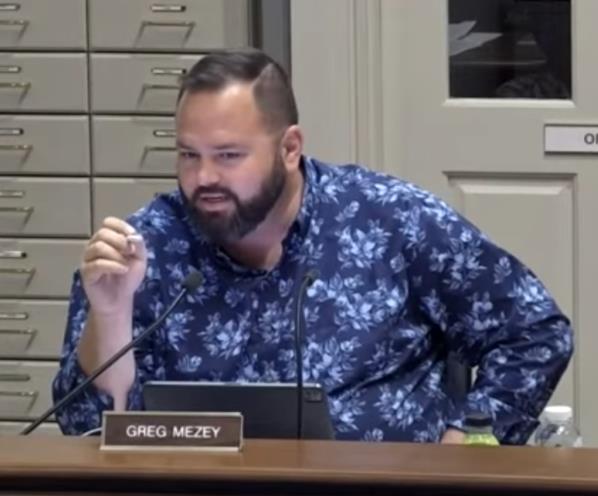
Mezey continued. “Is there a plan to do a funded agency review?” he asked. Akumfi’s projection of a 17.56 percent tax levy rise based itself on a “Maintenance of Effort” (MOE) budget. MOE essentially continues each department’s or agency’s existing programs into the next year and adjusts upward for inflation. Mezey would have each department or agency justify keeping what it already has.
“Something has to be cut, but what it is” will have to be determined, Akumfi acknowledged. His was an open-ended answer.
Last summer, the Administrator had projected that a Maintenance of Effort Budget, if adopted for 2026, would have hiked the tax levy by just over 20 percent. The MOE plan was never adopted. By fall, after legislators had tinkered and tapped prior years’ savings, their final adopted budget carried only a 3.59 percent tax levy increase. (At one point it was a fraction of a percent lower.)
Still, the MOE budget the Administrator presented at this year’s retreat excluded additional, expensive “cost drivers.” Or he could only provide educated guesses about them.
Gas and diesel prices stand as an “emerging and uncertain” cost, Akumfi acknowledged. The MOE budget also skirted making good on a promise to raise all employees to a “living wage,” a possible $1 Million adjustment. And the proposal made no provision for first-step expansion of the Rapid Medical Response (RMR) program, turning it into a quasi-ambulance service.
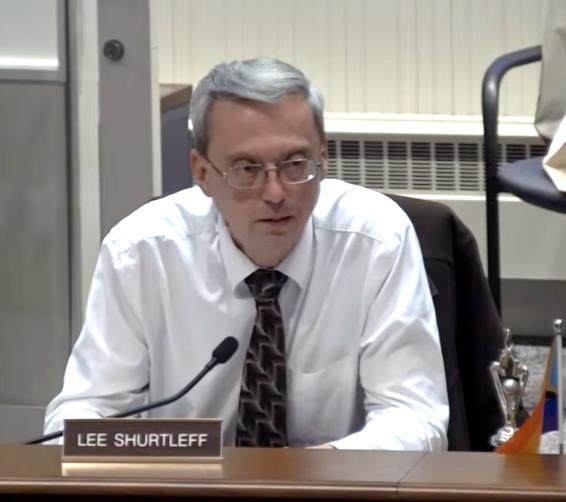
“If you try to run a county-wide ambulance service, you’re going to add 100 FTE’s (full-time equivalent employees),” Groton’s Lee Shurtleff warned. “It’s unfathomable we’re thinking of going into that service,” Shurtleff, former director of Tompkins County’s Department of Emergency Response, RMR’s oversight agency, stated.
Days before, Governor Hochul had proclaimed agreement on a state budget. But details remained too sketchy for Akumfi to factor. And the MOE budget failed to provide increased funding for the TCAT bus service, Tompkins Cortland Community College, or offer government-supported nonprofit agencies cost of living increases.
“We are still suffering the effects of the pandemic in this community,” Legislature Chair Shawna Black advised fellow lawmakers. Black mentioned mental health services and the Sheriff’s Department’s crime fighting efforts. “We’ve added a whole ‘nother department in the RMR program,” Black noted. “I love it, but it costs a lot of money.”
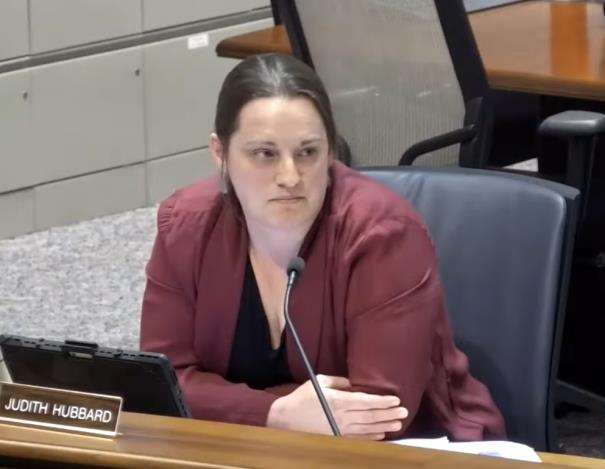
Shawna Black was among the seven who cast their non-binding votes in favor of a five percent or higher tax levy increase. Ithaca City representative Judith Hubbard, a legislative freshman, was another.
“I think we’ve been doing a very good job of trimming the budget,” Hubbard observed. But “we’ve trimmed essential maintenance,” she said.
Hubbard, perhaps more so than anyone else, focused on those left behind, people in danger of losing vital services unless government—Tompkins County government—steps up to help.
“We want to maintain a vibrant county government that serves the people,” Hubbard stated. “We’re going to have to have a big increase in the tax levy,” she predicted. School district tax levies have risen by far more than has this county’s, Hubbard maintained. “We’ve stayed at two to three percent.”
But taxes are a cost of living, too, others observed.
“We will need to pay more in taxes,” Ithaca legislator Travis Brooks admitted. “But homeowners on fixed incomes don’t have money to pay extra,” he pointed out. Brooks represents some of Ithaca’s poorest neighborhoods. “The assumption is that if they own their home, they can pay the taxes. Some people can’t,” he said.
“Seniors, they’re really struggling,” Enfield-Newfield’s Randy Brown said in agreement. Brown related that a constituent of his is so strapped that she has to visit her neighbor’s house to use the phone.
“We’re talking of replacing a car that’s three years old,” Greg Mezey said, citing standard procurement policy. As for taxpayers, he said, “They’re driving a car that’s ten years old.”
If a legislative grievance emerged the night of the retreat, it was that Korsah Akumfi must do more to rein in department heads. He must remind them who is boss. He must tell them that we’re all in this thing called County Government together.
Lee Shurtleff referenced “silos,” bureaucratic fiefdoms, and he blamed the county’s long-used “target-based budgeting” policy for fostering them.
Akumfi put it differently: “We need a ‘buy-in’ from departments in some of the things that we do,” he said.
For tax-conscious Greg Mezey, the Administrator’s explanation was backwards.
“At some point, you’re the County Administrator, we’re the Legislature,” Mezey bristled. “If only the department heads want to do it, we do it?” Mezey asked. “Who’s the tail and who’s wagging who?”
Akumfi agreed that departments need to keep spending within their budgets, yet conceded sometimes they do not.
“We need to be able to contain these moneys,” Akumfi admitted. Departmental leaders need to be convinced that their department isn’t “my department,” but instead “a collective.”
“It’s difficult to re-engineer their thinking,” Akumfi recognized.
Be “more vocal in your ‘No,’” Mezey counseled the Administrator.
Payrolls are growing fast in the Administration’s projected budget. Wages and benefits would rise by $5.8 Million, a 6.2 percent increase. Three-quarters of the expected rise would come from costlier fringe benefits. Akumfi would keep 2027 employee headcounts about the same as now, at about 850 persons.
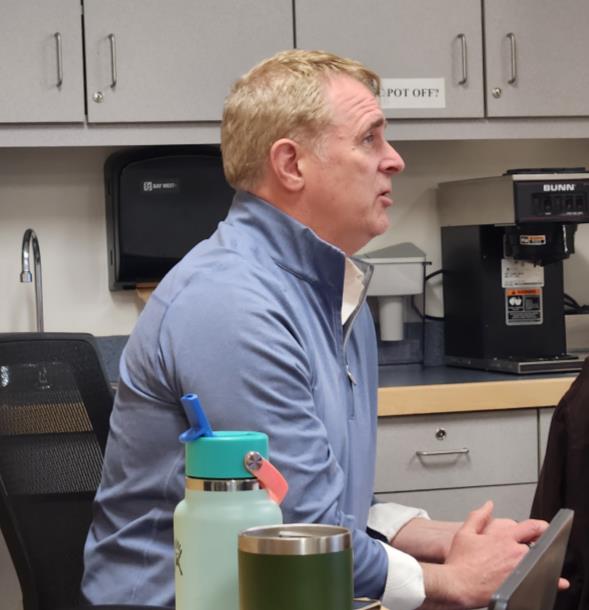
“If we don’t flatten it,” Lansing’s Mike Sigler said of the payroll number, “we’re going to have this discussion every year.”
New York State’s tax cap for the 2026 budget was 3.59 percent, and the 2026 levy increase fell just under it. Akumfi predicted at the retreat a smaller tax cap, 2.75 percent, for the year ahead.
“I would like to go for the cap,” Sigler said when asked how high next year’s tax levy should rise. He’d keep it at 2.75 percent and no higher, well beneath the current year’s levy increase.
“I would put in a hiring freeze,” Sigler said. “How many people would we have to cut to get to the cap?”
Sigler also threw out the option of suspending for one year so-called “over-target requests,” those unplanned departmental and agency increases that always crop up.
Tompkins County may save money on the roads we drive. Mezey advanced the idea of combatting rising petroleum prices by delaying some paving projects until next year. Perhaps the Iran War will be over by then, and asphalt prices may fall, he said.
One week after the retreat, at a Legislature meeting accorded wider public access, the Administrator spoke more about economies and of doing something to lower the 17 percent tax hike that all concede no one would accept.
“What we have communicated to the departments is for each department to submit specific cost reductions or controls and also revenue enhancement proposals that will support us to close that gap,” Akumfi informed legislators.
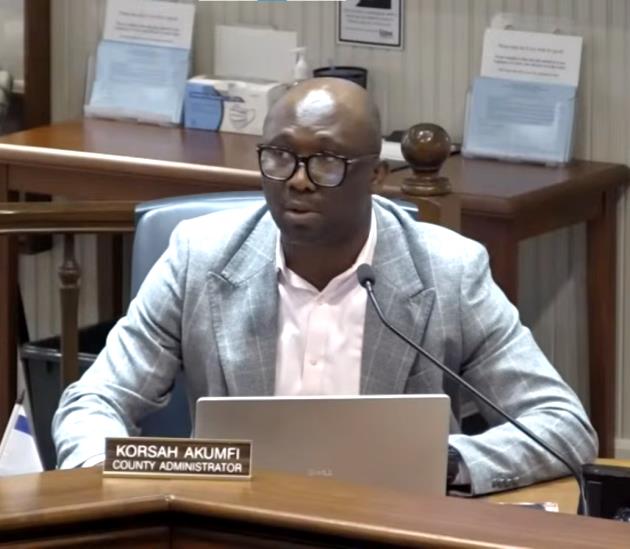
The Administrator alluded to “personnel cost management,” and to what he called “shared services and consolidation,” not only “across departments,” but also “with municipal partners.”
What would such shared pain feel like? Would it ask towns like Enfield to newly contribute to services like Rapid Medical Response? No elaboration came forth.
There could be a second budget retreat in July. There was one last year. By mid-summer, state mandates will become better known; cost increases easier to calculate; departmental requests firmer in focus.
“Are we hunkering down like most of Tompkins County is doing?” legislator Mezey asked the Administrator as the early-May retreat rolled on and on. “Can we contain costs?”
Of any on the Legislature, Lansing’s Deborah Dawson is best known for preserving accumulated savings and for refusing to surrender when department heads or human service agencies beg for more money than she thinks they should get. She’s also blunt.
“We cannot afford to go on this way,” Dawson told retreat colleagues and anyone else who cared to listen. What we’re doing is “not sustainable.” she said.
Yet at budget time, come September, past experience her teacher, Dawson forecast what will happen: “Nobody is going to rein this budget in,” she predicted. Her advice: “You’re going to have to suck it up.”
###