
We wait on a budget. What else is new?
Analysis and commentary by Robert Lynch; April 25, 2026
You’d never build a government like the one New York State has built for itself. No sane person ever would.
New York State was supposed to have put its budget in place this past April first. It didn’t. And as of this writing more than three weeks later, it still hasn’t done so. No one can predict when we will have a budget. New York’s dominant political class doesn’t seem to care.
Tompkins County’s first line of defenders in Albany, State Senator Lea Webb and Assemblymember Anna Kelles, repeatedly and blithely brush off the ongoing fiscal impasse. They assure us that the day-by-day, week-by-week budget “extenders” they vote to enact will do what they must to keep the paychecks and benefits flowing.
But that’s all that they say. Their assurances lack the slightest degree of outrage. Webb and Kelles are majority Democrats. They’re of the party that controls both legislative houses and the governorship. Each must obediently answer to her leadership. Neither dares to rock the boat.
But I will rock it. And I’ll be blunt. New York State’s structure of governance lacks reason, common sense, or any fair respect for democratic principles. It’s always operated this way for as long as I can remember. And unless the people of the Empire State rise up and demand change, it will probably always remain that way.
As the lead of her weekly online message written to constituents Friday, April 24, Senator Webb stated:
“Dear Neighbor: The budget is moving forward, and this week in Albany we passed another budget extender to keep the government open while negotiations continue.”
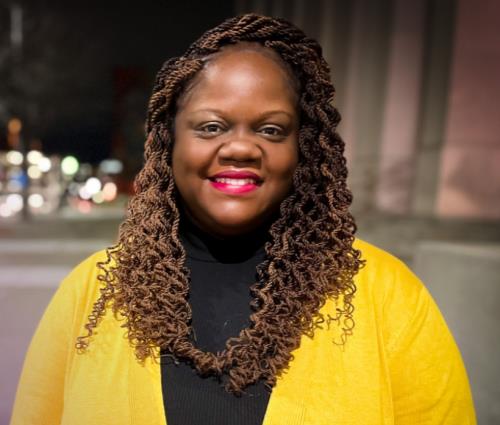
Nothing to worry about, friends; nothing to see here. It’s what’s become Lea Webb’s underlying narrative. To readers like me, her words do not comfort.
And for the record, last Wednesday’s extender was the sixth—yes, the sixth—Band-Aid legislators have slapped onto the Empire State’s open wound since late-March. No doubt, they’ll have to bandage the wound still more.
And this year’s delay is not a one-off. In New York State, tardy annual budgets have become the rule and not the exception. Commend Kate Lisa of the downstate-focused “City and State” for keeping recent score:
“The budget was one week late in 2022, 32 days late in 2023, 20 days past the deadline in 2024 and a whopping 38 days late last year—pushing negotiations into May,” Lisa wrote April 7. And that was back when this latest impasse was only on its second, week-long extension. Since then, extensions have grown shorter, and more numerous. Back-bench lawmakers often go home in-between extension votes. Only leadership remains.
Reach back farther. At times it’s even gotten worse.
“Crossing the finish line in May isn’t all that bad, comparatively,” Gannett’s Emily Barnes wrote April, 22. “The state’s 1997 and 1999 budgets under then-Gov. George Pataki went into August. A couple years later, in 2001, Pataki’s budget was late again by 125 days and budget conversations between then-Gov. David Paterson and the Legislature in 2010 also exceeded the April 1 deadline by 125 days.”
So, quite clearly, the problem is systemic. It’s a product of how the New York State legislative process is structured and functions… make that, how it’s meant to function, even if it truly does not.
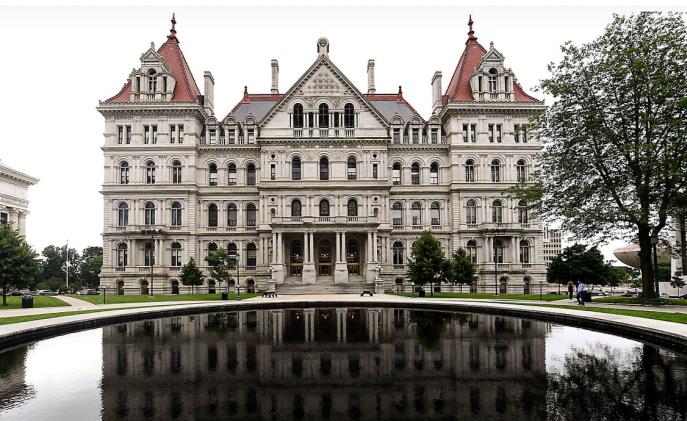
And because budget impasses have become so politically engrained within New York’s legislative attitude and expectations, the systemic problem transcends who happens temporarily to occupy the Governor’s Mansion or command a legislative super-majority. Democrats and Republicans may share the blame. But because Democrats hold all the levers of power at present, they deserve to shoulder all the resulting blame right now.
Long has it been said that the New York State budget is crafted by “three men in a room.” Ignore the fact that two of those people are now women. Gender holds no claim to power.
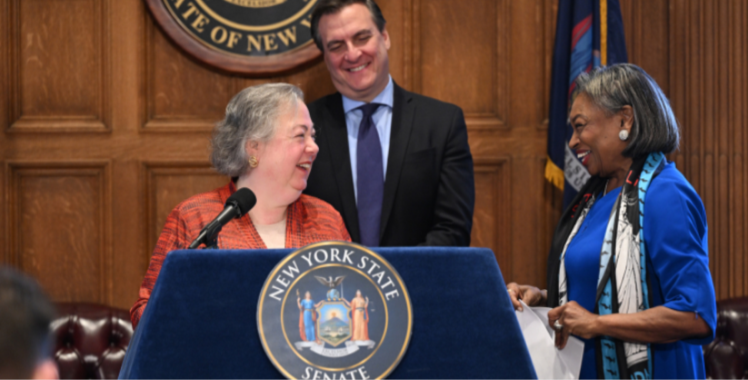
Governor Kathy Hochul, Senate Majority Leader Andrea Stewart-Cousins, and Assembly Speaker Carl Heastie are those three most favored people right now. The State Senate may have 63 members; the Assembly 150. Yet Stewart-Cousins and Heastie often negotiate with Governor Hochul in secret. Sure, chosen insiders like Senate Deputy Majority Leader Michael Gianaris squeeze inside the door. But most rank-and file remain in the dark. At least that’s what they tell us. Certainly, minority Republicans haven’t a clue.
“It’s a hallmark of Hochul’s strategy to wear down lawmakers until they concede to her spending priorities,” City and State’s Kate Lisa writes.
Yet why does it have to be this way? Why must budgets be negotiated in private by the chosen few? Why can’t spending be resolved out-in-the-open on the legislative floor or during committee debates?
Why can’t it be as simple as the Senate and Assembly coming to agreement on a budget—or maybe, a series of budgets for things like education, health care, police and highways? Then the governor gets to sign or veto those budget bills? And should she cast her veto, then the Legislature gets the opportunity to override that veto by a two-thirds vote?
Oh, that would be too simple for a state like New York. Because in New York, as a product of the system that’s been set up, a “state budget” gets stuffed into it more things than does a Christmas turkey. It shouldn’t be that way, but it is.
You may like or dislike Anna Kelles’ politics. But our local Assemblymember has done a good job of concisely identifying the political obstacles we now confront:
“Why the Governor has so much power over the New York State budget,” Kelles asks. Her answer:
“In most states, the Governor proposes a budget and the Legislature has broad authority to revise it through back-and-forth negotiations. In New York, the Governor has notably more power than the Legislature throughout the negotiating process.

“The Governor starts by sending a full budget plan to the Legislature in January. This plan can include entirely new programs that have fiscal impacts on the budget, and it can also include policy proposals that do not have any fiscal impacts.
“But unlike in many other states, the Legislature cannot freely rewrite that plan or replace it with its own version. Instead, the Legislature has to work from the Governor’s proposal and respond to it within a more limited framework:
- The Legislature can remove proposals from the Governor’s budget plan or reduce funding for proposals, but we generally cannot change the detailed language within each individual proposal.
- The Governor can revise her budget plan for 30 days after submitting it to the Legislature, which allows changes while negotiations are already underway.
- After the Legislature passes a budget and sends it to the Governor, she can cross out individual items before signing it into law. This means the Legislature must either send a budget the Governor is prepared to accept or risk having parts of it removed without any further opportunity to negotiate.
“This means the Governor is not just proposing a starting point, she is shaping the structure of the entire negotiation, and the Legislature is working within that framework,” Kelles concludes her first explanation.
Next question Kelles asks, “What happens if the budget is late?” Her answer:
“If the budget is not passed on time, the state cannot legally spend money unless the Governor sends the Legislature short-term budget bills, often called “extenders.” These extenders keep government running for a limited period of time. Once an extender is received by the Legislature, we can either vote it up or down, but we cannot amend it before voting. This means we either pass the extender as written or risk a government shutdown.
“The Governor also decides what goes into each extender and how long each extender lasts, whether a few days, a week, or longer. In practice, this gives the Governor significant control over the timeline and pace of negotiations once the budget deadline passes. She can require frequent votes or stretch things out in ways that shape the direction of negotiations.”
That’s how our Assemblymember, Anna Kelles, sees things.
Is it right for this much power to rest with just one person, the Governor? Many Democrats castigate President Trump for taking so much into his own hands. Yet one seldom hears comparable criticism leveled at Hochul for the power she grabs.
Based on what insiders have learned or what’s leaked out from those locked rooms, the impediments to agreement this budget cycle include issues like Hochul’s drive to contain auto insurance rates through tort reform, to dial back New York’s 2019 climate law, to sweeten state pensions for newly-hired employees, and to confront the seemingly-unrelated issue of whether to allow New York City’s new mayor to impose a wealth tax on rich people who own second homes.

Yes, even immigrant protection and buffer zones around abortion clinics and houses of worship have found advocacy stuffed into the turkey that may become the 2027 New York State Budget.
“Here we are twenty-two days late on the budget, for the fifth year in a row,” Republican Senator Tom O’Mara, who not too long ago represented western Tompkins County, said this past Friday. O’Mara complained of both procrastination and secrecy.
“We really do need to get this budget done,” O’Mara stated. Our school districts need to come out with their budgets to put before the voters in the middle of May,” he said. “The time for putting those together is rapidly approaching and that’s a big problem for our districts. It will only result in, perhaps, unnecessary property tax increases, not knowing what state aid is going to be.”
Yes, late state budgets hurt. They hurt school districts planning their own budgets. They hurt counties. And they hurt towns like Enfield. How much will our “CHIPS” highway aid be raised this year? We don’t know. And it’s spring. Road work will start soon, if it hasn’t already.
“We really need to get moving here,” Senator O’Mara told constituents. “We’re getting no information from the majority on where any of these major issues that are sticking points stand.”
Problem identified. Grievances registered. Now what’s the solution? Here are my thoughts:
- The first step is to generate public outrage. Same old; same old cannot continue. And unless average New Yorkers stand up and voice their anger, what we’ve so long endured and come to accept year after year will continue to exist until the day we die. And it will likely persist thereafter. Please, get mad.
- Next, we need to ask tough philosophical questions of ourselves. Do we benefit from the “Strong Governor” breed of politics that we have in New York? The status quo’s advantage lies in that a single election for a single office (that is, the Office of Governor), can instantly alter a full one-third, if not, in practicality, one-half of the political equation. The status quo’s disadvantage lies in its concentration of power in that singular executive position. Is power better diffused through the voices and votes of our more than 200 elected legislators, Senate and Assembly?
- Next, we should demand transparency. Why should budget negotiations occur in secret? Budget business should involve all members of the Senate and Assembly, not just leadership. If the law must be changed to enforce such broader participation, we should change the law. If enforcement begs for constitutional protection, we should amend the state constitution to ensure compliance.
- Next, we should clear away the legislative litter. A new law affecting who gets sued for how much after a car accident holds no place in discussions toward a state budget. Neither does whether New York extends sanctuary protection for undocumented immigrants statewide. Let those bills stand on their own two feet. Give them fair, independent consideration, not a stealthy, hurried vote in the dead of night. Laws enacted when nobody’s looking have become the laws we New Yorkers have come to hate the most.
And finally, need I save this most monumental change for last: We need seriously to consider uncoupling ourselves from New York City. Upstate and Downstate have co-exited as incompatible partners for too long. It’s time to thoughtfully contemplate an amicable divorce. The five boroughs may need to go one way; the rest of us the other. (I’d tag Nassau and Suffolk Counties onto upstate for now; but we can wrestle with that option later.) Let New York City go in Mayor Mamdani’s democratic socialist direction, should it prefer. From Westchester to Williamsville, we, the rest of New York, may find ourselves getting along better resembling places like Pennsylvania, Michigan or Ohio.
****
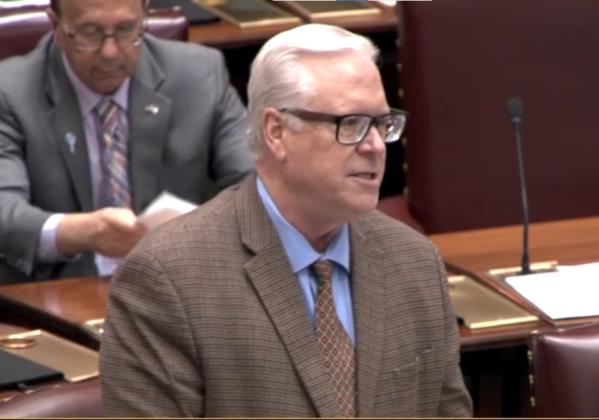
“What’s been a dysfunctional, secretive and unproductive effort appears to only be getting worse,” Assembly Minority Leader Edward Ra was quoted by Spectrum News on April 15. And that was back when New York was only on its fourth budget extender. Assemblymember Ra didn’t like Hochul interjecting talk of that New York City second-home tax. Ra claimed she’d just introduced the new tax spontaneously, even though it had never been part of executive or legislative proposals before that point.
“It’s a concerning process,” O’Mara complained of the budget process more than a week later. “I really see or feel no sense of urgency on getting this budget wrapped up. We continue to just extend spending,” O’Mara said.
“A late budget is not ideal, but as long as you’re moving the extenders and it’s not too long-lasting, it’s very manageable,” Senate deputy leader Gianaris told City and State back on April 7, more than three weeks ago. Easy for him. He’s among those on the inside.
Of course, no reasonable person would design a budget process this way—or a state political circus that’s incrementally made it what we expect… and dread. Something needs to change. And only we, those of us on the outside looking in, can change it.
###