

Also: Town Board awards Bostwick Bid; welcomes new Deputy Supervisor
“I agree with the abundance of caution aspect,”
Enfield Supervisor Stephanie Redmond, Town Board meeting, March 11
“It’s about as likely a data center or a crypto mine is going to come to Enfield as the next Walt Disney World.”
Enfield Councilperson Robert Lynch, same meeting
****
by Robert Lynch; March 17, 2026
As goes Dryden, so goes Enfield. It’s happened before. It could happen again.
In 2011, the Town of Dryden gained credit—some might say notoriety—as the first of its kind in New York State to ban hydraulic fracturing, better known as fracking. One year later, in June 2012, the Enfield Town Board followed suit, imposing first a fracking moratorium; and then, after another 12 months, a permanent fracking ban.
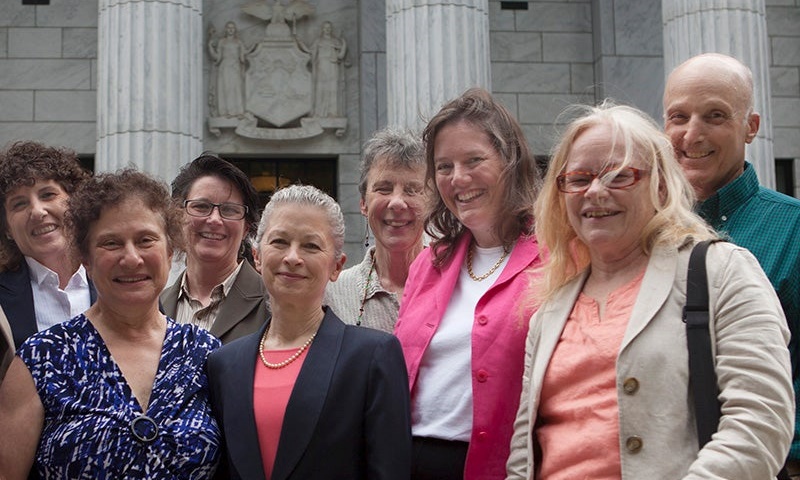
Enfield’s “Prohibition Within the Town of Gas And Petroleum Exploration And Extraction Activities….” came amid controversy, but it still became law. Other towns piled on. Governor Cuomo banned fracking statewide by Executive Order in late-2014. And the New York Legislature codified Cuomo’s order into statute at the turn of the decade.
Today, the hot-button land use issue is data centers and cryptocurrency mines. The Town of Dryden has spoken. And soon, once again, the Town of Enfield may echo Dryden’s call.
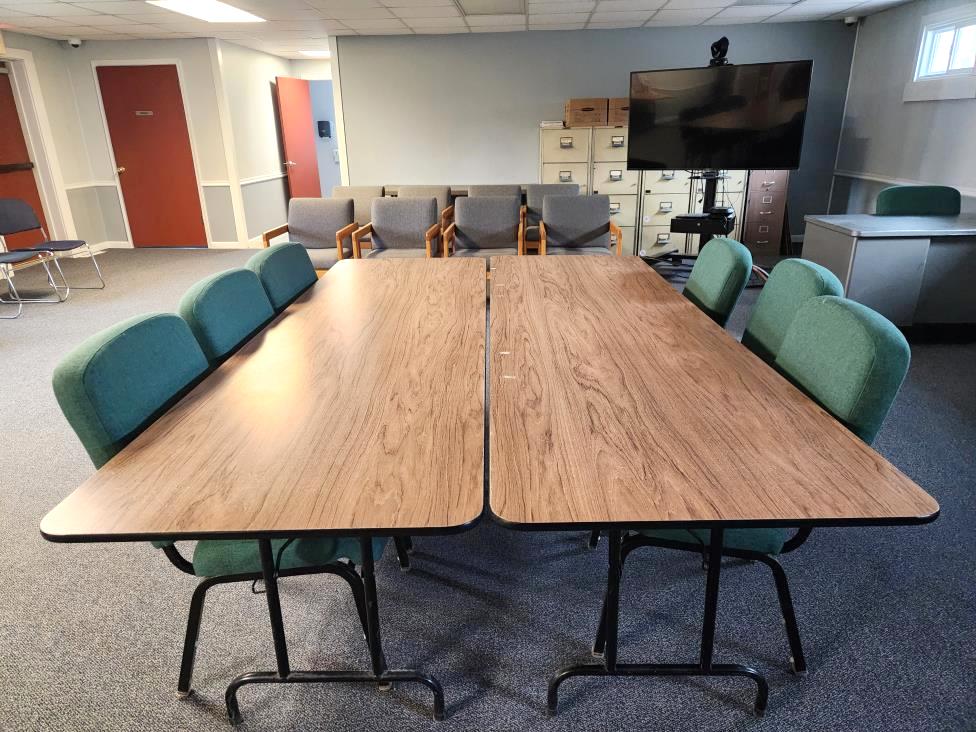
Councilperson Jude Lemke began Enfield’s latest discussion last week, while from a remote location attending her Town Board’s March 11 meeting.
“I want to get a sense from the Board,” Lemke said, “There’s a lot of controversy about these data centers and crypto mining centers,” Lemke reminded colleagues. “And the Town of Dryden recently passed a law… They have banned those facilities. So I’m just raising whether we want to pursue a similar path just out of an abundance of caution.”
What Dryden did in mid-February was ban crypto mines and data centers within its borders altogether, and a ban with little exception.
“I’m in favor of that, yes,” Town Supervisor Stephanie Redmond answered quickly, unquestionably endorsing prospects of a ban.
Councilperson Cassandra Hinkle would soon affirm Redmond’s position, thereby sealing a three-person working majority in favor of moving forward. A fourth Councilperson, Melissa Millspaugh, participated little if at all in the discussion. But the audio record provides no indication that Millspaugh objected one bit.
Lemke, an attorney, said she’d “put something together” so as to minimize legal expense. Expect the draft local law to come up at a future meeting.
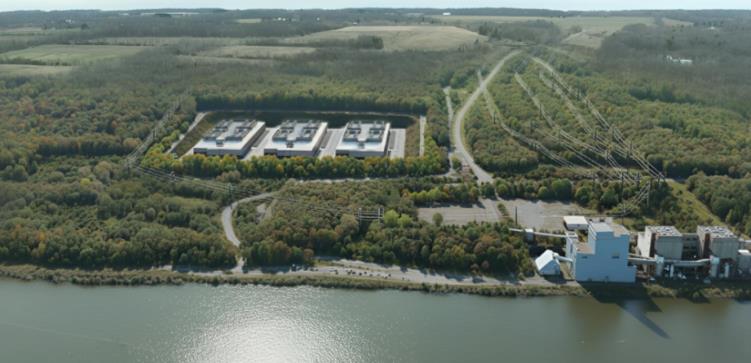
The prospects—some would say, the dangers—of local data centers have written many a headline since the AI Data firm TeraWulf announced last year it plans to acquire rights to the now-shuttered Cayuga Power Plant lakeshore in Lansing and convert it into a data center.
In August, TeraWulf and Cayuga Operating Company, LLC, owner of the former coal-fired generation plant, announced their entering into an 80-year lease for the 183-acre site. Drawing upon the existing plant’s capacity and adding new buildings, TeraWulf projected it could eventually develop up to 400 megawatts of digital infrastructure capacity, a portion of that potential available later this year.
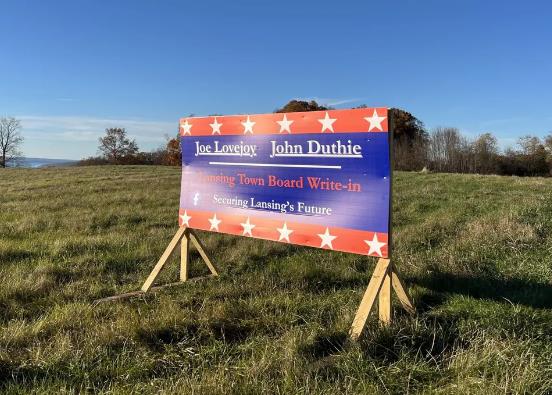
Since the announcement, however, the TeraWulf project has become mired in controversy. Zoning disputes have arisen, environmentalists have urged the project be scrapped, and competing camps have drawn battle lines, with candidates entering last-minute and running as write-ins in last year’s Lansing Town Board elections. Most recently, opponents filed suit against both the Town and the developer.
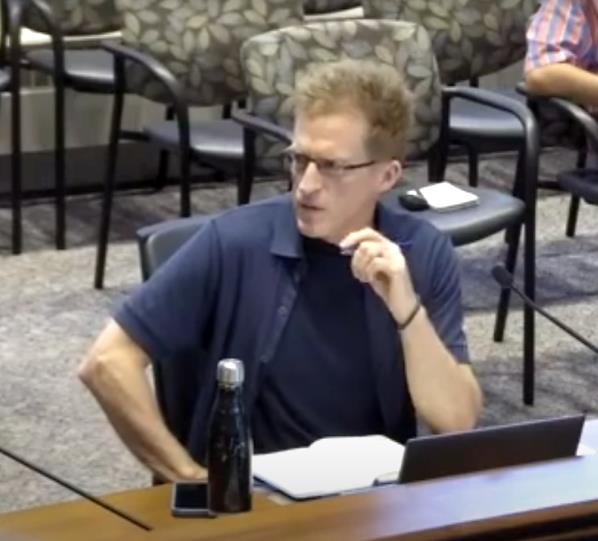
The Town of Dryden, on the other hand, faces no similar threat. No Dryden data center has been proposed or even contemplated. No mothballed power plant waits repurposing within town boundaries. True, a major electric grid does crisscross Dryden, with high lines into which a data center might tap. But no one’s talking about doing that right now. And just where such a center might locate becomes anyone’s guess.
No, the concerns that energized Dryden leaders to ban data centers and crypto mines at their February 19 meeting are those more elusive; risks anchored in techno-skeptical ideology and NIMBY-based protectionism, one can infer from the reported comments of some Dryden officials.
In a February 20 story, The Ithaca Voice quoted Dryden Supervisor Jason Leifer at a December Board meeting as having said he didn’t want data centers “because they have been an industry with ‘deplorable’ business practices.” The Voice also quoted Leifer as having linked AI centers to the erosion of personal privacy and an infringement on civil liberties.
“We are talking about things that process data that’s been scooped up by like all the Flock cameras downtown,” The Ithaca Voice quoted Leifer. “That’s what all of these AI data centers are all about. It’s surveillance,” Leifer said.
A parallel goal among municipal data center opponents lies in the demand for electricity. Their argument holds that with fewer data centers and crypto mines around to gobble up power, fewer kilowatts would get consumed and electricity prices may fall.
The tool the Town of Dryden employed to ban any sort of TeraWulf clone that might venture within its limits, and the same weapon Lansing has already used to wield against its for-real AI interloper, is a tool not found in Enfield’s own toolbox, namely a town zoning law.
The Town of Enfield has no zoning. No zoning law is planned. And were any zoning law ever proposed, the resulting firestorm would certainly eclipse the current discussion over the likes of AI.
“They have zoning, so it’s a little easier for them the way they passed it,” Councilperson Lemke acknowledged at the March 11 meeting as she spoke of Dryden’s strategy.
The ban Dryden adopted, a prohibition clearly anchored in town zoning law, meticulously defines “Data Center, “Cryptocurrency,” and “Cryptocurrency Data Mine.” It then categorically excludes each such facility and its activities from the zoning law’s “Allowable Use Groups Chart,” a list into which any proposed facility must fit to secure itself a zoning permit.
The new Dryden law’s key paragraph makes it clear by its words that, “It is the purpose of this Local Law to define data centers and cryptocurrency facilities and otherwise take no action to include such uses within the table of allowable uses, thereby protecting the order, conduct, safety health and well-being of the residents of the Town who are faced with heightened risks associated with cryptocurrency facilities and data centers.”
“The way this works is the local law defines it, and we very deliberately don’t put it in our use table,” Dryden’s Dan Lamb told his Town Board’s February meeting, a meeting reported by The Ithaca Times. “And if it’s not in the use table, you can’t do it,” Lamb explained. “I think it’s pretty clear; I don’t think we can do anything unambiguous in what we allow in this town and what we don’t allow.”
But might Dryden’s exclusionary strategy be too smart by half? Could a cunning AI developer challenge the categorical exclusion in court? Perhaps. But to that, Dryden officials would remind us that fracking companies once contested Dryden’s pinpointed exclusion as well. Gas drillers challenged Dryden in court. And the drillers lost.
Efforts have emerged at the state level to impose a three-year moratorium on new data center permitting. Ithaca Assemblymember Anna Kelles has sponsored the Assembly version of the pending bill. Local State Senator Lea Webb has become a co-sponsor of the upper house version, with Democrat Liz Krueger the key Senate sponsor. The Kelles-Krueger bills, filed in early-February, are currently before their respective committees. The bills’ support from Governor Hochul remains uncertain.
“I agree with the abundance of caution aspect,” Enfield Supervisor Redmond said of the pro-active position Councilperson Lemke encouraged at the March Enfield meeting that her town take. “I think getting this in the books might be a good way to start, and we can always reevaluate it later.”
“I’m also in favor even if the measure is only symbolic,” Councilperson Hinkle echoed. “I think from a protection standpoint and keeping the character of Enfield, and letting everyone know where we stand on matters, it’s not a bad thing.”
The data center and crypto mine ban passed Dryden’s Town Board unanimously last month. Any similar law in Enfield, however, isn’t likely to achieve unanimity.
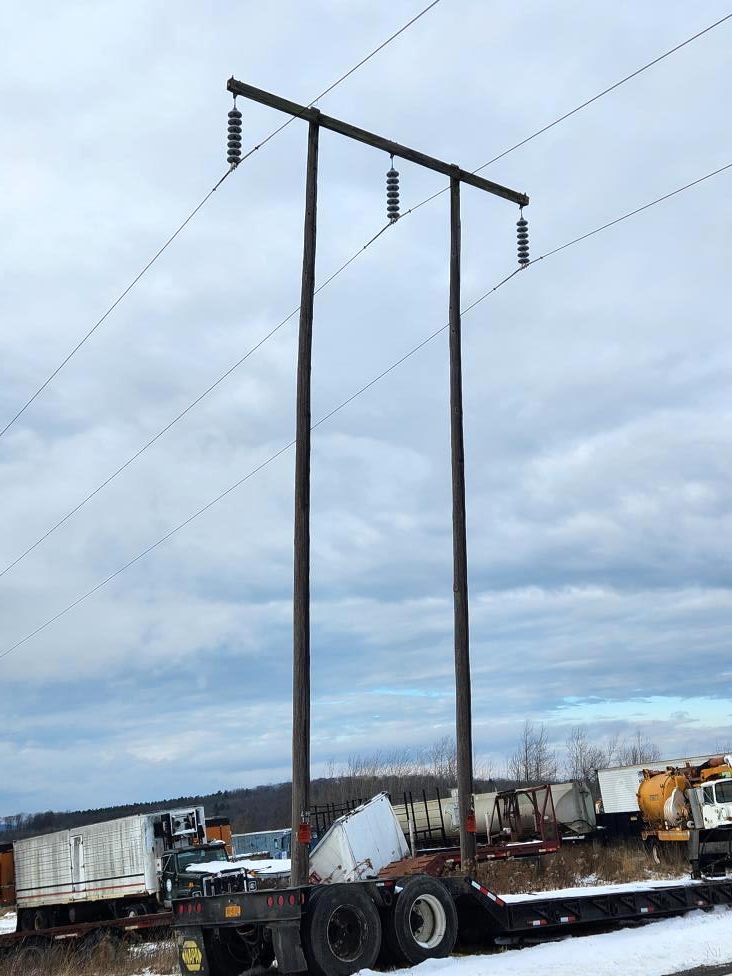
“I am not in favor of it,” Councilperson Robert Lynch (this writer) responded to Jude Lemke’s regulatory initiative. “Not that I love data centers; I don’t love AI and I don’t love cryptocurrency mining,” Lynch qualified. “But you’ve got to realize that it’s about as likely a data center or a crypto mine is going to come to Enfield as the next Walt Disney World.”
“We don’t have the infrastructure for it,” this writer explained. “It’s different from fracking. Fracking, we have the gas underneath. With crypto mining, you need big, beefy power lines, like Lansing’s got over at the TeraWulf facility.” Enfield has only the 115 kV “FLAIR” line to its south, probably not powerful enough for an AI center, he said.
What’s more, the TeraWulf center, if it needs to, can draw cooling water from Cayuga Lake. Again, Enfield lacks such a plentiful freshwater resource.
“So I think it was even a reach for Dryden to do what they did,” Lynch observed. “Well, little Enfield or little Dryden isn’t going to stop crypto or AI, sadly… It’s going to happen elsewhere, and I don’t think we should spend a dime of legal expense on drafting a law that will be totally inapplicable to this town. That’s my opinion.”
“I do agree with it’s very unlikely to come here,” Supervisor Redmond countered. “But you don’t know what the future will bring and there’s always different technologies becoming available.”
And that’s where the March 11 data center discussion ended.
The data center issue consumed a mere three minutes of the Enfield Town Board’s more than two-hour March meeting. Far more immediate was how—indeed whether—the town can proceed with the Bostwick Road culvert project, a flood mitigation effort years in the planning, but one that’s proven of late more costly than planned.

In this latest installment, it appears Enfield got lucky. Two days before the meeting, Supervisor Redmond had opened bids for excavation and stream work to install a giant, already-purchased concrete box culvert that’ll carry Enfield Creek beneath Bostwick Road in a spot a short distance east of Route 327. Four construction bids came in. They varied wildly. The low bid asked $351,300. The high bid registered at more than $1 Million.
With little hesitation, the Town Board accepted that low bid from JB’s Excavation Services of Apalachin.
“Maybe some of you guys got the same sticker shock that I did,” Supervisor Redmond said, recounting how she’d happened to open the high bid first and “nearly fainted on the spot.” The higher bids, she said, would have left us “completely dead in the water.”
JB Excavation’s bid registered more than 40 percent—or nearly a quarter-million dollars—beneath that of the next-closest bidder. The winner will put the culvert in place and realign the roadside stream this summer. State rules require the contractor restrict its work to between mid-May and September because Enfield Creek is a protected trout stream.
Highway Superintendent Barry “Buddy” Rollins vouched for JB Excavation’s proficiency. Rollins said the firm had repaired a second Enfield stream off Hubbell Drive a few years back. They did good work, he said.
Far more costly than the work itself was purchase of the actual culvert. The Town Board in January awarded a Watertown firm, Jefferson Concrete Corporation’s $471,600 bid for the big concrete box.
Total Bostwick project cost has risen far above the $693,866 awarded Enfield through a 2024 state-funded Water Quality Improvement Project (WQIP) grant. The Town will proceed, nevertheless. Redmond proposes to tap budgeted bridge fund reserves to cover any cost overruns.
“This is one of our last hurdles for the Town Board,” the Supervisor celebrated as the most recent Bostwick bid was awarded. “After this, we’re looking at shovels in the ground,” she said. “It’s been like three years in the making, so I’m excited.”
An administrative transition that few in Enfield will likely notice day-to-day occurred at the March Town Board meeting. Having served since February 2023, Greg Hutnik tendered his resignation as Deputy Town Supervisor, and Supervisor Redmond officially appointed Enfield event venue operator Terrance Bloom as Hutnik’s successor.
Greg Hutnik must leave the deputy’s position as he and his family are moving to Danby. As Hutnik left his presumed last meeting, Board members and attendees offered him a round of applause.
The Town Board acknowledged Redmond’s choice of Bloom by resolution. It was a ceremonial exercise, given that state law grants the Supervisor exclusive power to pick her deputy. The position pays just over $5,000 annually.
I’m passionate about creating more resources for not just residents in general, but specifically for youth in the future,” Bloom, owner of Porter Hill Road’s Stone Bend Farm, stated as he introduced himself.
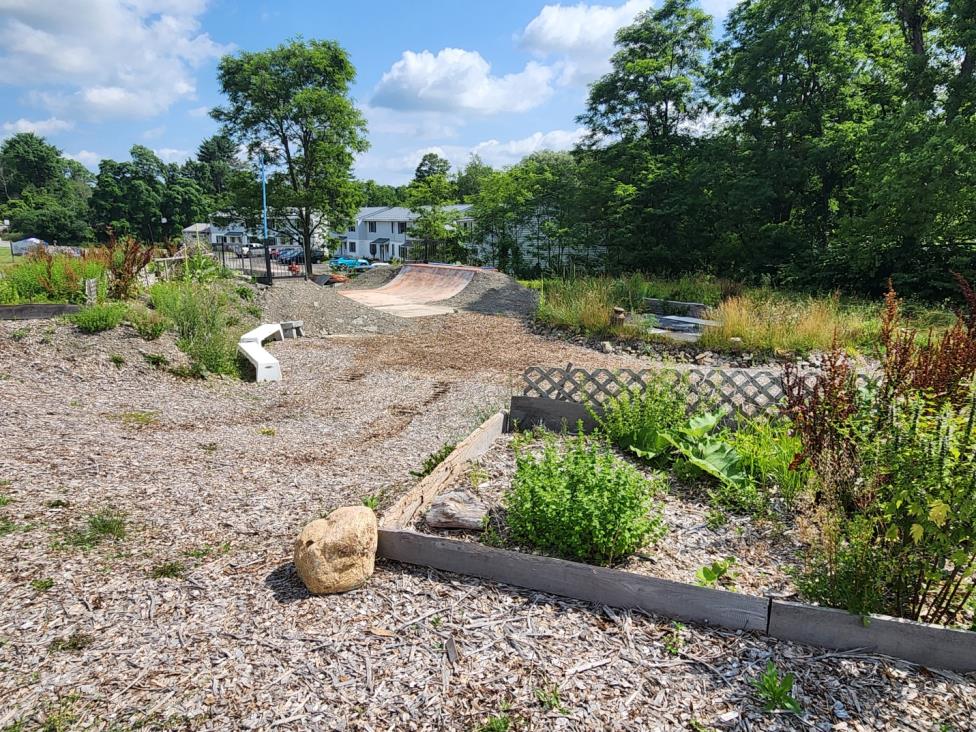
Bloom will likely focus on reimagining the “SkateGarden” skate park across from the Town Hall. It’s a place that Redmond seeks to enhance.
“I’ve been around, I’ve worked my ass off for quite a long time, and I’m happy to keep working,” Bloom promised.
Terry Bloom’s appointment did not come without criticism. At the meeting’s start, resident and recent Town Board candidate Rosie Carpenter spoke against the appointment, referencing an alleged dispute she and Bloom had when they were neighbors. Carpenter accused Bloom of having dug a trench through protected wetlands and flooding her property.
“I’m sure there are people in the community that have an opinion about who they think I am,” said Bloom, who arrived at the meeting after Carpenter had made her assertion. “But I promise you if we haven’t had a long conversation, you don’t know me,” Bloom insisted.
Redmond first disclosed Bloom’s selection during a broadcast interview 12 days before the meeting, having announced her decision there even before notifying all others on the Town Board.
Councilperson Lynch initially planned to abstain on Bloom’s affirmation, but later joined in the ceremonial support, acknowledging that neither the Board nor the public holds any “veto power.”
Among other Town Board matters addressed March 11:
- Two Cornell students from the University’s ”Design Connect” program updated the Board on their progress in repurposing the skate park that the new Deputy Supervisor will have a hand in crafting. The students, identified as project managers, sought input and got suggestions.
Supervisor Redmond said she seeks a park that is “very youth-focused, yet also becomes “a gathering space for everybody.” Councilperson Melissa Millspaugh encouraged development of a “natural play space” for children. Councilperson Lynch described what exists there as “a place without character right now” and “a concept without really an end point.” The Cornell students will seek more input, primarily from youth, and may return to the Town Board in April.
- The Town Board approved a contract and License Agreement that allows the Enfield Food Pantry to continue using the downstairs level of the Enfield Town Courthouse for another ten years. Aside from some tightened language, the revised contract establishes a general 48-hour deadline “for the removal at its own expense of all waste food, garbage, or other commodities deemed unfit for distribution and placed outside the pantry.” The Pantry Board reportedly agrees with the new sanitary stipulation.
- And in contrast with the bidder interest for replacing the Bostwick Road culvert, the Supervisor reported no quotes at all came in for another Enfield need, namely the long-distance transport of Highway Department floor drain wastewater, now that the Ithaca Area Wastewater Treatment Plant will no longer accept the effluent. The newly-arisen expense could cost Town taxpayers in the tens of thousands of dollars. The Town Board voted to rebid the service, with new bids to open in May.
###