
Town Board tags Cincinnatus’ call for stricter oversight, transparency, thrift
by Robert Lynch; March 3, 2026
The Town of Cincinnatus may be tiny, but its leaders shout through a loud megaphone. They’ve shouted again. And once more, the Town of Enfield has listened. Let’s see if anyone else does.
At a special meeting February 25, a session called principally to enact a senior citizens tax benefit before a fast-approaching state deadline had passed, the Enfield Town Board (with member Jude Lemke excused) unanimously endorsed a Town of Cincinnatus resolution that takes aim at the large, double-digit increases in electricity delivery charges that New York State Electric and Gas Corporation, NYSEG, seeks to impose.
“Be It Resolved, that the Town Board of the Town of Enfield formally and strongly urges the New York State Public Service Commission [PSC] to conduct a thorough and immediate review of electric delivery charges, rate increases, and cost-recovery practices applicable to NYSEG customers;” the Town of Enfield resolution states.
“Be It Further Resolved that the Town Board calls upon the Public Service Commission to prioritize ratepayer affordability, demand greater transparency from NYSEG, and require demonstrable cost-containment and operational efficiency measures before approving any future rate increases…” Enfield’s resolution continues.
What the local Town Board adopted that recent Wednesday night was not a product of Enfield’s own creativity or initiative. No, the 11-paragraph, 450-word plea to regulators was lifted almost word-for-word from a similar resolution adopted February 10 by the Town Board of Cincinnatus in eastern Cortland County.
Census records show Cincinnatus claims just 998 residents, fewer than one-third of the more than 3,300 who populate Enfield. All five Cincinnatus Town Board members are Republicans.
Credit Enfield resident and recent Town Board aspirant Rosie Carpenter for having brought the Cincinnatus resolution to the Enfield Board’s attention. She did so at the regular monthly meeting two weeks earlier. Some will recall that Carpenter, running as an independent, lost last November’s election for Councilperson by a mere 19 votes.
“They’re asking that anybody in the smaller towns that are around, if you’d like to join them… they’re asking that you would do so and get some more people behind it because the rates are outrageous,” Carpenter conveyed Cincinnatus’ appeal to the Enfield Board during her privilege-of-the-floor remarks.
Enfield Supervisor Stephanie Redmond requested Carpenter send her the Cincinnatus text. Carpenter did so. And Redmond placed Enfield’s own redraft onto the February 25 agenda.
It’s the second time in four months that the Enfield Town Board has followed Cincinnatus’ lead.
In mid-October, Cincinnatus Board members adopted a resolution to oppose implementation of New York’s earlier-adopted, yet initially overlooked “All Electric Buildings Act.” Cincinnatus had urged Washington lawmakers to override New York’s planned restrictions through preemptive federal legislation. Had the state law taken effect, it would have banned the installation of fuel oil, propane or natural gas furnaces and cook stoves in any newly-built home beginning at the start of this year.
The Enfield Town Board October 22 took its cues from the arguments that Cincinnatus had made. It then retooled Cincinnatus’ recommendations so as to mollify one board member who’d objected to outright federal pre-emption. Enfield then passed its own resolution to encourage New York delay the All Electric Buildings Act’s implementation. Enfield argued that the local grid can’t handle the increased electrical demand that an all-electric mandate would require.
Frustrating many climate activists, Governor Kathy Hochul in November imposed a temporary legal roadblock to the electrification law’s imposition. The mandate remains on hold.
Nevertheless, the Town of Cincinnatus’ objections were heard loud and clear back then, definitely in Enfield and perhaps in Albany and elsewhere as well.
What’s before the Public Service Commission now is NYSEG’s proposed 34.7 percent increase in delivery charges for electricity and 39.4 percent increased delivery charge for natural gas. (No natural gas lines currently extend to Enfield.)
In a two-hour deep-dive examination into the NYSEG rate issue February 17, utility officials explained their rationale and fielded a barrage of questions from members of the Tompkins County Legislature.
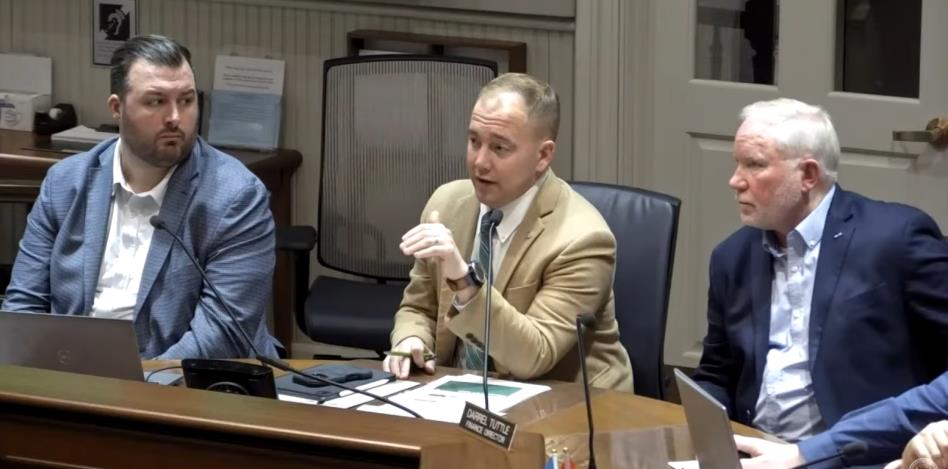
As summarized in a County-authored news release, “NYSEG is proposing over $10 billion in system investments over five years, aiming to provide cost stabilization for customers and address infrastructure needs.” The release added, “For the Ithaca Division, NYSEG is proposing investments of $991 million to area substations, addressing emergent capacity constraints, meeting future electrification needs, and reinforcing the transmission system for increased resilience and reliability.”
A trio of NYSEG managers, including the company’s Vice President of State Government relations, Timothy Ellis, sat at the end of the Legislature’s oval table for the marathon interrogation. They fielded a wide range of questions, ranging from whether the planned expenditures are truly needed, why ratepayers must now fund long ignored infrastructure maintenance, and why NYSEG, as reported, intends to close its customer service office in Etna.
Farther away, other, maybe more influential voices can also be heard.
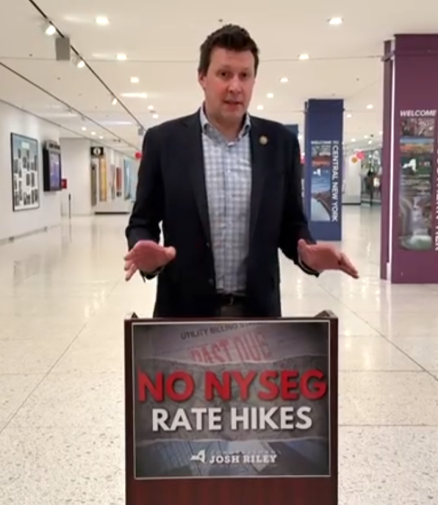
At Public Service Commission hearings in late February, 19th District Congressman Josh Riley alleged that NYSEG is raising rates while syphoning off profits to its Spanish-based corporate parent, Iberdrola.
Cross-examined by Riley, “NYSEG executives confirmed for the first time they authorized a $450 million dividend to Iberdrola (while) effectively asking Upstate New Yorkers to foot the bill for their massive corporate payout,” according to a February 20 statement issued by Riley’s office.
“NYSEG ripped hundreds of millions out of our community to line the pockets of their foreign parent company in Spain, and they admitted under oath yesterday that they knew all along they were going to jack up rates and make Upstate New Yorkers pay for it,” the Democratic Congressman said in his office’s statement. “It’s robbery, plain and simple,” Riley insisted.
And among those seeking to unseat Congressman Riley, a more radial initiative emerges.
Alexander Portelli is a Republican, perhaps lesser known than State Senator Peter Oberacker, the GOP’s apparent front-runner in the race to oppose Riley. But for his lack of name recognition, Portelli compensates with radical ideas.
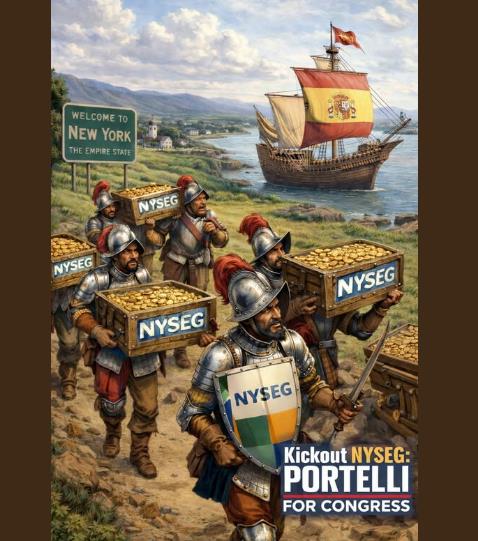
“I will introduce a bill to Congress banning foreign companies from having any part in our power grid,” Portelli said as he launched his campaign. “With this,” Portelli said, “we will kick NYSEG, National Grid, and Central Hudson out of New York forever.”
Informed February 25 that some people like Portelli want to kick NYSEG out of New York, Enfield Supervisor Stephanie Redmond, a generally progressive Democrat, appeared to welcome the idea.
While both Congressman Riley and potential rival Portelli take aim at NYSEG’s alleged $450 Million profit-skimming scheme, most talk in Enfield this recent, late-February night became far more granular. It was not about nine-figure payouts, but rather of monthly utility bills lying on the kitchen table.
Councilperson Melissa Millspaugh talked of her older-adult in-laws getting a $1,300 monthly NYSEG bill. “My father-in-law nearly had a panic attack,” she said.
Millspaugh, her husband and their two young kids closed off rooms to conserve heat during the late-January/early-February cold snap. “We spent two weeks in my kids’ bedroom and their playroom, and that was it,” the Councilperson reported.
The Millspaugh’s still got a NYSEG bill for $1,700.
Councilperson Robert Lynch (this writer) brought “homework” to the meeting, six years’ worth of NYSEG December monthly statements. He compared delivery charges from each year to the next.
From 2020 to 2021, the rate rose by 22 percent. The next year it jumped again, this time by a more modest seven percent, only to bound again in 2023 by a further 25.5 percent. Annual increases were 24 percent in 2024, and 23 percent in December 2025. Over those six years, the delivery rate had jumped from 3.6 cents to nine cents per kilowatt hour.
“We have to figure out why this rate for electricity delivery is going up so much faster than inflation,” Lynch told meeting attendees. “And I hope that more towns will sign onto this,” he said, referring to the Cincinnatus resolution. “I think it’s a good thing to put before the state.”
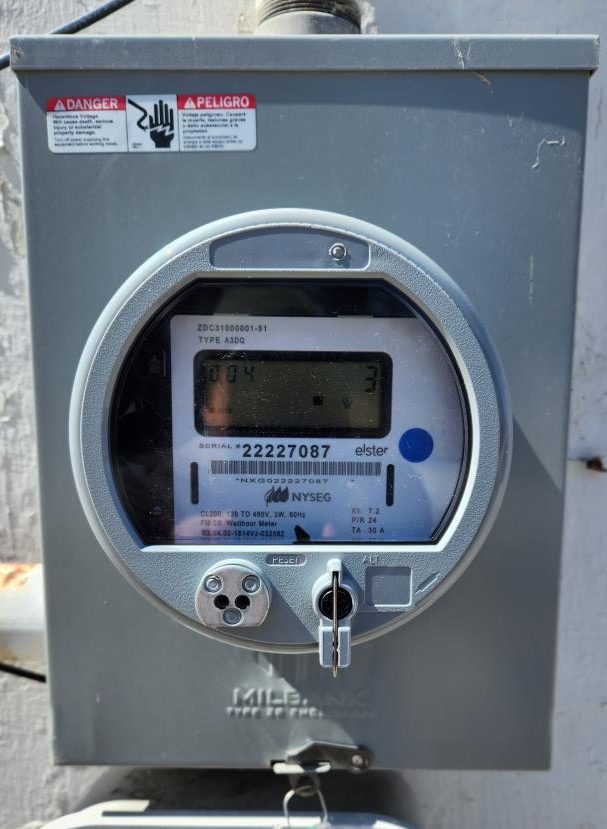
As many know, everybody’s NYSEG bill conflates three separate charges. The two costliest ones arise from the supply of electricity and the cost of delivering it to you. (The third component includes taxes and miscellaneous expenses.) Supply charges comprise about 44 percent of the current bill; delivery charges another 40 percent, Enfield-Ulysses legislator Rachel Ostlund informed Enfield leaders in her February 23 report to their Town Board based on the mid-February NYSEG meet-up.
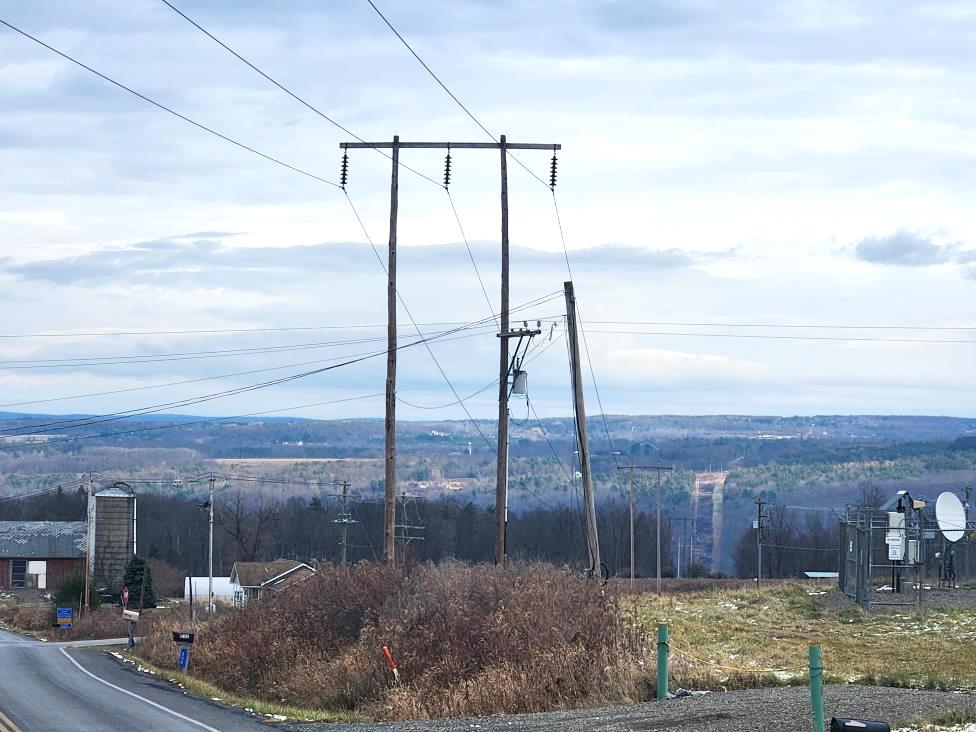
Supply charges, Ostlund reported, are those “which NYSEG doesn’t control and doesn’t profit off of.” They are just pass-through expenses, Ostlund said she’d been told.
“I somewhat doubt that,” Councilperson Lynch said of the “pass-through” assertion, “because I know that NYSEG’s supply rates can vary a whole lot more than a number of the independent ESCO’s (Energy supply companies) can vary.
As an example, Lynch reported that while the variable rate on a privately-run ESCO service had stayed flat from January to February of this year, NYSEG’s supply charge at another address had spiked from 13 cents to 25.3 cents per kilowatt hour during that same monthly period, a 92 percent, one-month increase.
Supervisor Redmond holds an enviable position at the moment. By choice, her family lives off-grid.
“I don’t pay an electric bill. It’s great,” Redmond told the meeting. “I don’t even know when the power goes out.”
That said, the Enfield Supervisor is thinking of others. And Redmond took a few minutes’ that night to tout “Community Choice Aggregation,” a municipally-orchestrated arrangement whereby a town or city government selects a favored energy supply company and then generally subscribes every resident to that supplier unless the resident chooses to opt-out. At bottom, it’s collective buying power.
The City and Town of Ithaca have attempted for years to implement an aggregation model locally, only to be thwarted by regulatory red tape. Latest word is aggregation under the “T-Gen” banner could launch this September.
Community Choice Aggregation has a heavy “Green New Deal” component within it. And that’s an element that Stephanie Redmond likes.
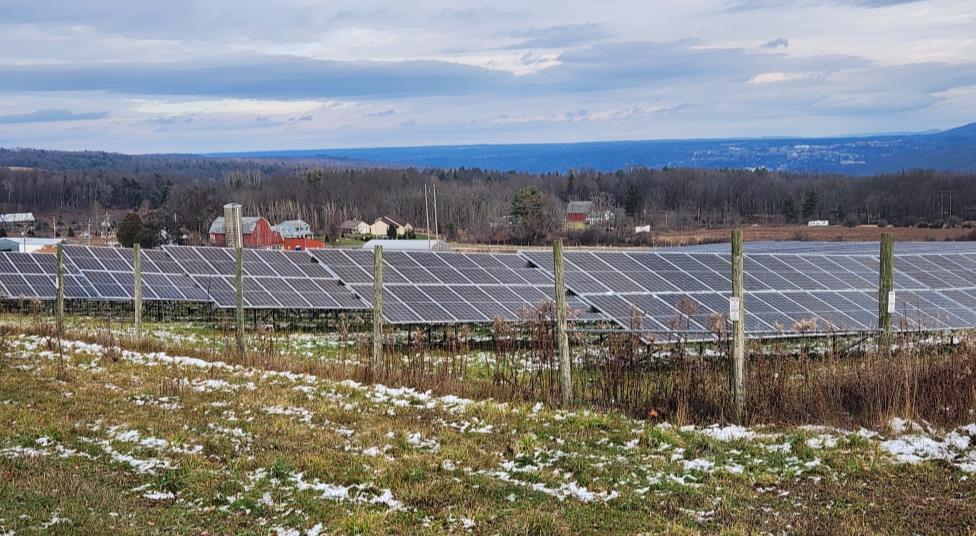
“I’m really having high hopes for it because it’s basically taking solar farms and breaking them apart, and put them on people’s houses,” Redmond stated, “so you’re able to pay your regular amount that you’re paying and gradually gain ownership of the solar panels,” she said.”
Community Choice Aggregation is a bit more complicated than that description, and not every home—or neighborhood—is fit to have its own mini solar farm. What’s more, unless it supplies all of one’s needs, rooftop solar won’t negate the proposed—maybe threatened—34.7 percent NYSEG delivery charge increase now before the PSC.
By contrast, blunt defiance is more the Town of Cincinnatus’ style.
“Rubber‑stamping rate increases without explanation will no longer be tolerated,” the Cincinnatus Town Board wrote in the “Official Announcement” accompanying its February 10 resolution. “Cincinnatus is demanding answers, accountability, and fairness.”
Leaders of that tiny Cortland County town continued to vent: “No town should stand alone in defending its residents from unjustified utility costs. We cannot ask our residents to choose between putting food on the table and keeping their lights on. Cincinnatus is standing up, speaking out, and pushing back.”
And likewise, by adopting Cincinnatus’ narrative chapter and verse, so is the Town of Enfield.
###