

Passions build as Lansing Board hits roadblock in move to ban data centers; Enfield weighs in
Reporting and analysis by Robert Lynch; November 25, 2026
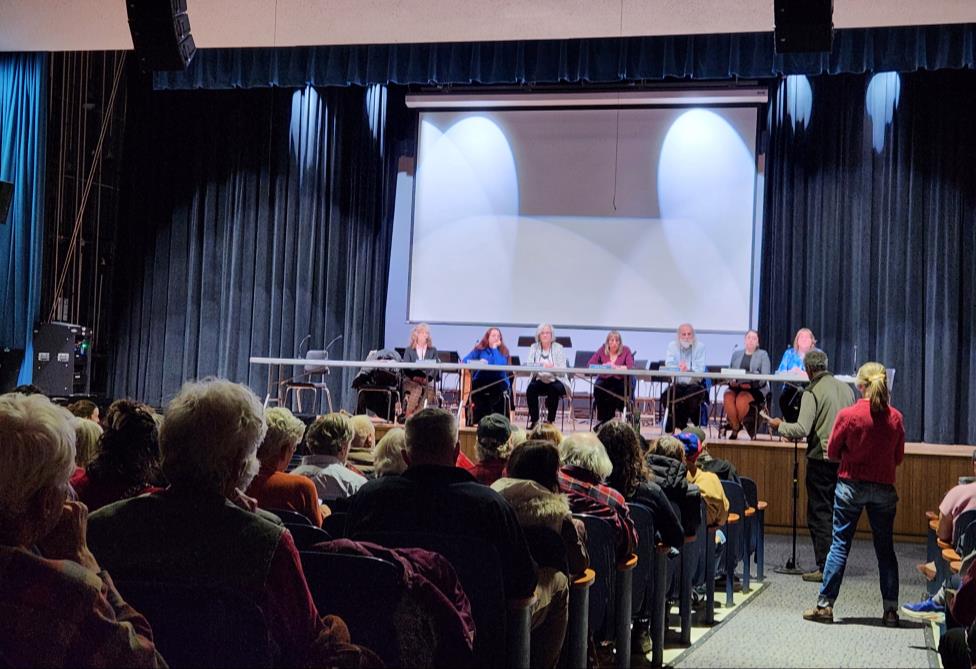
Cassie from Dryden bore passion… and also a bit of a potty mouth. At a public hearing held one night before the Lansing Town Board tried its best to decide whether to ban the former Milliken Station power plant from transitioning to a data center, Cassie addressed the board with the dramatized flair a Broadway actress.
“I’m here because Lansing is being asked to make an extraordinary sacrifice for a corporation that will never have to live with the consequences of its decisions,” the uber-animated Cayuga Lake protectionist launched her two-minute, bluntly-personalized monologue against TeraWulf, the pushy data driver she sees as villain-in-waiting. Cassie was just warming up.
“You can bring on your lawyers. Try us. I dare you. But no, you do not get to intimidate a community into surrendering its lake, not here anyway… Our home is not your balance sheet, and believe me, it won’t be yours anymore in short order if you’re not careful… Folks, you don’t deserve polite.”
Cassie’s mile-a-minute, take-no-prisoners putdown of the company she hates and those who run it overwhelmed not only the Lansing Middle School acoustics, but also the opinions of anyone else who’d turned out that night to make a point. If you were in the room, Cassie’s two-minutes are what you’ll remember.
Our self-elevated hearing headliner closed with her harshest, full-throated rebuke: “Last, but not least, Get the F**k off our lake, Paul Prager!”
Paul Prager is TeraWulf’s co-founder and CEO. He didn’t attend.
And with that, the audience awarded our speaker a cheer… a somewhat restrained affirmation, to be sure. Mind you, everyone had to take a few seconds to regain composure, however much of that there was.
Several hundred attendees had packed the Lansing Middle School auditorium for the nearly two-hour hearing that night. Most wore red in solidarity with people like Cassie. The vast majority favored a data center ban. And they hate TeraWulf. When activist Mary Anne Grady Flores called for a show of hands to affirm support for the zoning prohibition the Town Board is considering, nearly every arm shot up.

But there were also rough moments aplenty. An auditorium of inflamed activists can be like a class full of second graders on a warm, spring afternoon awaiting the final bell. Ignore civility and quiet. Applaud those who like. Heckle those you don’t. And keep doing it no matter how often those in charge tell you to stop.
“We know that you guys are happy and mad about different things; we understand. But can’t we please just dispense with it tonight?” an annoyed Councilperson Judy Drake said from the head table at one point. It failed to work.
The TeraWulf data developer’s takeover of the mothballed lakeside power plant we once called Milliken Station stands at a critical juncture. The Maryland company wants to move as fast as it can to tap Milliken’s well-wired grid and feed the appetites of OpenAI and Anthropic with banks of computers.
But it can’t do so right away.
First, there’s the Town of Lansing’s pending zoning law change that would ban on data centers altogether. Because of a late-breaking TeraWulf maneuver, the zoning change has gotten tied in a parliamentary knot. But there’s also Governor Kathy Hochul’s moratorium on “Hyperscale Data Centers,” like the one TeraWulf now calls “Lake Hawkeye.” Declared by the governor last July, the statewide moratorium is set to run just one year. Most, however, predict it will continue much longer.
Of the 48 people fortunate enough to secure speaking privileges at the hearing last Tuesday—the sign-up sheet had been pulled away before late-arriving stragglers could register—as many as 38 opposed the data center and endorsed the town-wide ban. Of the few who took TeraWulf’s side that night, at least two of them worked for the company.
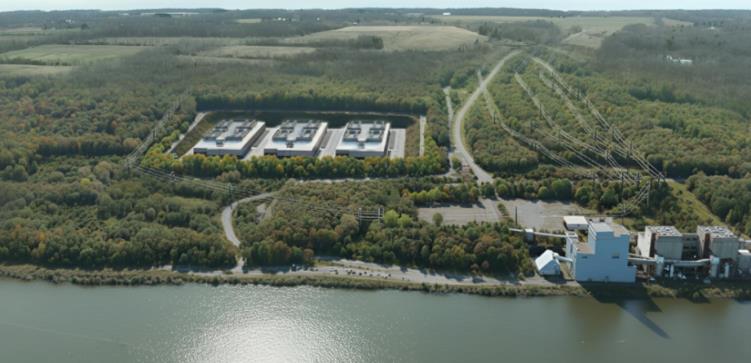
The proposal on which Lansing sought comment was an amendment to town zoning law that would take the same path to banning data centers as has Dryden. Lansing would newly-define data centers and cryptocurrency mines within its zoning code and then remain silent concerning any way to regulate them. Dryden saw it as a clever ploy. But one could counter that the strategy is too clever by half. TeraWulf has threated to sue.
The November 17 hearing drew media like a magnet. Syracuse and Elmira TV were there. And media interest continues. Redevelopment of the long-shuttered power plant on Lansing’s Cayuga Lake shoreline has become the hottest of topics.
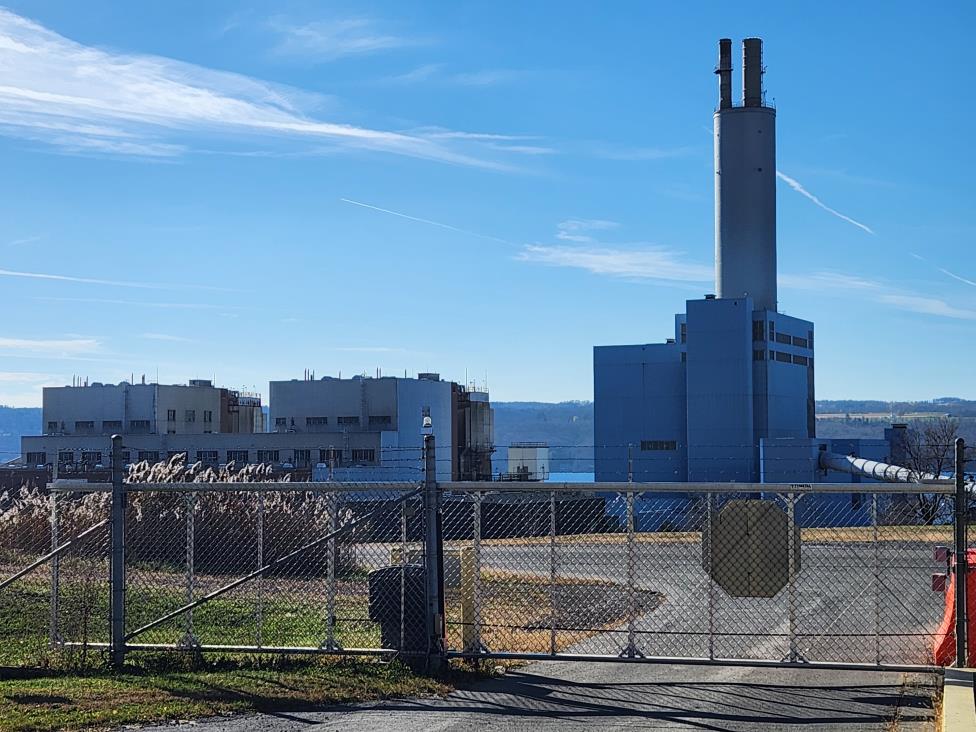
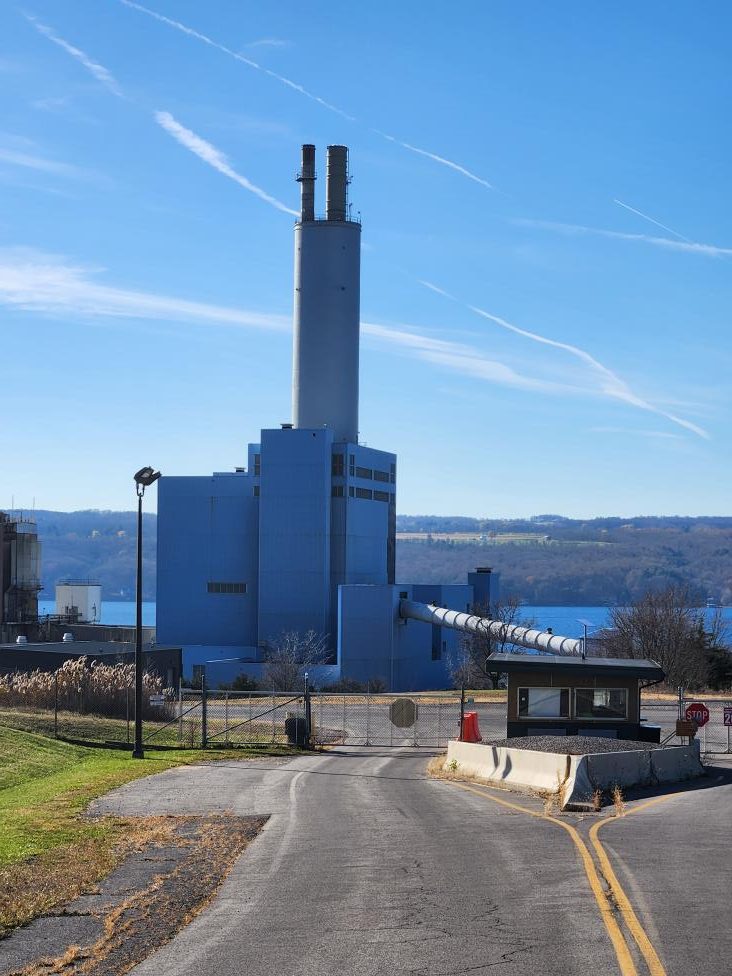
But staring at the plant right now, you’d never know it. The once-thriving facility that for decades turned coal into kilowatts looks all but abandoned. It’s wide, paved entrance road begs for a car or two. Its gates are locked; its guard station unstaffed, and its welcome sign encircled by weeds. To those who remember the ghosted Portland cement plant of a few decades back and a bit down the lake, recognize that Milliken Station is starting to look the same way. Neglect ages anything quickly.
To confront modern reality, most view a data center option as just about the only way to breathe new life into old Milliken. But it’s life that arrives via a sinister, destructive, and backhanded sort of route.
With zero fanfare, the 300-Megawatt, twin-generator, coal-fired power plant smothered its embers in 2019. Sixty-four years of service thus ended abruptly. The plant was long-owned by NYSEG, but has changed hands several times since. Prior to its shuttering, the plant had been upgraded and retrofitted for cleaner coal technology. But later attempts to transition the plant from coal to natural gas power never happened. When Milliken’s owners assigned the plant its current and continuous, seven-year rest, they blamed economic forces for the closure.

But could Milliken Station reopen as the power plant it once was? Perhaps, providing each generator can still turn after standing idle for so long. Yet few have talked openly about re-firing the plant. Its owners show no interest. None of those 48 people who verbally addressed the Lansing Town Board’s hearing last week raised the repowering option. A few others outside of the debate have discussed it from time to time. And one of those few is this Enfield Councilperson.
“Bring the coal cars back! Please, Lansing, bring the coal cars back! I’d yearn to be stuck in West End traffic once again waiting for those long trains to pass if only the plant we all know as Milliken Station could resume generating power,” this writer, Enfield Councilperson Robert Lynch, stated November 17 in a public hearing comment that only reached the Lansing Town Board through its written transcript.
“[W]e need to do more than just identify a problem. We need to chart a meaningful solution,” I wrote Lansing leaders. I sought to counter those who’d ban a data center, yet leave Milliken Station with zero future. “We need the plant to pump energy into those power lines, not for a data center to suck power out from someplace else,” I wrote.
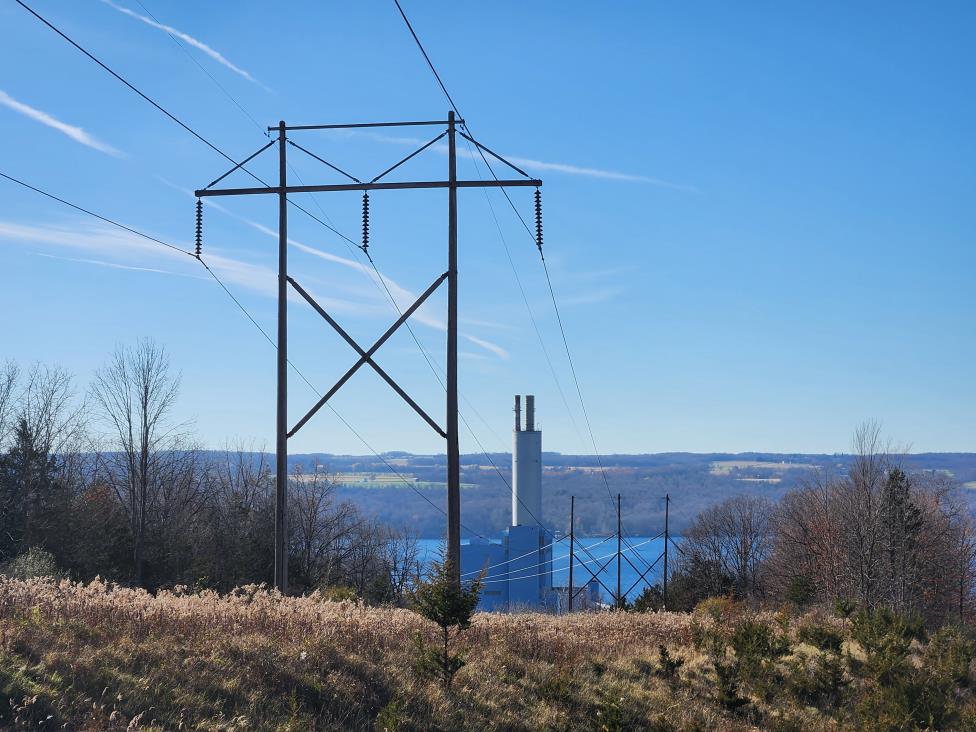
And that’s the cruel irony behind what TeraWulf would do to Milliken Station. Simply put, they’d trash the place. What brings value to TeraWulf—and to similarly-situated data center operators nationwide—is not the steam plant or the generators, but rather the substations and transmission lines attached to them. Instead of sending power out to other places, data center operators pull electricity back from elsewhere to power their massive banks of computers that feed Artificial Intelligence (AI).
“Read TeraWulf’s web page,” I wrote Lansing in my pleading. “TeraWulf plans ‘removal of the stack and the existing power plant structures over the life of the project.’ It’s plant demolition. What a shame. What a loss.”
So far, Lansing officials have not responded to this Enfield lawmaker’s outside-the-box idea. They may never do so. The Lansing Town Board has a more immediate concern at the moment. It’s a legal and parliamentary tangle brought on by the board’s own divisions, TeraWulf’s defiance, and a quirk in New York State Town Law.
One night after the public hearing, as leaders met in the same auditorium with a much smaller crowd, the Lansing Town Board split three-to-two on whether to enact the zoning law change that would effectively prohibit data centers. Town Supervisor Ruth Groff and Councilpersons Joe Wetmore and Laurie Hemmings supported the ban; Councilpersons Judy Drake and Christine Montague opposed it. Both dissenters said they’d prefer a data center moratorium rather than a ban. It’s a more cautious alternative.
Meanwhile—as company officials had disclosed at the hearing—TeraWulf has amassed petition signatures from owners of at least 20 percent of Lansing’s real estate. And under Section 265(1) of New York Town Law, such a “written protest” to the zoning change requires super-majority support, 75 percent concurrence from the board. Three out of five is only 60 percent. Either Drake or Montague would need to change her mind to allow the data center ban to pass. Neither has indicated she’d do so.
TeraWulf’s petition remains under Town legal review. Neither Lansing officials nor those of the developer have chosen to comment.
Across Cayuga Lake, six days before that media-magnetized Lansing hearing, members of the Enfield Town Board played to a nearly empty room. At Councilperson Cassandra Hinkle’s request, and by a vote of three-to-one (with Supervisor Stephanie Redmond abstaining because of a conflict-of-interest), Enfield’s Town Board backed a resolution endorsing the pending data center ban in Lansing. The endorsement dovetails with Enfield’s own incipient thoughts of data center moratoriums or bans.
The November 11 Enfield Resolution stated in part:
“Whereas neighboring municipalities have a legitimate interest in decisions that may affect shared natural resources and regional infrastructure, and meaningful public participation and comprehensive review are essential to protecting the long-term interests of the region… Be it Resolved, that the Town Board of the Town of Enfield expresses its strong support for the Town of Lansing and its efforts to oppose or challenge the proposed TerraWulf (sic) Cayuga Data Campus through all lawful and appropriate means.”
Councilperson Hinkle’s resolution was copied in large part from the text of a similar resolution adopted October 12 in the Seneca County Town of Covert.
Nancy Spero, Chair of Enfield’s Water Protection Committee, endorsed Councilperson Hinkle’s initiative. She spoke at the start of the November 11 meeting.
“I want to remind everybody that we’re all in this together,” Spero would later tell the Lansing public hearing, speaking as Enfield’s only representative that night. “All of us who live around the area are protectors of this precious resource, our lake, and stewards of the environment,” Spero said.
Cassandra Hinkle had lost her voice and was Zooming from home November 11. So Supervisor Stephanie Redmond and Councilperson Melissa Millspaugh handled the advocacy. Redmond also works as program manager of the group, Cayuga Lake Environmental Action Now (CLEAN). CLEAN’s website has already taken a stand regarding the TeraWulf Lake Hawkeye venture.
Recalling the political heat he’d taken from constituents five years earlier when Enfield had intervened in a Native American governance dispute in Seneca County, this Councilperson, Lynch, said he stood reluctant to meddle in another town’s internal affairs. But if Hinkle’s resolution were broadened to support Milliken Station’s reopening, he’d sense an opening.

“I don’t like data centers, and I don’t like this one,” Lynch said of TeraWulf. So “how do I square these two concerns: the mind-your-own-business concern and the wanting-to-make-a-statement-for-the-common-good concern?”
What emerged from that dilemma was a proposed resolution rewrite that would have, in the amendment’s words, encouraged “the Town of Lansing and state agencies to do everything within their authority to preserve and reactivate the Cayuga Power Plant (Milliken Station) as a functioning power plant so as to provide a renewed supply of available, affordable electrical energy needed to serve Enfield, the Finger Lakes Region, and Upstate New York.”
“We in Enfield benefit from plentiful, affordable electrical power,” this Councilperson told colleagues. Keeping the lights on gives us standing.
The idea didn’t fly. Nobody seconded the amendment. It silently died on the Town Board’s floor.
“That was so much more long-winded,” Councilperson Millspaugh responded when pressed to explain her objection. “Cayuga Lake is what’s important.”
Cayuga Lake “used to freeze over so you could drive a Model T all the way down the lake,” Supervisor Redmond said she’d been told. “When was the last time you saw somebody driving a Model T all the way down Cayuga Lake?” she asked. “We need to stop heating the water.”
And Redmond, the climate activist, maintained that restarting Milliken Station would only elevate lake temperatures further. The plant’s having operated for 64 years really didn’t matter to her.
“You want it torn down and never used as a power plant again?” this Councilperson asked his objectors. Others on the board deflected the question.
“I am for protecting the lake,” Millspaugh replied. And that was where she left it.
If a summary can be drawn from the November 17 public hearing in Lansing, it’s that the big, beefy power plant that once was Milliken Station has become for many a convenient cast-off. The Lake Hawkeye data center is certainly not desired, the critics would say, but neither is the coal-burning behemoth that stands on the shoreline now. Where should electricity come from, you might counter? Well, from someplace else becomes the easiest answer.
Assemblymember Anna Kelles may not have projected the loudest voice of those at the Lansing hearing last week. But of the 48 who spoke, she was the leader most well-known.
“The election was historic… and data centers were the biggest losers,” Kelles stated. And as for TeraWulf, our lower-house state legislator showed no mercy:
“As elected officials, our job is to represent the majority of our constituents, not a corporation that has sued us, harmed us, bullied us with endless FOIL’s and emptying our coffers and making taxpayers pay for those bills,” Kelles asserted. “Are they good neighbors? Truly?”
“They are not the good neighbors that they purport to be,” resident Wendy Bush told the hearing.
“A ban is an ethical commitment to the sustenance of our beloved environment,” Mark Zuss would add to the conversation. He, like many, viewed data centers and AI as existential threats.
Remember, the night was alive with anger. At one point, Lansing Supervisor Ruth Groff threatened to evict the disrupters. To the best of knowledge, she never did that. Nevertheless, corralling the room proved difficult.
“We’re in a middle school. But I think we are all adults here,” Groff’s colleague, Joe Wetmore, acknowledged at meeting’s midpoint. Still, claps and catcalls kept coming.
Passion overwhelmed the room that night. It couldn’t be bridled. And for Paul Prager and the company he leads, community passion has become their most formidable adversary. Meanwhile, an old power plant sits and rots.
###