

ICSD sets 3.4% levy hike; speeds Heights flood repairs
Reporting and Analysis by Robert Lynch; April 17, 2026
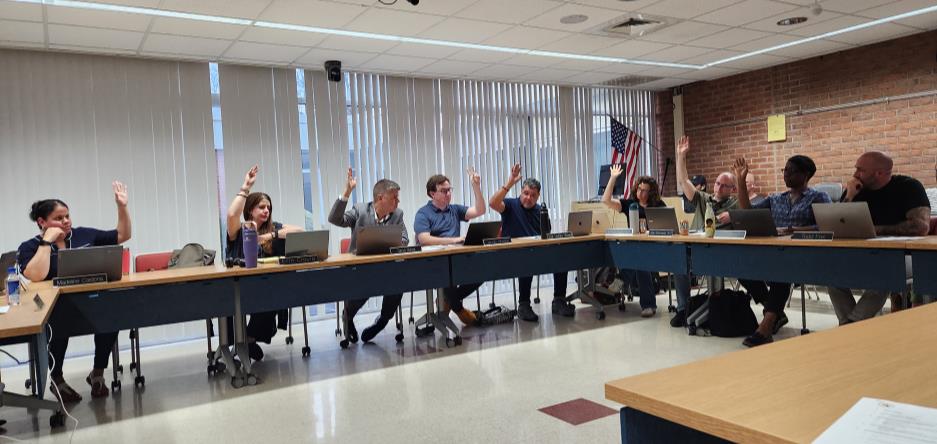
If there was any air conditioning, it wasn’t working well. Had it been that night, members of Ithaca’s Board of Education April 14 might have grown more focused; attended to their driving, taken fewer side trips, and reached agreement sooner on the 2026-27 District Budget. Members finally landed at their destination. But it took work.
Finding just enough votes to make a majority, the board Tuesday adopted the $177.6 Million proposed budget, its spending left essentially untouched from that earlier presented by district administrators. Ithaca City School District (ICSD) voters will either ratify or reject that budget in a May 19 referendum.
Far less contentious, yet equally significant, the ICSD Board set aside up to $1.5 Million from the school district’s savings account, its “fund balance” accumulated through prior budgets, to underwrite expected flood remediation at Cayuga Heights Elementary School (sometimes assigned the acronym, “Ches”).
Flood waters rushing down a hillside behind Heights Elementary during the March 31 deluge caused major damage to the building’s first floor. Remediation work has already begun. Only the first $500,000 of repairs will be covered by insurance. Administrators have yet to tally a full damage estimate.
We’ll deal with the budget first:
As finally adopted, yet only after 90 minutes of sometimes-tense deliberation, the proposed ICSD budget would raise spending by just over five percent from the current year and hike the tax levy by 3.4 percent. That’s less of a levy rise than administrators had originally sought, yet still higher than were a couple of lower-tax options earlier presented to the board. One year ago, the levy rose by 3.76 percent.
Reflecting on that hour and a half of often-meandering discussion, one found absent any grand, visionary fiscal optimism—not from Superintendent Dr. Luvelle Brown, not from program-conscious progressives like Erin Croyle or Karen Yearwood, nor from taxpayer guardians like Todd Fox.
The budget, itself, earned few if any accolades that night. Praised far more was the administration’s new computer tool that helps the homeowner calculate the budget’s impact on his or her own property.
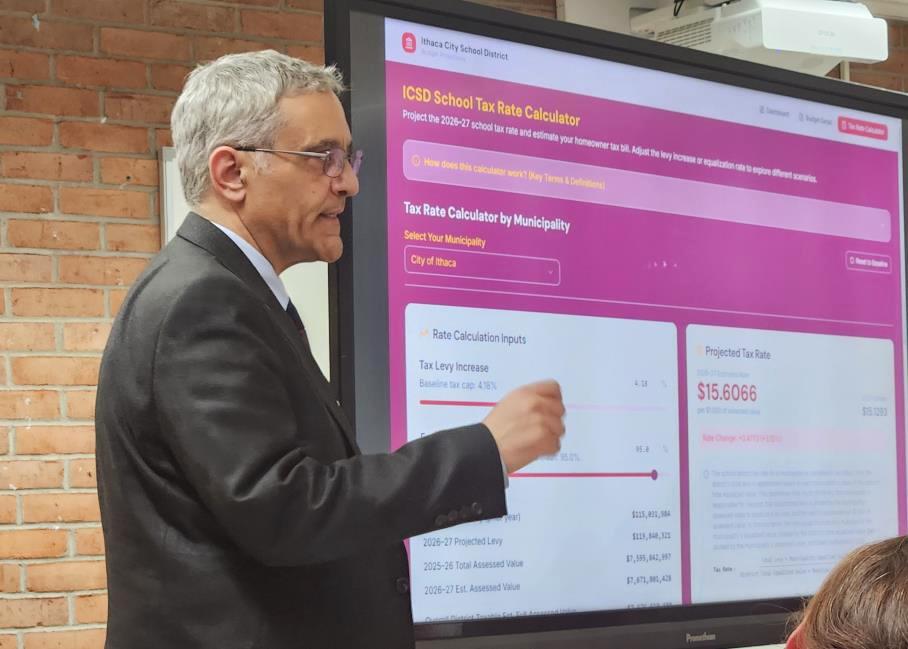
The budget program is “not only transformative, but also very innovative,” Superintendent Brown proclaimed at the discussion’s start.
It leads to “a different way of looking at the budget,” Dominick Lisi, Assistant Superintendent for Business and Finance, advised attendees.
That may be true. But praising the budget tool rather than the budget is somewhat like going to the Taughannock Falls overlook and walking away talking about the tower viewers instead of the waterfall.
No, there was little satisfaction and more equivocation that night. Perhaps the empaneled, elected educators fell victim to the curse of too many choices. A tool that enables an infinite range of fiscal alternatives also invites an unbounded field of divergent opinions. Spectators seated in chairs against the wall of the all-too-small, all-too-stuffy ICSD board room sensed indecision.
“If we suddenly have another disaster like what happened to Ches, or gas prices go up even more, or whatever, are we suddenly going to say, ‘Oh, my gosh, you should have made the rate even lower, you should have made it higher…’” Emily Workman pondered aloud.
Workman’s quandary stood as a good testament to the curse of too many choices.
The ICSD Board adopted the budget in a split vote; five votes in favor, one opposed, and (surprisingly) three abstentions. Because of those abstentions, the budget barely passed.
At the last regular Board of Education meeting, March 24, little attention was given to spending. Talk focused on the tax levy. And on how much to tax, members could not then agree. At a subsequent committee session on April 9, fresh word about the Cayuga Heights school flood and the uncertainty that flowed from it over the remediation’s cost forestalled any recommendation on taxes then as well.
Fiscal reality dictates that should spending remain untouched, any lowering of the tax levy would pull money out of the fund balance. And the fund balance reserves will be needed to fix the Cayuga Heights School.
At the Tuesday meeting, the board’s majority saw the 3.4 percent levy increase as a middle-ground compromise. Superintendent Brown had wanted a higher, 4.18 percent increase, a percentage just below the New York State tax cap assigned the ICSD this year. At the April 9 committee session, Superintendent Brown had first floated a 3.9 percent increase, only to later throttle it back to 3.4 percent.
“I think 3-4 is the right number,” Garrick Blalock, chair of the Facilities and Finance Committee, said of the compromise number Tuesday night. “I think 3-4’s the number that gives us a healthy fund balance, healthy reserves, and t also recognizes the pressure, the inflationary pressure that taxpayers are under.”
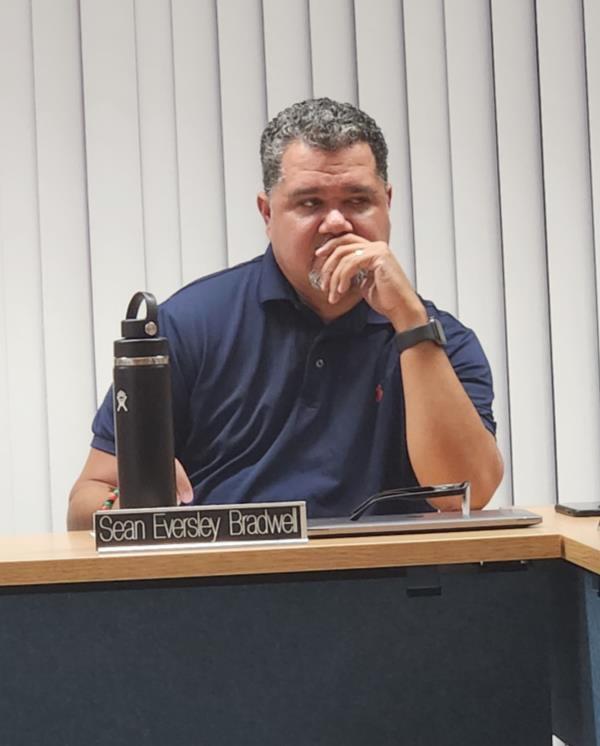
“I’m thinking about, as a taxpayer, you want me to approve a school district budget and I’m in a world where I’m paying $5.00 for a gallon of gas,” Board President Sean Eversley Bradwell commented. Compared with the alternative increase of above four percent, “I feel better going to taxpayers asking for 3.4, understanding all these other financial constraints.”
The lone dissent in the budget vote came from Todd Fox. Fox was elected two years ago during the ICSD’s taxpayer revolt, the one that rejected the budget that year. Fox stood his ground Tuesday for a tax increase even lower than the one adopted that night, a levy increase no higher than three percent. And Fox had a plan to achieve it. He’d tap into fund balances this year and replenish them later. Fox would sell off the long-mothballed Danby Elementary School and reap the proceeds. Danby hasn’t held a class there for almost a half-century.
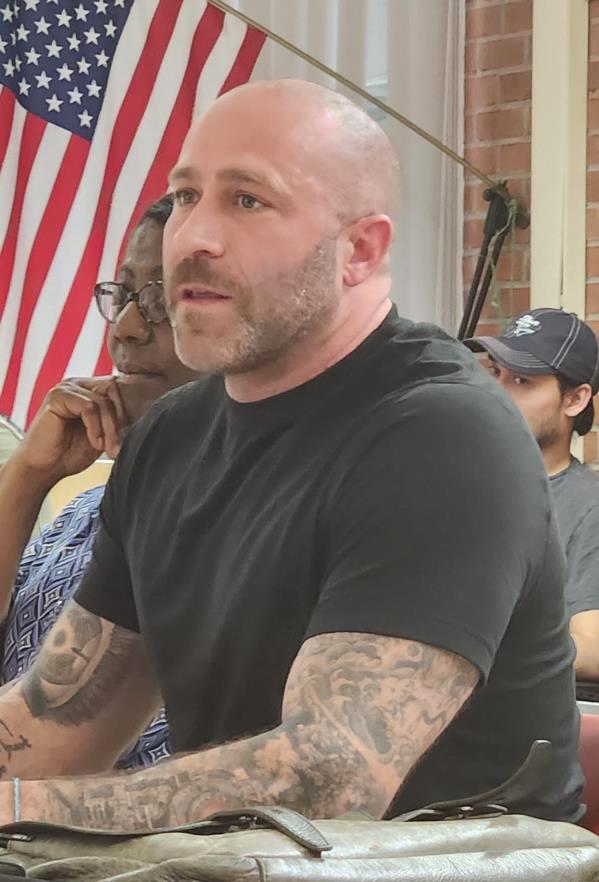
Danby’s “probably worth $1 Million if you put it on the market,” Fox predicted. If you drew down the fund balance by $1.4 Million to contain this year’s levy increase to three percent, Fox reasoned, “we could recoup that 1.4 (Million) from that one sale.”.
“Hey, we have that lever, that number, and we should dispose of that asset,” Fox said of the Danby building. “And I’m happy to do that this year, next year, whenever it is, as soon as possible.”
“It’s a little weird to me that this late in the game we’re talking about selling Danby,” colleague Erin Croyle countered, “because that’s something like that to me is not a factor in what we’re talking about now.”
“Maybe next year,” Croyle suggested the district consider offloading Danby. “But for the budget, you’ve got to have a vote, set timelines; you’ve got to move forward.”
The three unexpected abstentions on the budget vote came from Adam Krantweiss, Jacob Shiffrin and Emily Workman. Collectively, each in his or her own way, they redirected attention this budget cycle to the little-spoken issue of spending.
Theirs became the side trip the night’s budget journey took. And some at the table, including Board President Eversley Bradwell, did not enjoy the ride. It began late in deliberations, commencing after member Karen Yearwood had moved the budget for adoption—complete with its 3.4 percent levy hike.
Krantweiss said he couldn’t support the budget given how it came to be. He read from a prepared statement.
“I’m going to abstain from the budget vote because I disagree with the process in which the budget was developed,” Krantweiss had written and then spoke.
Administration had prepared the budget and handed it to us, he said. Yet “I feel like we as a collective board have not had substantive public discussions at the full board meetings to provide collective input about how to fund categories included in the budget…”
Krantweiss continued, “We’ve talked a lot about using the reserves to save taxpayers some money this year, but we haven’t even discussed making budget cuts to save money. Not that we would necessarily do that or want to do that, but we haven’t even talked about it together.”
Adam Krantweiss rattled off issues he believes the full board should have discussed, but hasn’t: class sizes, course offerings, the number of teachers in the classroom, even the restoration of the controversial 2024 elimination of Mandarin language classes at Ithaca High School.
Krantweiss’ grievance runs deeper than that of one rogue board member’s complaint about process. It asks the question, “Who’s in charge here?” Is it all nine members of the Board of Education, or is it a well-funded administration that begs annually for deference, joined by allied board members holding a similar vision?
“Against my better judgment, I am opposed to a number of things that were also said about the process,” President Eversley Bradwell remarked at one point. He didn’t elaborate.
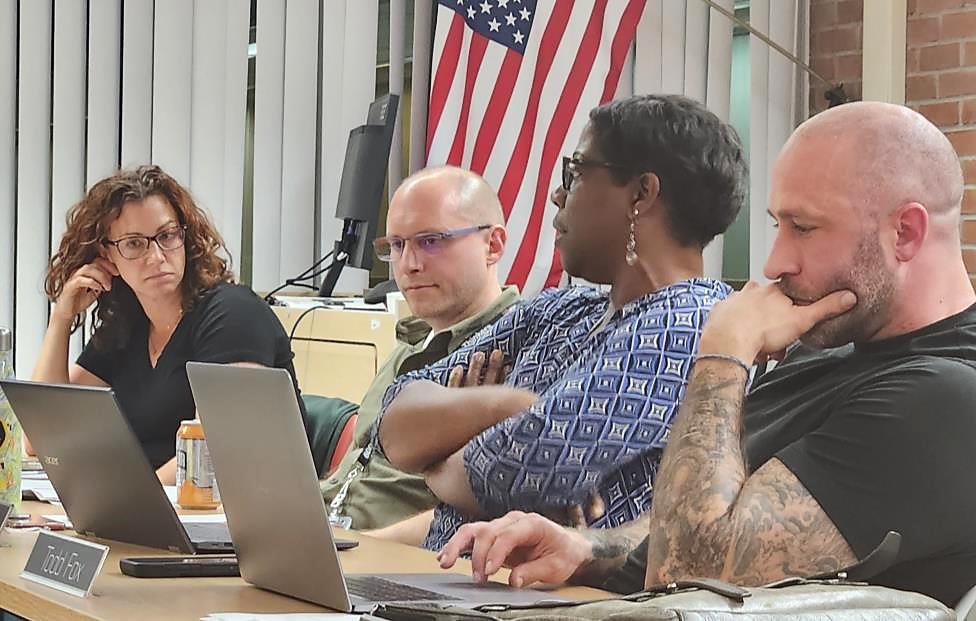
“I’m somewhat flabbergasted,” board member Karen Yearwood interjected. Yearwood maintained that the program-related issues Krantweiss had raised have been fully aired at meetings of the Curriculum Committee, meetings few from the public ever attend. Krantweiss sits on that committee.
Krantweiss countered that committee consideration is far different from full board involvement.
Erin Croyle offered the most passionate rebuttal.
“The budget process is a year-long process,” Croyle reminded Krantweiss. “You had all year to have these conversations, all year to bring up all these items, but you’re doing it tonight in this format with a canned speech.”
“Salaries are people,” Finance Chair Blalock reminded everyone. “The reason I think perhaps we haven’t had a lot of focus on the expense side of the books is because… changing expenses means changing the people and how they teach, how this district educates.”
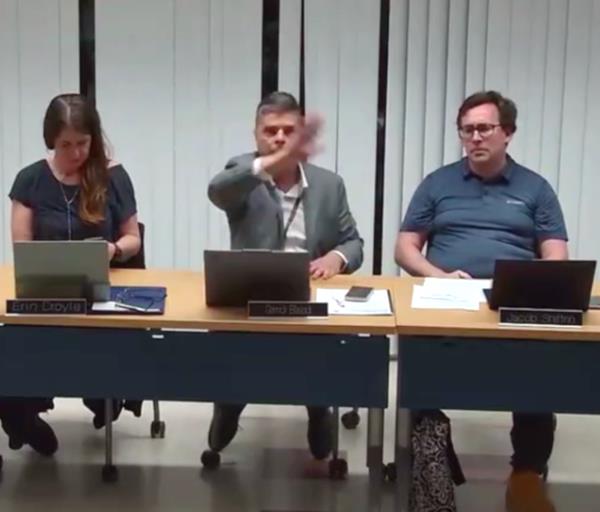
“Should we just take a sponge and wipe the blackboard of our education model all down and start all over again?” Blalock asked, waving the air like he held that sponge.
Yes, the room was hot; the night was long.
Jacob Shiffrin and Emily Workman joined Adam Krantweiss with their abstentions. Neither talked as long as Krantweiss did, nor evoked as much drama. Yet each conveyed general agreement with the process-rooted argument. Workman urged that the “collective input” issue earn discussion at a future meeting. Shiffrin said he didn’t “have sufficient information on the content of the budget to make an informed vote as a board member.”
Yet both Krantweiss and Shiffrin promised to support the budget in the May referendum.
The side trip had ended; the destination reached. The roll was called. The budget passed; just barely.
****
As of meeting night, officials had not fully assessed the dollar loss from the March 31 flooding at Cayuga Heights Elementary. But to be on the safe side and to cover what might be worst-case outcomes, the board passed an emergency authorization allowing the district to draw up to $1.5 Million from its unappropriated fund balance to cover remediation work at the school. Officials say insurance will cover the first $500,000 in claims.
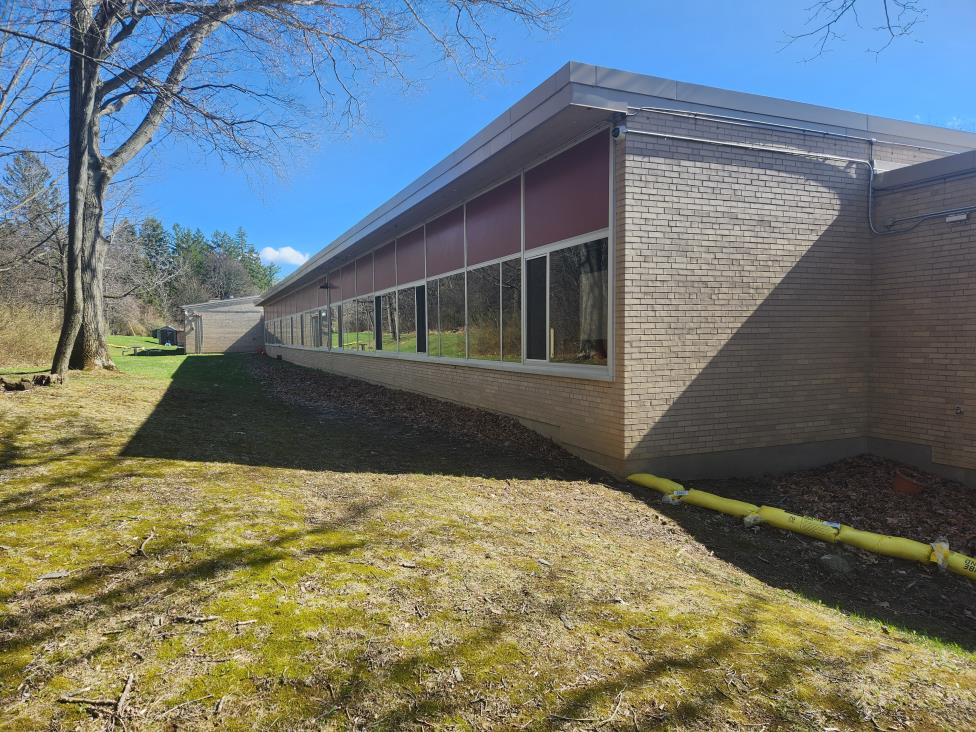
Preliminary damage estimates that night varied wildly. The district’s contractor, SERVPRO, had put in an initial estimate of $388,000 for remediation alone. But Assistant Superintendent Lisi quoted state benchmarks predicting that mitigation and reconstruction work could cost $150 to $250 per square foot. And for 13,000 square feet of damaged area, those guidelines could push costs to $1.95 to $3.25 Million.
Lisi’s best compromise guess was $800,000 to $900,000.
“I think 1.5 (Million) is way too high,” Todd Fox, a commercial developer, reacted. “We don’t have hard numbers back,” Fox stated. “I don’t think the damage is as much as you think it is. It’s mostly cosmetic. There’s nothing structural; no electrical, no plumbing. It’s like flooring and drywall.”
Fox would have set aside only $500,000 now and sought more money later should the need arise. Board President Eversley Bradwell floated a $1 Million mid-ground compromise. Board members stuck to the original $1.5 Million commitment, approving the resolution with only Fox casting an abstention. Fox later explained he’d need more information before he’d support the higher figure.
Most on the board agreed with Erin Croyle’s assessment supporting worst-case contingency. “I don’t understand why we wouldn’t say 1.5 as a C.Y.A. and call it a day,” Croyle remarked.
There’s another consideration, too; government red tape. If you submit the state an emergency authorization now only to come back later with a second appeal, the state might claim it’s no longer an emergency and demand such formalities as competitive bidding, Lisi cautioned.
We should also acknowledge that “it could potentially cost us more,” Eversley Bradwell warned. “Any time you open the wall, there’s the potential you’ll find something.”
Cayuga Heights Elementary remains open. Students are using mostly the upper floor. Remediation work’s begun. Crews have packed up books and ripped up floors. Eversley Bradwell doesn’t like using the term ‘disaster.’ “It’s not a disaster, but a natural occurrence,” the Board President said, though he quickly added, “It looks like a disaster when you walk through the school.”
###