

Verizon’s money-saving relocation secures planners’ grudging consent
by Robert Lynch; August 18, 2026
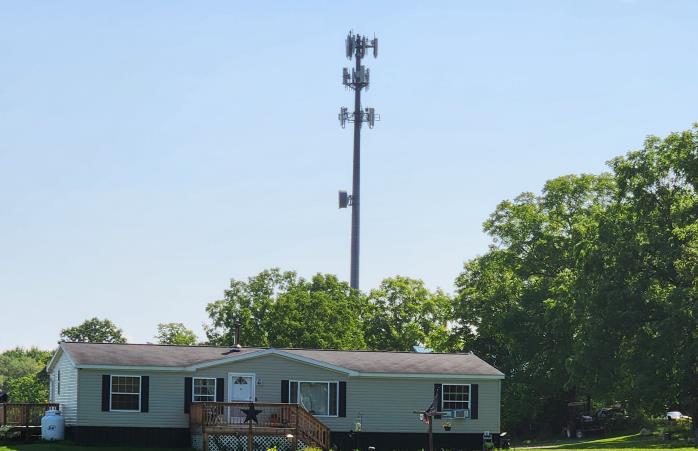
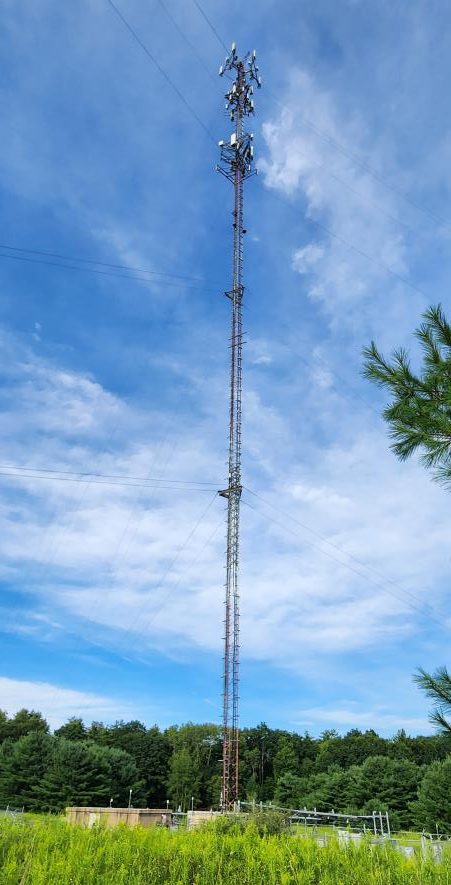
They’ll stand like Tweedledee and Tweedledum; two, nearly 200-foot tall communications towers on the east side of Van Dorn Road, only a few football fields apart. And once things shake out, the newer of the two may be laden with cellular antennas, while the older one may stand there nearly naked.
But that’s the way of business. And that’s also the way of Enfield town government. It’s a government whose Planning Board determined this month that legal compliance coupled with lax regulation gave it no choice but to permit the new tower to go up.
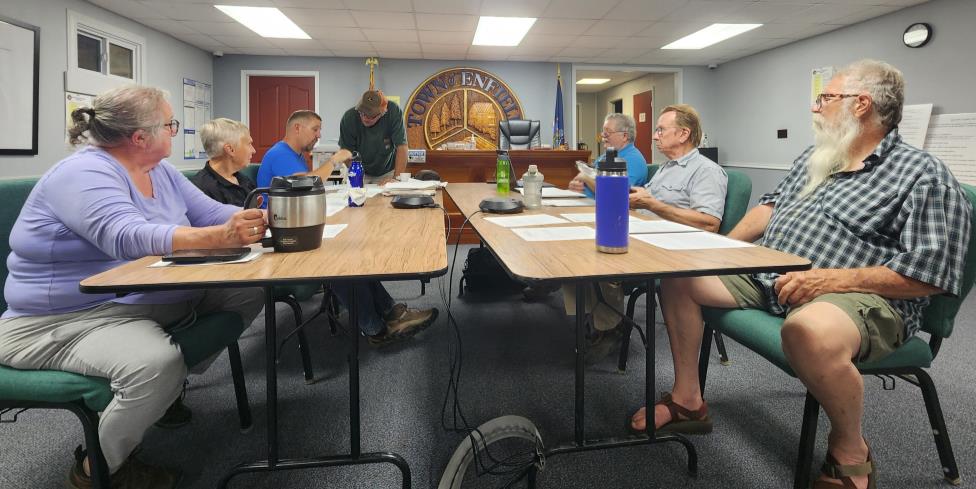
“We don’t have no zoning and we don’t have no money, and big companies come in here and they look at us and (it becomes) 100 percent an easy target; that’s what Enfield is,” Planning Board member Rich Teeter remarked near the close of planners’ August 5 meeting. It was one at which the Town Planning Board granted agents for Verizon Communications permission to erect a new, 170-foot free-standing tower at 217 Van Dorn Road North.
Verizon would hop its antennas to the new tower from an existing one that stands only a few tenths of a mile away. And it would do so for only one reason: to save money.
That said, expect the rules to change. Because Enfield officials concede that the current paucity of regulation constrains their ability to deny a tower outright or to impose wise, common sense limits, they’ve instructed the Planning Board to recommend—and for the Town Board to subsequently consider—amendments to the town’s Site Plan Review Law. The changes would not halt this latest structure. But they could curtail excesses when the next tower applicant comes along.
In a resolution adopted unanimously at its meeting August 12, the Enfield Town Board directed the Planning Board “to draft and recommend appropriate amendments to the Town of Enfield Site Plan Review Law that would establish new and heightened standards of review for the approval of communications towers and other commercial development within the Town.”
The Town Board’s Resolution adds that “such standards (are) to include, but are not necessarily limited to, those of structural height, lot line setbacks, lighting, liability insurance, and tower decommissioning.”
The Town Board’s resolution called upon the Planning Board to hand up its recommendations within six months.
Back in early February, Tony Phillips, Director of Zoning and Permitting for Verizon’s Agent, Kendall Communications, first approached the Enfield Planning Board about building a new cell tower. Phillips also represents Harmoni Towers, the firm that would construct and own the new tower and lease tower space to Verizon.
Phillips and his nationwide carrier made no apology about their motives. Verizon already serves that section of Enfield adequately. The only beneficiary from jumping towers is Verizon’s bottom line.
“Their rates are going up and up and up exorbitantly on the existing tower,” Phillips complained August 5 about the current tower’s owner from which Verizon leases. “They charge you every time you touch the tower. You want to do any kinds of upgrade on your equipment, the rent goes up,” he said.
Phillips described construction of this new, second tower, as part of Verizon’s “High Rent Relocation Program.” Phillips had no precise figures for planners August 5, but he at first suggested that the site move could save the carrier a half-million dollars over Verizon’s 30-year lease. Then he estimated annual savings might be as much as $50,000 to $100,000. His numbers were guesses.
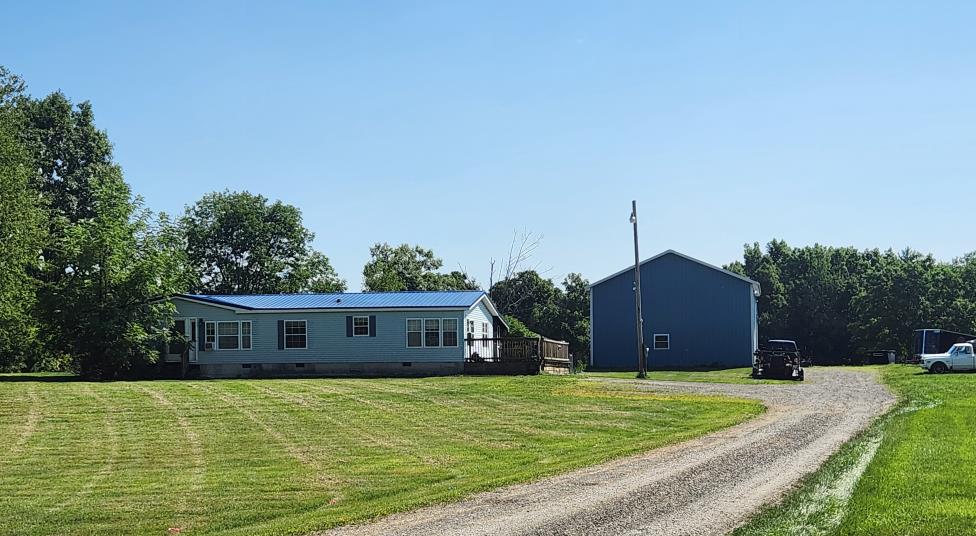
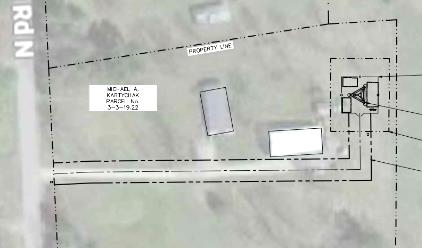
Verizon’s builder would place the new tower on a large lot owned by Michael and Jamey Kartychak at 217 Van Dorn Road, just north of Hayts Road. Initially, Phillips and his companies had planned to put the tower close to the road. But under Planning Board pressure last winter, the Harmoni site was moved to a spot behind the Kartychak house and shed, close to the owners’ rear lot line.
It took months for Phillips’ company and Verizon to get their paperwork together. Finally, on August 5, the public got to speak and the board to act.
“We’ve already got a tower that’s right next door to me,” Kathleen Smith of 253 Van Dorn Road, told the Planning Board at the early-August Public Hearing. “This is the first I’ve heard about it,” Smith complained. She’d only learned of the plans after the applicant had days before the hearing mailed out the required written notifications to neighbors within a half-mile radius.
Of any neighbor who addressed the meeting, Smith was most passionate.
The tower “can affect property values up to ten percent,” she insisted. “It can affect health concerns, environmental concerns, and noise,” she alleged. Smith maintained that the existing tower emits “humming and beeping noises,” to which she added, “and they don’t come fix it for months.”
“Why do we need one right after another, right next to each other?” Smith questioned. “I think they’re taking advantage of a poor rural location, thinking that nobody will say anything; we’ll just shove in another one,” she asserted. “I highly object.”
This Enfield Councilperson, Robert Lynch, also weighed in. Living nowhere near either tower, but having followed every step of the process, this writer questioned the alleged “hardship” Phillips had claimed his client suffers.
“What we’re dealing with here is not a matter of hardship,” this writer stated. “We’re dealing with corporate greed, and that’s what’s going on here… This is about money. And it’s also about playing Enfield as a patsy.”
The Councilperson cited published figures reporting that Verizon’s current CEO, Danial Schulman, earned $34.3 Million in 2025. Schulman’s predecessor, Hans Vestberg, earned $31.18 Million that same year and $24.16 Million the year before. Lynch also noted that when Schulman was lured away from PayPal last October, he crowed that his strategy was to “reduce our cost to serve” and to “deliver sustainable long-term growth for our shareholders.”
“What the CEO of Verizon makes is totally irrelevant to this conversation,” Phillips later countered. “Nobody questions what other CEO’s make for other companies or your president or anybody else,” the agent maintained. “For them to make their property profitable should be congratulated,” he insisted.

“If trying to make money is bad, then I guess I’m living in the wrong place,” Phillips remarked.
About a half-dozen Enfield residents addressed the Public Hearing in-person or online. Some raised questions. Others were ambivalent. “I don’t use Verizon,” Janice Wetzel remarked, “so I have no interest in Verizon putting the tower up.”
Kevin and Wanda Fenton own property closest to where Harmoni would build. If the tower tumbled straight over, it would land in the Fenton’s’ vacant woodland.
“You want to put a tower on it, have at it, buddy,” Kevin Fenton told Verizon’s agent. “As long as you keep it off my property,” he warned. He’d found surveyors’ stakes close to his boundary. “If this tower falls on me, I’m going to sue somebody, anyway,” Fenton said with half a chuckle. He walked out.
The Kartychak’s, owners of the newly-approved site, did not attend the Public Hearing. Nor have they attended any prior proceeding.
Even before the Town Board adopted its Resolution of August 12—one week after the Planning Board had granted Verizon’s request—Planning Board Chair Dan Walker had offered how he’d amend the rules. Walker would add to the Site Plan Review Law the new stipulation that:
“All towers or structures greater than 50 feet tall shall be set back a minimum of the structure height from the lot line of adjoining parcels including road Right of Way lines.”
The current Site Plan Review Law demands that any new commercial or industrial building provide at least 50 feet of clearance to a neighbor’s lot line. But in reviewing prior applications for new towers, Enfield planners had traditionally advised applicants to provide an additional “fall zone” equal to the height of the tower. The fall zone would assure that were a tower to tip over, yet remain intact, all debris would rest on the applicant’s own land and not on somebody else’s.
In this instance, the latest Verizon proposal fails the fall zone test. To fit the tower between homeowner Michael Kartychak’s buildings and his rear lot line, the new tower would barely clear the 50-foot requirement, let alone the 170-foot fall-zone allowance. The applicant’s engineers predict that were their tower to fall, it would crumple upon itself.
“I don’t think it’s great being on a small piece of property the way it is,” Planning Board member Teeter acknowledged. “But unfortunately our laws only restrict us to do so much without putting the Town itself into a legal predicament,” he lamented. I’d prefer it in a field, he said.
“But we are where we are,” Walker answered.
And that’s the dilemma Enfield Planning Board members faced. The “fall zone” precedent is not yet grounded in the law. When planners in recent months had raised the fall zone issue to the cell company’s agent, the agent had balked. Tony Phillips had asked Walker to cite the regulation he sought to enforce. Walker could not. Planners came to realize that “going rogue,” enforcing rules that don’t exist, carries the risk of litigation.
“In a situation like this, where a planning board in a town that has no specific regulations saying that something can’t be done, it seems to me that we have to have some kind of pretty solid, weighted evidence to deny something happening that doesn’t go against any of our policies,” Planning Board member Michael Carpenter observed August 5. “Legally, we’re bound to follow the law,” he concluded.
Carpenter at one point asked whether planners could employ “Section 18” of their mandated environmental review, the evaluation of whether a tower is “consistent with community character.”
“Is it inconsistent with community charter there?” Walker rebutted as to the permit just approved. “There’s another cell tower 2,000 feet away. So that’s the community character.”
“I’m sure that if you took this tower into two thousand towns in upstate New York you would not get approval in every one of them,” Carpenter predicted. Some would say “community character” dictates one tower as sufficient; but two towers as “way out of line.”
The Planning Board had already voted. The matter was dropped.
Carpenter tossed out another thought. If Verizon’s saving so much money, could it rebate some of those savings to neighbors as compensation for their sacrifice, as a “gesture of good will?”
Phillips brushed aside the idea. “That’s not something they normally would do,” he said.
Planners admitted to themselves that Enfield’s lack of zoning—restrictions members made clear they have no desire for the Town to enact—cripple their ability to stem the proliferation of cell towers.
“We have an open field in Enfield,” Board Chair Walker surveyed the regulatory landscape.
“Should towers be approved just to save corporations money, or should they be approved on an as-needed basis?” Board member Henry Hansteen asked.
“Unfortunately, that’s why you have one gas station on one corner and another on the other corner,” Rich Teeter answered. “It’s a necessary evil.”
Tony Phillips predicted construction of Verizon’s new tower wouldn’t happen for at least a couple of months. But it will likely occur before winter; if not by then, then in the spring. And should all carriers vacate the existing Van Dorn Road tower and migrate to the newer, cheaper one, Enfield rules make no provision for the old tower coming down.
“I know it’s not good to look at,” Tony Phillips admitted about a cell tower at one point during the discussion, “but eventually you don’t even notice that it’s there,” he insisted.
We’ll see. Tweedledum will soon join Tweedledee.
###