

Recast ICSD Board orders tighter student cell phone rules
by Robert Lynch; July 23, 2026
For starters, know this: The words played to sympathetic ears. The six Ithaca Board of Education members who late Monday convened and voted to revise the district’s smartphone policy were those who’d called for the hurried, special meeting only three days earlier. They wanted change. And the three who’d declined to meet and revisit the guidelines either didn’t attend the July 20 session or else had left before the vote.
School Superintendent Dr. Luvelle Brown wasn’t there either. Neither were students. And aside from this writer, no one from the general public bothered to show up. Everyone in the room was either an elected representative or a district employee, including the president of the Ithaca Teachers Association. So how Monday’s decision will play to the broader community remains for later discovery.
But here’s what happened. After a rambling, sometimes circular talkathon that lasted almost two hours, the Board of Education directed the Superintendent of Schools to tighten—and toughen—the Ithaca City School District (ICSD) one-year-old regulations that were supposed to sever students from their cell phones during classes… but never really did.
By a vote of five-to-nothing, with one abstention, the Board adopted a Resolution this week. It “direct(s) the Superintendent to revise the practice of the Ithaca City School District to require that students’ phones are inaccessible during the school day.”
Additionally, the adopted Resolution “direct(s) the Superintendent to revise disciplinary approach to have the immediate removal of phones from students who have them out during the school day.”
“Teachers are not teaching; they’re policing,” Board member Todd Fox framed the problem that day.
Newly-elevated Board Vice President Jacob Shiffrin, a prime architect of Monday’s resolution, put it this way: “You’re less likely to drink alcohol if you don’t have it on you, ” he said, equating youthful, never-ending cyber-addiction to worshiping the bottle.
“We are allowing students to have addictive devices on their person,” Shiffrin asserted, “which I think, teachers aside, that sucks for kids.”

“Get the cell phones out of the hands of the kids,” Sara Garner told colleagues at the meeting, her voice rising to make a point. “I don’t care if they go in lockers. I don’t care if they go in pouches, or in an office that’s locked for the day,” Garner said. “How much time is wasted from teachers’ micromanaging the situation, which is not why they became teachers?” she asked.
And that’s the problem as a newly-formed majority of the Ithaca school board views it. All too often this past year, instructors have become smartphone traffic cops. And when they’re enforcing edicts, they can’t be imparting knowledge. Instructional momentum gets lost when the teacher must command, “Emma, put away your phone; you know the rules.”
In January 2025, Governor Kathy Hochul proclaimed a bell-to-bell ban on student smartphone use throughout New York State. The Senate and Assembly quickly gave the edict legislative weight. Forced to comply, the ICSD purchased on short notice $20,000 worth of Velcro phone pouches for each of its secondary students to keep and use.
Once inside the pouch, a phone supposedly cannot receive incoming calls or data. But loosely-interpreted district policy still allowed students to place their safely-pouched phones within their backpacks, pockets, or lockers. Where else could they go? Compliance hinged on the honor system, supplemented, of course, by teacher oversight.
The Biblical admonition of, “Lead us not into temptation” quickly informed self-discipline.
Shiffrin condensed present policy to bumper-sticker simplicity: “Hey, students, do a socially unacceptable thing, which is to put your phone in this stupid pouch, keep it in your backpack, and resist the temptation for eight hours. I think that’s unreasonable to expect of students.”
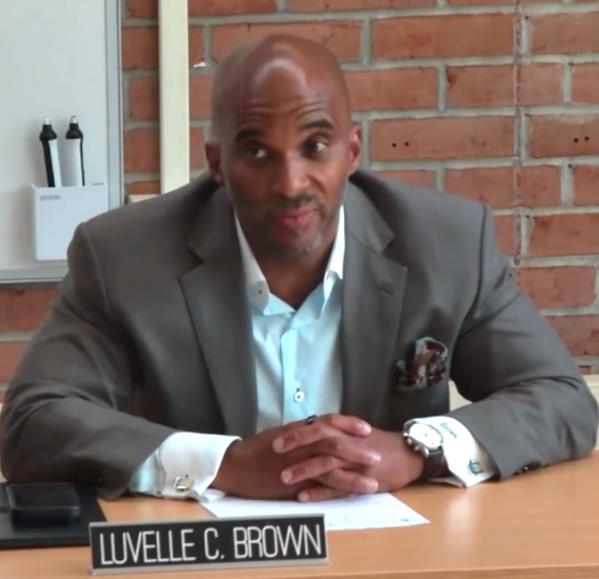
To the board vice president, putting trust in the peer-pressured, cyber-habituated Gen-Z high schooler’s self-restraint overstates expectations.
Emily Workman would elevate enforcement over logistics. The one change Workman would prioritize, she said, is “holding the people who are supposed to be holding students accountable to not using their cell phones to actually holding them accountable.”
And to Workman’s point, lack of accountability is where this school board’s new working majority believes current policy has fallen into a pit.
In August of last year, to comply with Governor Hochul’s mandate, the ICSD adopted “Policy 5695.” It’s a three-page list of rules and expectations that discipline student cell phone conduct. Critics view the punishment plank of that policy as timid, offender friendly, and forgiving to a fault. It has no teeth. It leads the cynic to question, “Who’s in charge here?”
Under it’s “Interventions and Responses” section, Policy 5695 states: “The Superintendent shall emphasize equitable, restorative practices when enforcing this policy and ensure that responses considered punitive in nature do not disproportionately affect protected groups or exacerbate inequity.”
And the paragraph continues, “No student will be suspended if the only reason for taking such action is the student’s violation of this policy.”
Undergirding Policy 5695 as its enforcement tool is the “Internet-Enabled Device Implementation Overview,” posted on the ICSD website. It defines a “common set of tiered responses” the policy will employ to address violations.
As a “First Reminder; Relationship-Centered Response,” the guidance directs that the student, after taking out a phone, is “respectfully reminded in private of expectations.” The first encounter expects voluntary compliance. If he or she obeys, the matter ends.
“If behavior continues,” the guidelines’ second-tiered response then instructs, “an educator involves an administrator to take the device until the end of the day.” And, “An administrator holds a restorative conversation to explore causes and co-create a support plan with caregiver (i.e. the parent).” Tucked between those words, in the minds of many, lies the ooze of disciplinary surrender.
Policy 5695 grounds itself in numerous references to “restorative justice,” instead of punishment. The “Restorative Justice” principle has found favor among several of the ICSD board’s progressive members and the Superintendent. Former Board President Dr. Sean Eversley Bradwell had lauded the principle with special praise.
But Eversley Bradwell is gone. He retired last month after 17 years of service. Disciplinary pragmatists like newcomer Sara Garner and returning member Dr. Jill Tripp have taken his place.
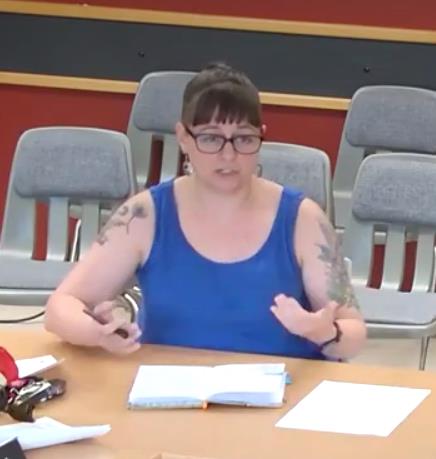
“The primary concern of teachers is not necessarily the policy as it is written, but in the implementation,” Kathryn Cernera, President of the Ithaca Teachers Association, Ithaca’s instructional union, informed the school board Monday. No one at the board table disagreed.
“After that gentle reminder, then what?” Cernera asked, stepping off from the policy’s first violation response to its second.
Wordsmithing the resolution in real time Monday—with numerous starts, stops, and erasures—the board briefly included—but then dropped—a directive for “the Superintendent to give a status report on the ban implementation for the first four meetings (presumably of the school year) as pursuant to board guidance.” In short, Dr. Brown, how are you enforcing what we’ve ordered?
Written marching orders or not, the tone of Monday’s talk carried a clear message that the board will demand those periodic updates into the fall.
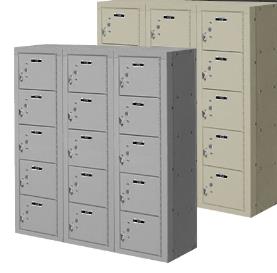
Todd Fox walked into Monday’s meeting with an idea. It never reached the resolution stage. Some who sat beside him that day saw it as a bit much—at least for now. Fox, the board member most insistent on keeping phones from kids as they learn, would have the ICSD procure small, “digital lockers” into which students would place their phones daily and secure them there, arrival to dismissal. Some, more expensive, locker technology would allow administrative oversight.
“This to me is going to be better than what we have right now,” Fox argued. Others pushed back.
Jill Tripp saw the locker concept as “a bit premature.” She also cautioned that it “does not go quite far enough.” It doesn’t cover electronic notebooks and computers. (Still, lockers that are large enough could handle larger devices.)
“There are so many other ways that those brilliant young minds are taking devices into schools,” Emily Workman counseled; pockets, backpacks, all sorts of ways “Teachers will still be dealing with this,” she cautioned.
Workman called for more data before deciding. That may have been one reason she abstained in Monday’s vote. Workman also stood skeptical of quick-fixes, like lockers.
“I want to make progress instead of just having data overload,” Fox responded. And even if the solution takes away only “97 percent of the problem,” Fox pointed out, it leaves just three percent of violations to deal with thereafter.
When Todd Fox had earlier raised the locker idea during the previous Friday’s Organizational meeting, Superintendent Brown was hesitant. Too little time; too much policy change, Brown argued. The start of school is only seven weeks away.
Yet lockers are available right now online, supposedly for immediate delivery. And a cabinet of 15 lockers can be bought for as little as $300. That’s small change for a district with a $177 Million budget and a problem to solve.
“There’s nothing magical about the first day of school,” Jill Tripp pointed out. New procedures could launch a few weeks late.
Given Workman’s abstention, the policy change adopted Monday passed with just the bare minimum number of votes.
Only seven of the board’s nine members attended Monday’s meeting. Karen Yearwood and Erin Croyle, two members who’d most likely be skeptical of any change in current policy, couldn’t make the meeting.
Garrick Blalock, who’d also opposed holding the emergency cell phone discussion, spoke little on the phone policy Monday. Blalock focused his attention on a second matter discussed at the meeting; a major commercial tax abatement. Blalock left early, before the cell phone vote came up.
“L.A (Los Angeles) has banned all electronic devices up until second grade,” Fox noted. (What’s more, that west coast school system has capped electronic device use for students in upper grades as well.) But even Fox isn’t prepared to reach that far; not yet.
Nonetheless, unless the political winds blowing through the ranks and rooms of the Ithaca City School district’s new-found, no-nonsense Board of Education majority shift radically between now and September 8—that’s the first day of school—phone rules soon will change. Pouches may go. Something else—whatever it is—may take their place.
And during class, between classes, and even at lunch, the Internet-to-the-world smartphone to which so many babies of the 21st Century have known for as long as they can remember may stand out of reach for an eternity—you know, for seven or eight hours.
“It’s going to be hard for the first couple months until people get it, that Ithaca’s serious about putting phones away,” Sara Garner said before she voted. I know, “you want tour phone.” Still, “Put it away.”
###