
by Robert Lynch; July 29, 2026
Coincidence or not, I instantly sensed the odor. As I walked up the first flight of stairs to the Tompkins County Industrial Development Agency (TCIDA) suites within the Seneca Street high-rise that used to house the Tompkins Trust Company’s back-end offices, I smelled what any retired “chain pounder” can recognize from first day on the job until death—“quench oil,” the petroleum derivative used to cool links of chain in the heat treating process. I recall it from when my late father, Morse Chain’s one-time electrical foreman, would sneak me into the factory occasionally on weekends back in the sixties. The unmistakable fragrance permeated the place. How the smell wafted its way into the Seneca Building stairwell this more recent morning I’ll never know.
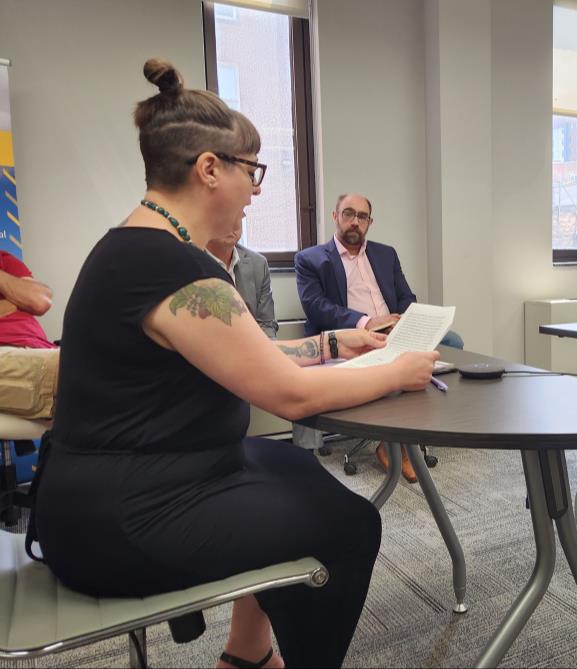
But appropriate it was. I and a handful of others, including at least two from the press, were there for a public hearing. It’s the kind of legally-required testimony-taking session the TCIDA often holds with little if any attention.
But indeed, there was attention this time. And most of the comment wasn’t all that nice. A developer wants to build apartments on part of the long-vacant Morse Chain/Emerson Power Transmission site on South Hill. And it wants a TCIDA-approved tax abatement to boost profitability.
What’s made controversial the 230-unit development by Beacon Communities, LLC—a subset of the larger SouthWorks undertaking—is the recent intervention by the Ithaca City School District (ICSD) and specifically its Board of Education along with its instructional union, the Ithaca Teachers Association.
“Ithaca has a need for the development of safe, affordable housing for our working families,” Teachers Association President Kathryn Cernera acknowledged as she addressed the TCIDA’s July 29 hearing. Yet, she added, “I am here today to urge the IDA to strongly consider the impact the tax abatement the developers of the SouthWorks project are requesting would have on our schools and our community as a whole before making any decision about this project.”
Wednesday’s hearing came two days after the ICSD Board of Education released a more than 600-word, bullet-pointed letter to the agency, urging it to “pause this project until the (letter’s many) questions can be investigated.”
“I’m not for or against this project,” Ithaca School Board member Garrick Blalock, a prime architect of the letter, testified at the hearing. “I’m for making an informed decision with properly studied numbers.”
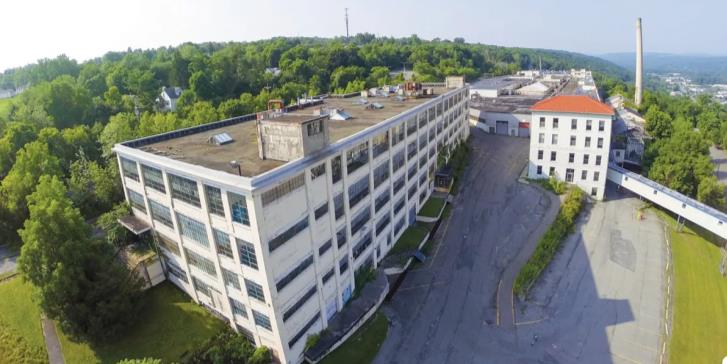
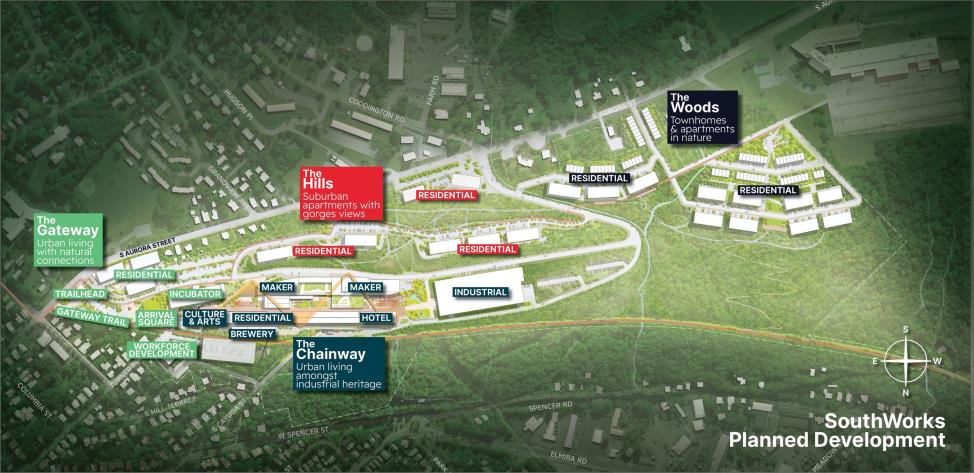
The proposed Beacon Communities housing project comprises only a small slice of the giant “SouthWorks” redevelopment of the Morse Chain/ Emerson Power Transmission site. Local developer David Lubin, partnering with a Philadelphia-based development firm, has planned for more than a decade to transform the sprawling industrial site into a mix of housing and light industrial uses.
Retrofitting portions of the old factory will likely come later. Building new housing on portions of the factory’s unused former parking lot and open areas, one would judge, becomes the more expedient—and lucrative—first step. It’s the lowest fruit that hangs around old Mr. Morse’s plant right now.
What Beacon and the TCIDA propose is a 30-year abatement of property taxes. Approval of the requested Payment-in-Lieu-of-Taxes (PILOT) agreement would be coupled with agency-authorized relief on sales and mortgage recording taxes.
Following the 40-minute hearing’s conclusion, the agency took no action. But it could make decisions as soon as its next regular meeting, set for August 12.
TCIDA filings price the ten-building, 230-unit housing project at $177 Million. Its development would cluster on two portions of the SouthWorks site, known operationally as “The Woods” and “The Gateway.”
“The Gateway” would construct 100 apartments in two, low-rise buildings within the City of Ithaca. “The Woods” would place 130 additional units in a cluster of eight, townhouse structures, located in the Town of Ithaca. Both Beacon developments would target tenants earning 50 to 80 percent of average median income. The projects therefore meet the definition of “affordable housing.”
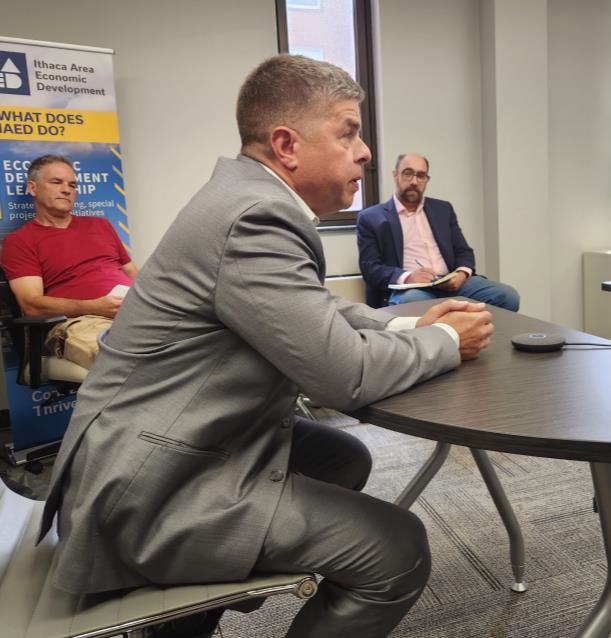
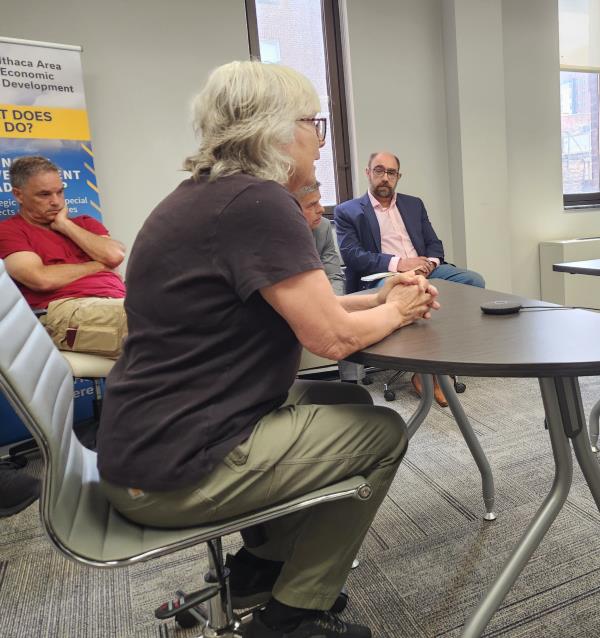
Beacon Communities sent no representative to the TCIDA hearing. No description of project details was offered hearing attendees other than the legal notification read by Agency officials. Only three of the TCIDA’s seven members attended Wednesday’s hearing, each sitting at the board table along with agency Interim Executive Director Kurt Anderson and the agency’s clerk.
Six people, several of them prominent in the community, addressed the TCIDA in-person at the Wednesday hearing. All but one of them questioned granting Beacon Communities its requested abatement without further study. Two of the five were Ithaca Board of Education members. A third board member, Sara Garner, attended the hearing, but chose not to speak. Those who spoke said they represented themselves.
Eight more people submitted written comments. Each letter was either critical of the abatement or sought answers to questions. Those at the board table took turns reading the letters.
Ithaca Board of Education member Jill Tripp referenced the letter sent the agency by the full Ithaca Board. “I believe it shows that the information you’ve been provided by the developer is not sufficient to make this scope of a decision on the project,’ she stated.
Tripp cautioned the agency that the 30-year abatement’s duration “is approximately or close to three generations of school children.”
“That is a lot of people over a lot of time to go forward when you don’t have what you consider to be sufficient numbers to explain exactly how much that (the abatement) will cost the Ithaca City School District and the Ithaca School District taxpayers,” Tripp testified. Approving the abatement without knowing the facts first, she said, would be “irresponsible.”
As discussed more extensively at a Board of Education meeting July 20, the ICSD’s elected leaders worry that a PILOT agreement to Beacon Communities—and more generally to SouthWorks overall—starves the school system of revenue while likely importing more students for the district to teach.
Nobody’s put a firm number on how many additional pupils might enter the district. Not every one of the 230 newly-arriving “Woods” or “Gateway” tenants would bring with them one or more children. What’s more, in some instances, families would relocate to Beacon’s housing from other homes in the district.
At the July 20 meeting, school board member Blalock quoted colleague Todd Fox, a housing developer himself, as estimating Beacon could bring “150 kids” into the district.
And as Blalock projected that day, assuming each student requires approximately $25,000 to educate, 150 new students would cost the district nearly $4 Million additionally each year.
“So this is a deal that’s going to generate $4 Million a year of added expense to us and bring in basically no revenue,” Blalock told school board members July 20.
Speaking to the TCIDA hearing Wednesday, Blalock kept projections more open-ended.
‘What are the right numbers and why don’t we have the right numbers in front of us?” Blalock asked the IDA. He noted that the school board and IDA officials met as far back as December 2024, albeit regarding the larger SouthWorks venture. And when they did, he said, all of the questions that are being asked now were also asked back then.
At the hearing, no one provided exact figures as what the 30-year PILOT agreement—as compared with normal, by-the-book taxation—might cost the Ithaca district in terms of lost revenue.
However, the ICSD Board’s July 27 letter projected that were the Beacon Communities’ project left without an abatement, the project would generate about $180,000 annually in school taxes, whereas a PILOT agreement “would presumably result in school taxes well below the $180k.”
“[W]hereas most TCIDA projects migrate to full tax bills after 7 or 10-year abatement, this project would pay little to no taxes for 30 years,” the Board’s letter asserts.
The Morse/Emerson factory has long stood vacant. Morse-Borg Warner first sold off the aging plant to Emerson Power Transmission when it consolidated operations at Borg Warner’s newer, Warren Road facility in Lansing. Emerson moved out of the South Hill plant in 2011.
Rich John recently retired as a Tompkins County legislator. As that legislator, he’d served the Industrial development Agency as its chairman. Speaking as a private citizen Wednesday, John offered the only meaningful support for the Beacon-SouthWorks PILOT agreements of anyone in the room. He was a minority of one.
“Get this derelict property back on our tax rolls. We spent a substantial amount of time studying this,” John reminded the hearing board. “We did our homework,” he said. “This is a great project.”

In the opinion of the former TCIDA chair, SouthWorks will bring jobs, job training, environmental remediation, economic revitalization, while “creating a brand new neighborhood in our community.”
“It’s very easy to say you support affordable housing,” John stated. “Everybody does, right?” he remarked. “But it’s ugly how it gets built,” he asserted. “And yes, taxpayers subsidize it. That’s the only way it will happen.”
“And if you want affordable housing for 30 years, you need a 30-year PILOT,” John insisted. “Otherwise, the developer doesn’t have to rent it as affordable, anymore.”
That said, what the majority of Wednesday’s speakers—and those who wrote the agency—want is better numbers, not necessarily to stand in the housing project’s way.
“I would just ask you not to buy what my grandparents referred to as a pig in a poke,” school board member Tripp told the agency. “And take a careful look at the real numbers that can be found out for this proposal.”
Wednesday’s hearing was efficient. Kurt Anderson kept speakers close to their strict three-minute time limit. The IDA had set aside an hour for public comment. The hearing adjourned 20 minutes early.
And as we left, I remarked to Rich John about the smell in the stairwell. He’s toured the Morse site more recently than have I. And yes, despite all the cleaning that’s been done, he says a faint whiff of that quench oil lingers. Old Morse Chain dies hard. It’s still fighting.
###