

Ruling on oil furnace, gas stove ban puts Hochul in a heat-wave bind
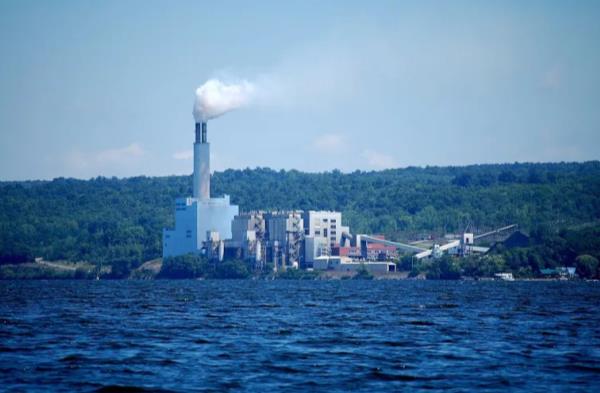
by Robert Lynch; July 3, 2026
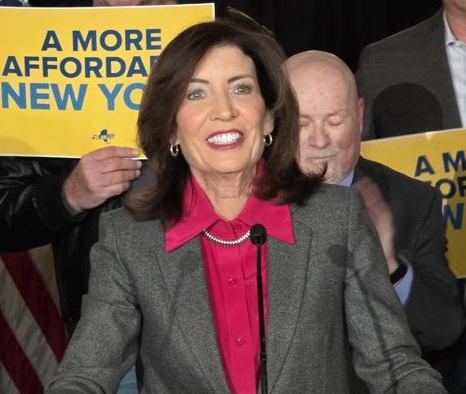
For New York Governor Kathy Hochul, the decision could not be more ill-timed. As an early-summer heat wave placed incredible strain on the Empire State’s power grid and prompted the governor to urge residents to set their air conditioner thermostats to higher-than-comfortable levels, the Second Circuit of the U.S. Court of Appeals has cleared away—at least for the moment—legal objections to an adopted state law that would mandate most new homes heat and cook only with electricity.
In a unanimous ruling June 30, a three-judge panel of the Second Circuit held that the “All-Electric Building Act,” passed by the Legislature, but with key provisions temporarily suspended by Hochul, does not violate federal statutes. Industry challengers had contended that the law’s sweeping powers were left reserved to Washington.
The holding puts Hochul in a bind because she must now decide whether to lift a stay that she’d placed on the New York law’s first phase of implementation. Its imposition would have banned oil, propane, or natural gas furnaces in most new home construction after December 31 of last year. The All-Electric Building Act would also have banned gas cooking ranges in those new homes.
Hochul’s delay of implementation, ordered last November, was based on her desire to let the legal challenges play out. Unless plaintiffs appeal further, her legal justification has ended.
Nonetheless, because the Second Circuit’s author acknowledges that her Circuit’s holding conflicts with that of another appeals court covering western states, that conflict may drive the U.S. Supreme Court to resolve the disagreement. The conservative-dominated High Court has proven more skeptical of environmental overreach than have some of its subordinate courts.
The three-judge decision could also face a mid-stop and be appealed to the entire Second Circuit panel of judges.
The Second Circuit holding, authored by Circuit Judge Myrna Pérez, a Biden appointee, dealt primarily with the plaintiff’s claim of what’s termed federal “preemption” of the New York law. Her panel’s holding affirmed Federal Judge Glenn Suddaby’s July 2025 ruling that the federal Energy Policy and Conservation Act (EPCA) did not preempt New York State’s authority to ban installation of fossil fuel heating systems and appliances.
The challenged law in question was one of those frequently-feared “dead-of-night” things; substantive regulation tucked into an overladen budget bill, in this instance in the spring of 2023. No one much noticed it then. As deadlines approached, they did.
As many as a dozen industry and labor interests, led by Mulhern Gas Company, LLC, had brought suit in lower courts and on appeal to challenge the law. Plaintiffs included the New York State Builders Association, the New York Propane Gas Association, and two local units of the International Brotherhood of Electrical Workers. Plaintiffs argued that federal preemption overrode the New York statute, as the New York law would “effectively set covered gas appliances’ maximum energy use to zero.”
“But the text of the preemption provision cannot support Appellants’ expansive construction,” Judge Perez wrote in her introductory paragraph. “EPCA preempts energy conservation standards for covered appliances and a fairly limited realm of additional regulations which operate in a similar manner,” she wrote. “The challenged laws fall outside of that realm.”
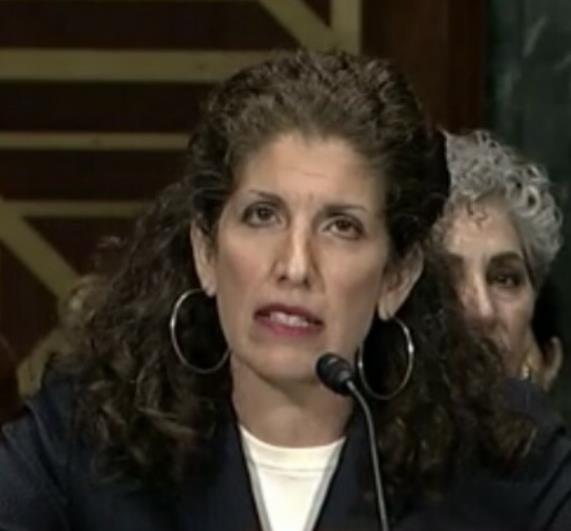
The appellate court ruling “is a welcome return to a commonsense understanding of state and local control over the homes we live in and the air we breathe,” said Dror Ladin, Senor Attorney for Earthjustice, an intervenor in the case on behalf of the law’s supporters, Nexstar television reported this week.
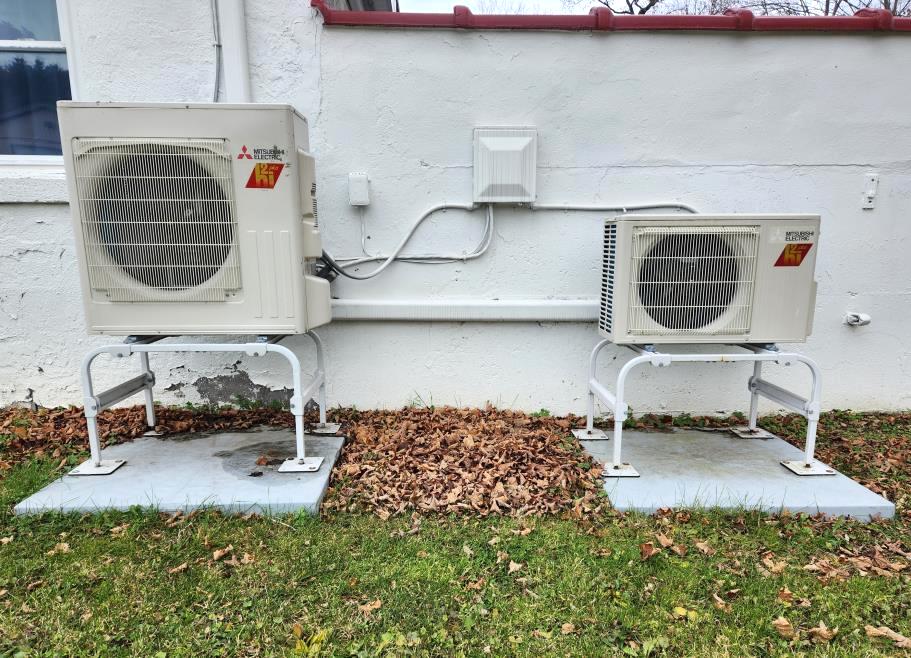
At its meeting last October 22, the Enfield Town Board adopted a resolution urging Governor Hochul to delay the law’s implementation on grounds that the local electric grid lacks capacity to handle the load that a rapid transition to heat pump technology would require.
Enfield’s urging followed related action by a Town Board in Cincinnatus, Cortland County. Cincinnatus had also urged that the electrification mandate be sidelined. But Cincinnatus would have Congress and President Trump enact and sign new laws that would have made federal preemption more clear-cut.
“The Enfield Town Board welcomes the intelligent, aspirational transition to renewable energy sources for home heating and associated energy applications, yet also recognizes the infrastructure limitations that currently impede total electrification efforts in rural communities such as its own,” Enfield’s request for a gubernatorial intervention stated last October.
Weeks after Enfield’s Town Board voted, Governor Hochul’s attorneys entered a “stipulation” in court postponing the state law’s implementation pending appeal. However, that stipulation was only temporary, not permanent.
The All-Electric Buildings Act would roll out in two phases. And it still may, although the legal obstacles could postpone deadlines. The first phase was supposed to ban fossil fuel heating and appliances in buildings that are under eight stories tall and built after December 31, 2025. There’d be limited exceptions. The second phase would expand the ban to all buildings of any height or size built after December 31, 2028.
Given that most buildings in rural Tompkins County rise to fewer than eight stories, the first deadline would have applied to most construction locally. The law carved out exceptions for hospitals, factories, farms and restaurants. And the statute only impacted new construction or major renovations, not routine replacements of oil furnaces or propane ranges when they simply wear out.
The Sierra Club and the American Lung Association had each submitted amicus briefs in the case.
“Burning fossil fuels, like methane gas, in homes, schools, and businesses is a threat to New Yorkers’ health and our climate,” Bridgett Lee, a Senior Attorney with the Sierra Club wrote in a statement the day of the Second Circuit’s holding.
But Judge Perez’s ruling stuck closely to the law of federal preemption, not to the health, economic or environmental arguments advanced by activists.
“These appeals concern whether [the Energy Policy and Conservation Act; EPCA] preempts state and local laws which prohibit fossil-fuel-powered appliances,” Judge Perez wrote. “EPCA, in relevant part, imposes energy conservation standards on covered appliances, and its preemptive text closely aligns with its affirmative regulatory scope. The statute does not directly regulate the availability of fossil-fuel-powered appliances, and its express preemption provision does not extend to laws far beyond its defined regulatory reach,” she stated.
“Thus, for the reasons explained below, EPCA does not preempt the challenged laws,” Judge Perez held.
The Second Circuit holding parsed statutory language, seeking contextual exactitude for otherwise commonplace words and phrases like “energy use,” “concerning, and “related to” as the federal statute employed them.
Perhaps easier to understand, the judge analogized the EPCA’s regulation of appliances to other federal laws that set national mandates for mobile homes.
“[I]t is plain that a federal statute that sets standards for the construction and safety of manufactured homes (i.e., mobile homes) does not preempt zoning regulations that ‘exclude mobile homes’ from certain areas,” Judge Perez wrote.

“We do not mean to minimize the overall impact of the challenged laws,” the judge acknowledged. “They will undoubtedly have an effect on the market for, and availability of, certain covered products” she wrote. “But that is irrelevant to the question at hand because the preemption provision targets regulations concerning appliances’ ‘energy use,’ not, as [industry and labor group] Appellants sometimes seem to suggest, regulations concerning the covered appliances themselves.”
“EPCA, a statute that at its heart promotes national energy conservation goals, does not preclude these particular state and local efforts to regulate the use of fossil fuels,” the Appeals Court concluded.
The legal snag that could propel the All-Electric Buildings Act to reach the U.S. Supreme Court lies late in the Second Circuit’s 46-page opinion, a complication that most other reports on this story have overlooked. The west-coast based Ninth Circuit, a court that claims equal standing with the New York-quartered Second Circuit, has ruled differently.
Two years ago, in a California case, the Ninth Circuit had before it the challenge to a local law that effectively barred the installation of natural gas piping in newly constructed buildings. Like the New York-based federal courts, the California trial judge had determined that the federal preemption under the EPCA did not apply. But on appeal, the Ninth Circuit held that it did.
Second Circuit Judge Perez acknowledged, “After much consideration of the statute’s text and relevant precedent… we conclude that the reasons for divergence are too compelling and reluctantly believe it necessary to create ‘a split among the Circuits’.”
Judge Perez wrote she’d prefer to side with a dissenting judge in that California dispute. But a “split among the Circuits” is one of the surest ways to invite SCOTUS to step in as referee.
As the All-Electric Buildings Act has received what may (or may not) be its final verdict, New York State wrestles with record-breaking early-summer heat. The electric grid is strained. Brownouts remain a possibility. And Governor Hochul finds herself urging air conditioner thermostats be inched upward.
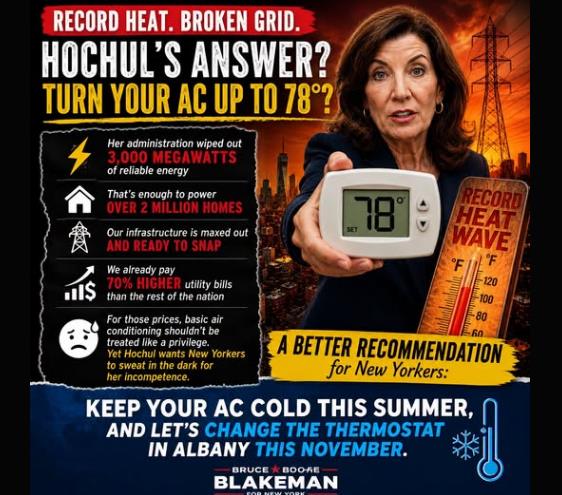
“My team has been coordinating with (electric utilities) and New York City leaders to ensure all large consumers able to switch to other fuel sources have done so to reduce their usage,” Hochul said in a statement July 2, released two days after the Second Circuit’s ruling came down.
“I am also calling on New Yorkers to do their part to proactively conserve electricity if safe to do so by setting air conditioning units between 75 – 78 degrees and avoiding unnecessary appliance use,” Hochul’s statement added. “These small steps can go a long way.”
So, to make matters clear, the governor is urging use of energy other than that generated by Mr. Ready Kilowatt, your power provider.
Critics, including Republican gubernatorial candidate Bruce Blakeman, have mocked Hochul’s recommendations. Blakeman says we need more fossil fuel plants instead.
And tellingly, Governor Hochul has announced absolutely nothing about whether she’ll lift that legal stay imposed last November and move to implement the All-Electric Buildings Act. Timing is everything.
###