

Tompkins County gives Dems landslide wins; Tenney, Langworthy, and (maybe) Constantino weather national Blue Wave
by Robert Lynch; November 5, 2026
Tompkins County has become downright predictable when it comes to local elections. If you were betting Polymarket and predicted Democratic victory percentages here of 75-80 in Tuesday’s election, you’d be going home with money right now.
Not one single upset occurred this past Tuesday in the elections for state or federal office that affect our area. Kathy Hochul won for Governor. Josh Riley secured his second term in Congress. State Senator Lea Webb and (uncontested) Assemblymember Anna Kelles were each returned to office. Democrats also won the smattering of municipal races locally within our county. If a Blue Wave impacted many other parts of our nation this Election Day, it didn’t just ripple here. One can safely say that for us, the Democratic-dominant storm waters simply kept rolling as they have for quite some time.
Still, just beyond Tompkins County’s borders, the waters of political change failed to capsize the ship of Republican incumbency. Trump-loyalist Claudia Tenney will return to Congress in the district that begins for us just north of Trumansburg and west of Buck Hill Road. The GOP’s Nick Langworthy will continue in the Southern Tier district that comes as close as Alpine and Odessa. And in the hard-fought North Country district where Republican Elise Stefanik has retired, another Republican, Anthony Constantino appears to have eked out an albeit narrow win to succeed her.
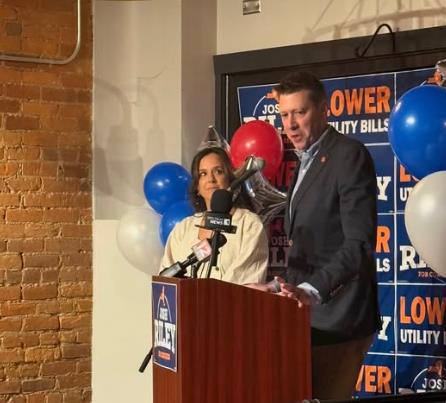
Riley’s Win: “The results tonight are a testament to the work we all, as a community, have done together over these two years, reelected Congressman Josh Riley said in his victory statement, reported by Spectrum News. “This has always been about bringing people together, rolling up our sleeves and getting stuff done for upstate New Yorkers.”
Riley celebrated his victory in Trumansburg election night.
Riley, a one-term, Ithaca-based Democratic incumbent, was expected to win his race over Republican State Senator Peter Oberacker. Months ago, the NY-19 District face-off between the two was seen as a bellwether race, a must-win priority for each party. But then Republicans pulled out their big money. It became a signal that Oberacker had little chance of winning.

Unofficial, district-wide returns, reported Wednesday evening, had Riley winning 166, 853 votes (56.4 percent) to Oberacker’s 124,343 votes (42.1 percent). [For this report, blank, voided, or write-in ballots often keep candidate totals from reaching 100%.]
New York’s 19th District spans all or parts of eleven counties. It stretches east to the Massachusetts state line. And it comes as little surprise that deep-blue Tompkins gave Riley his largest voter percentage. About 78 percent of Tompkins County voters cast ballots for Riley (27,592), compared to just under 21 percent (7,311 votes) for Oberacker.
But NY-19 is not deep blue everywhere. Of the district’s eleven counties, Riley prevailed in only six of them. They included the vote-heavy county of Broome. 38,667, or 56.6 percent, of Broome County’s votes went for Riley. Oberacker prevailed in the other five counties.
Josh Riley won voter majorities in Broome, Columbia, Rensselaer, Sullivan, Tompkins and Ulster Counties. Oberacker took majorities in Chenango, southern Cortland, Delaware, Greene and Otsego Counties. In the rural southern Cortland County towns, Oberacker secured nearly 60 percent of the vote. He got 57.3 percent in Chenango County.
In his concession statement, Peter Oberacker said, “I’ll keep fighting for Upstate New York, and I hope Congressman Riley joins me.”
Right now, however, Oberacker has little place to fight. To enable his run for Congress, Oberacker gave up his opportunity to stay in the Senate. Before redistricting at the start of this decade, Oberacker had represented portions of eastern Tompkins County, including Dryden.
It’s the third time Josh Riley has fought to represent the submarine-shaped southern tier 19th District. He lost narrowly to Marc Molinaro in 2022. Then he ousted Molinaro two years later. Now, he’s successfully defended his incumbency, an asset that gains value with each succeeding political cycle.
In declaring victory, Democrat Riley talked about working with his party’s newly-won majority to secure anti-corruption legislation. He said he’d like to eliminate corporate PAC s and impose term limits. Each objective faces its constitutional obstacles.
The reforms, Riley touted, “would ban members of Congress from owning or trading stocks because the focus in the work should be helping folks in the community, not lining your own pockets,” Spectrum News quoted the congressman.
State Legislature: More than three out of every four Tompkins County voters who participated in Tuesday’s election supported Democratic incumbent Lea Webb for a third term in the New York State Senate.
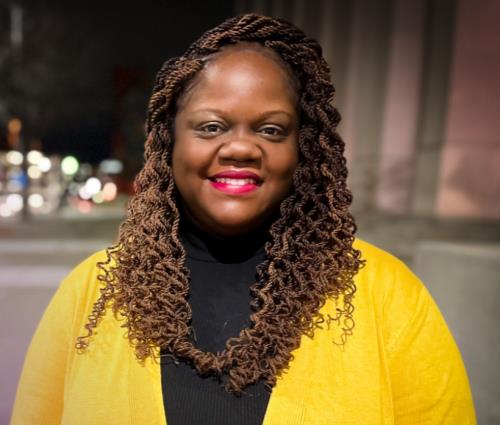
Webb’s Tompkins County victory margins were the highest of any in the three counties that the 52nd District covers.
Lea Webb won reelection districtwide with 59.6 percent of the vote (63,853 votes in total). Republican Michael Bolles, a Broome County-based political newcomer, got 41,565 votes (38.8 percent) districtwide.
In Tompkins County, Lea Webb secured a 76.2 percent majority (26,644 votes) compared to Bolles’ 23.7 percent (8,267 votes).
Lea Webb won her home county of Broome with 52.9 percent of the vote, but lost Cortland County to Bolles. It was close. Bolles polled 49.98 percent of the Cortland County votes, Webb 48.6 percent.
“It is a great honor to represent the people of Broome, Cortland, and Tompkins Counties,” Webb said via an Instagram post, reported by The Ithacan. “I look forward to continuing this work and ensuring that everyone in our district has a voice in Albany,”
Michael Bolles, a retired Binghamton firefighter and a 22-year Army veteran, announced his candidacy last March. He never faced any opposition within his own party, but found it hard gaining traction in much of Tompkins County. His campaign signs could be spotted in Dryden and Groton, but were almost nowhere in places like Enfield. In an earlier failed attempt to unseat Webb two years ago, Lansing Republican Mike Sigler’s signs were then more visible.
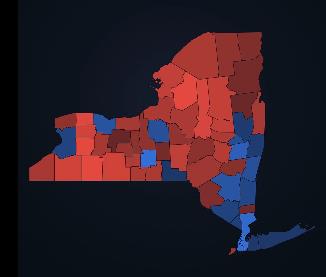
Lea Webb’s victory margin this year over Bolles was only a couple percentage points higher than that over Sigler in 2024.
The local contest for Tompkins County’s other state legislative office was uneventful. No one ran against three-term incumbent Democrat Anna Kelles this year. Accordingly, Kelles secured nearly every vote cast in the 125th District.
Other Races: Tompkins County elected a new County Clerk this year, Rachel Graham succeeds the retiring fellow Democrat Maureen Reynolds. Graham ran unopposed.
In the contest for Tompkins County Sheriff, incumbent Democrat Derek Osborne, also unopposed, won a new term with 98.8 percent of the vote.
Reflecting the gradual, state-mandated slide of municipal voting to even-numbered years, a few town-wide elections took place in Tompkins County Tuesday. The only contested races were in Dryden, where incumbent Democrat Jason Leifer won another term as Supervisor. James Ravo won for Dryden Town Justice.
Next door to Enfield, Michelle Wright won a Town Councilperson’s seat; Richard Goldman was elected Councilperson in Ulysses. Each candidate ran unopposed.
Some say Ithaca and Tompkins County comprise a deeply-Democratic political island surrounded by reality. If so, that reality begins just beyond the county line. Three congressional districts touch Tompkins County on the west and north. And in two of those districts Tuesday, incumbent Republicans won.
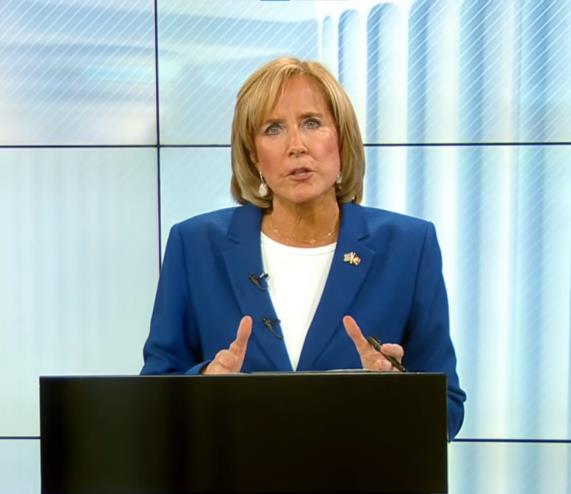
Claudia Tenney, nationally known for her undying support of President Trump, will go back to Washington to help finish Trump’s final term.
Republican Tenney bested her Democratic challenger, Alissa Ellman, by 20 points in the GOP-heavy 24th Congressional District. It’s a gerrymandered creature that bypasses Syracuse, Rochester and Buffalo, but otherwise slides along Lake Ontario’s shoreline and dips south to include Seneca County and also the Schuyler County Town of Hector.
“We have a lot of work to do as Republicans,” Tenney acknowledged in an election night victory post on Facebook, the Trump cheerleader fully aware that her party had lost its congressional majority.
“We have to regroup. We have to come back. We have to save this country. 250 years should not be the end of this country, though I’m a little worried,” the decidedly-conservative Tenney proclaimed, her partisan loyalties in full view.
Alissa Ellman, an army combat veteran who got cancer from the burn pits in Afghanistan, beat the disease back, only to then be downsized from her job at a VA hospital by DOGE, campaigned valiantly. She thought she had a chance at beating Tenney. Ellman fought hard in an October 20 debate.
But the 24th is a difficult district for Democrats to flip. It’s designed that way. Tenney won the race 171,460 votes (59.5 percent) to Ellman’s 112,261 votes (38.9 percent).
The 24th District includes all or parts of 14 counties. Tenney won all but one of them. And the one she lost, Ontario County, which includes the cities of Geneva and Canandaigua, she only lost by 92 votes.
In Seneca County, an Ithaca “exurb” to some extent, Tenney got 52.7 percent of the vote (6,220 votes), compared to Ellman’s 46.0 percent (5,433 votes).

For many of us, New York’s 23rd District can be imagined as Congressman Tom Reed’s old western Southern Tier stomping ground, only with Tompkins County now lopped off. It’s ruby-red, redder than even when Tompkins stood as part of it. Nick Langworthy is its Republican congressman now. Langworthy won another term in this week’s election. The Republican incumbent beat Democratic challenger Aaron Gies, 181,807 votes (59.4 percent) to Gies’ 119,749 votes (39.15 percent).
Langworthy handily won Chemung County, with its included City of Elmira; and Steuben County, where Corning is a part.
If there was an upstate House district that Democrats hung their hopes on this year it was Elise Stefanik’s North Country 21st. Democrats came close, but Republicans appear to have pulled off a victory this week.
Businessman Anthony Constantino, who made no apologies for his dogged loyalty to Donald Trump, secured a arrow, two-point victory over the Democrat, farmer Blake Gendebien. Unofficial tallies Wednesday, with all districts reporting, counted 140,119 votes for Constantino (49.86 percent) and 134,390 votes (47.82 percent) for Gendebien. The NY-21 race remained uncalled as of Wednesday evening. Gendebien had not conceded.
As some consolation for Democrats, one of the three districts that border Tompkins County did remain blue. John Mannion in the Syracuse-based 22nd district, which includes southern Cayuga County and much of Cortland County, held off a challenge from Republican Kailee Buller. Mannion’s victory margin was wide.
Tompkins County, as one would suspect, gave the victorious Democratic candidates for statewide office the predictable three-out-of-four margins of victory. Governor Kathy Hochul found support with 75.9 percent of Tompkins County’s electorate; Attorney General Letitia James also got 75.9 percent; and Comptroller Tom DiNapoli polled 78.9 percent.
By late Thursday, the Tompkins County Board of Elections had not posted town-by-town breakdowns of the countywide returns for Congress, State Legislature, or other offices.
###