
Negotiated, decade-long Haefele agreement would impose new, five percent franchise fee, to be passed to subscribers
by Robert Lynch; November 15, 2026
For the past 15 years, Enfield residents have avoided a town surcharge on their cable TV bills. And in the more than four decades since Haefele TV, Inc., the town’s franchisee, began stringing cables to Enfield households, the franchise fee has never been higher than one percent. That may soon change. It likely will. And if it does, it will change big time.
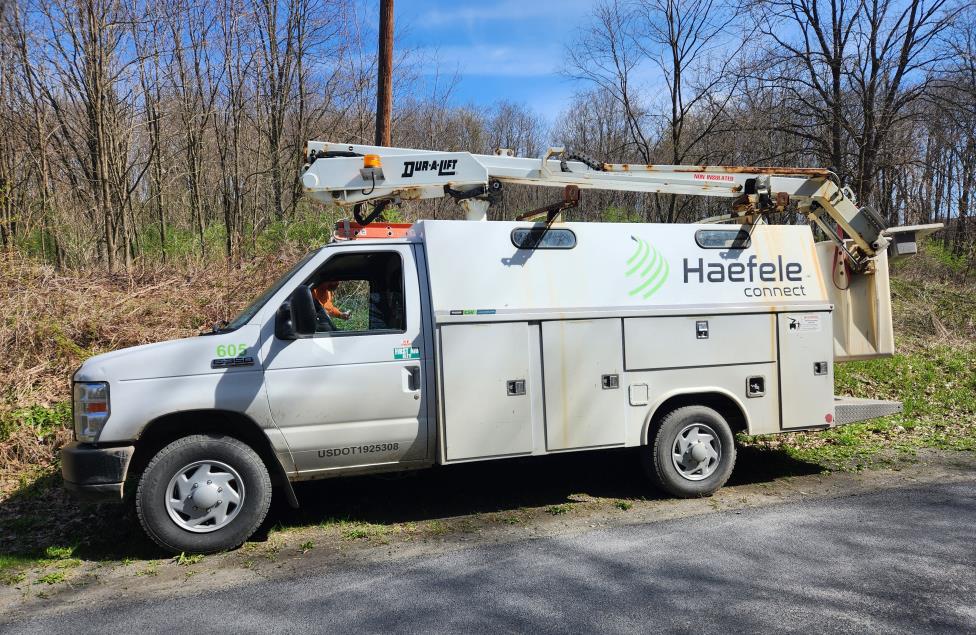
A long-delayed, attorney-negotiated ten-year franchise agreement, disclosed publicly for the first time at the Enfield Town Board’s meeting November 11, would impose a full five-percent franchise fee on Haefele TV, Inc. monthly cable television bills. The charge could begin later this year or early next.
A five percent fee is the largest percentage assessment the law will allow the town to impose, according to its negotiating attorney.
The Town Board set December 9 for a Public Hearing on the proposed 18-page Haefele contract. Board members said little about the draft agreement at this past Wednesday’s meeting. At least one board member reported he hadn’t yet seen the document. Town Supervisor Stephanie Redmond acknowledged she’d failed to circulate it to all board members.
Should the Town Board approve the agreement and impose the five percent franchise fee, Haefele TV would be under no obligation to eat the charges itself. It could pass the expense onto its cable subscribers. And the company president has assured us he will.
“Yes, it’s stated on the bottom of the bill,” company President Lee Haefele assured this writer in a phone conversation on Friday. The Enfield Town assessment will be passed through to cable customers, he said.
And Enfield’s draft agreement, scripted in legalese, acknowledges Haefele’s rightful prerogative:
“Nothing contained herein shall prohibit Haefele from collecting from its subscribers, by separate assessment, line item, inclusion in charges, or otherwise, the franchise fee applicable to Haefele under this Agreement or otherwise,” the agreement’s draft language states.
The five percent franchise fee would base itself on Haefele’s Enfield-based, cable TV gross revenues “derived from the operation of its cable system to provide cable service in the Town,” the draft agreement states.

“Gross revenues shall not include revenue from non-cable services, including internet or telecommunications services,” or other add-on costs like state and federal Universal Access fees, the draft document further specifies.
According to controlling law, the Town of Enfield can only assess franchise fees on the cable television portion of the Spencer-based firm’s local operation. It could not assess the five percent charge on customers who only access Haefele for broadband Internet or telephone service. Bundled services would need the segregate out the TV portion of the bill.
At present, Haefele’s advertised prices for cable television service range from $66 per month for “Lifeline Cable,” service—it provides just the four major networks and little else—to $156 per month for “Digital Cable,” its premium offering.
Most popular, no doubt, is Haefele’s “Basic Cable.” It includes such channels as Fox News and ESPN. Basic Cable costs about $131 per month.
So should Enfield impose its five percent franchise fee, expect Basic Cable’s charges, under the present fee structure, to rise by $6.55 per month. That’s $78.60 per year. Even “Lifeline Cable’s” annual cost would climb by nearly $40.
Yet that’s not the worst of it. Lee Haefele says factors beyond his—or the Town’s—control could raise fees still more.
Local stations, Haefele says, are bumping up their planned charges for cable systems like his to carry their programming. The increases could raise costs for those services by as much as 25 percent.
“It’s quite a jump there,” Haefele warned.
Add to that, the cable operator hasn’t yet received the projected cost increases demanded by the satellite-based subscription services his company accesses.
“We haven’t been very aggressive on pricing,” Haefele credits his company. As a result, he implied, it’s just not possible for Haefele to absorb the Enfield franchise fee assessment without a pass-through.
Among cable television services locally, Enfield stands as the outlier. In most of Tompkins County’s municipalities, the mega-provider Charter-Spectrum is the television franchisee. In Ithaca, what’s now Spectrum began in the 1950’s as locally-owned Ceracche TV. Ceracche got bought out by Time-Warner Cable. Time-Warner then got purchased by Charter-Spectrum.

But Anthony Ceracche’s cables never extended to Enfield. So in 1984, the Enfield Town Board contracted with Spencer-based Haefele TV, Inc. to provide local residents their first cable television reception. Haefele’s permission was granted as a “non-exclusive cable television franchise.” Yet no other larger or comparably-sized firm sought to muscle in and compete.
The December 1984 Haefele franchise agreement specified a limited service area extending along Route 79 from Rothermich Road east to the Sheffield Road, Ithaca/Enfield town line. It then wandered along Enfield Main Road (NY Rt. 327) from Miller’s Corners south to Harvey Hill Road. Service territory was supplemented by short excursions along several side roads.
The primary service area included just 321 homes. The 1984 agreement called for Haefele to provide seven, network-affiliated “basic” channels, plus four satellite-delivered stations and two premium channels (HBO and Cinemax). The original contract imposed a one percent (1%) franchise fee to be paid to the Town.
Subsequent franchise contract renewals between Enfield and Haefele were struck in 2001 and 2012. The 2001 renewal continued the one percent franchise fee, but the most recent 2012 renewal did not. The 2012 document provides no explanation as to why the local assessment was dropped.
Over the decades, Haefele’s service area has extended, little by little, to cover the vast majority of Enfield’s households.
The 2012, ten-year agreement lapsed in 2022, yet its terms continue to the present. Supervisor Redmond apparently overlooked the agreement’s expiration. It was more than a year after that expiration that the Town Board revisited the Haefele franchise.
Remember the April 2024 total solar eclipse? It was that far back—exactly two days later—that the Town of Enfield officially embarked on the current Haefele franchise negotiations.

On Wednesday, April 10, by a vote of three-to-one (Councilperson Jude Lemke was excused that night), the town board retained the Cohen Law Group of Pittsburgh and its principal attorney, Dan Cohen, to negotiate with Haefele on Enfield’s behalf. It was the first time in the history of these negotiations that Enfield had retained out-of-town counsel to handle the task.
“Getting outside expertise is just wise,” Supervisor Redmond argued before her Town Board that night. “When you’re not highly educated on the subject, you look for outside expertise. That is a matter of best interests of the Town,” Redmond maintained.
The Cohen Law Group’s flat fee was $8,900. The fee’s been paid. Given how negotiations have dragged out, Cohen Law may have lost money on the deal.
At the time it retained Dan Cohen, Supervisor Redmond and others on the town board were already eyeing the prospects of franchise revenues. They were talking annual sums of $50,000. In large part, that allure prompted them to go the lawyered-up route. The allure guides them still today. Not all on the town board agreed then, nor do they agree now.
“We talk about all these franchise fees,” this writer/Councilperson, Robert Lynch, reminded the Town Board that April 2024 night. “Those franchise fees get tacked onto the cable bill. They are nothing more than an excise tax. You’re not drawing this money out of the cable company’s own resources. You’re taxing our residents, and a very regressive tax to boot.”
This Councilperson’s position has not changed. When the Town Board this past Wednesday set the Haefele contract for public hearing, Lynch asked Redmond to read the hearing notice to assure him that it did not state or imply any particular board member’s endorsement of the agreement.
Already, some board members have talked about how to use the new-found Haefele money. One of those presumed uses was recently discussed in private session and cannot be disclosed. But Councilperson Lemke has speculated in past, public sessions that the franchise fee could accrue approximately $20,000 annually for the town. In fact, the board this fall had tentatively tucked that $20,000 into the 2027 budget’s revenue line, than pulled it back out when contract talks briefly appeared to have stalled.
Should the franchise fee win approval—as it likely will—no one has talked about using it for some special purpose; like reserving it to secure universal hard-wired Internet access throughout the town. Rather, the money would likely be applied to pay the general expenses of government.
But taxing hard-wired cable television has its limitations. Cable TV service has become a mature and dying industry. It’s like banking your future on dial telephones, manual transmissions, or crank-up car windows.
Remember that the fledgling, 1984, area-limited Haefele franchise had expected to serve 321 homes. Two years ago, when Dan Cohen was retained, Haefele’s Enfield cable TV subscriptions over a much wider territory had hovered around 300. Lee Haefele estimated Friday that they’d now dropped to about 241. “It steadily goes down,” he said of the TV subscriber base.
Moreover, Haefele indicated that those who remain on cable for TV service skew older. Younger viewers save money by streaming over the Internet.
As a result, of course, the five percent franchise fee disproportionately burdens Enfield’s graying population.
“We have invested in changing over to fiber-optic… we’re doing modernization,” Lee Haefele said in defending what his firm’s doing for Enfield. He said that Haefele in some instances is doing upgrades on which the big-boys elsewhere have dragged their feet.
For Haefele, the town board’s going out of its way to capture a few extra dollars from a dwindling subscriber base of perhaps 200—steps that included retaining a pricey Pittsburgh law firm—served little purpose. Lee Haefele or his designee plans to state the company’s case at the December 9 public hearing.
In other business before the Enfield Town Board Wednesday, November 11:
- The Town Board voted four-to-one—with Councilperson Lynch dissenting—to endorse efforts by the Lansing Town Board to, in Enfield’s words, “oppose or challenge the proposed TeraWulf Cayuga Data Campus through all lawful and appropriate means.” As it passed the resolution, the Enfield board also rejected, for lack of a second, Lynch’s proposed amendment that would have recast the resolution to couple data center opposition with language also urging reopening of the now-shuttered Milliken Station power plant, a facility on whose campus the data center would locate. [Expect more to be written on this action.]
- The Town Board ratified a proposed five-year renewal of its contract with the Enfield Community Council (ECC) to provide community and youth services in the town. The currently-expiring five-year contract provided two percent annual increases in Town support. The renewed contact raises those annual increases to an average of three percent, with a $2,000 funding boost spread between its two initial years. At Councilperson Lynch’s request, a clause was inserted into the agreement to condition its terms to the ECC’s continued ownership and maintenance of the Enfield Community Center, a former church acquired by the ECC in 2021, but whose ownership later became embroiled in litigation, a dispute purportedly settled earlier this year in the council’s favor.
- And acknowledging an unfortunate oversight in having scheduled its monthly meeting on Veteran’s Day, the Town Board joined Tompkins County in proclaiming November 8-14 as “Veteran’s Week” in Enfield. The resolution extended “an immeasurable debt of gratitude to the brave men and women who served in the United States Armed Forces, putting their lives on the line to safeguard our nation’s freedom, democracy, and values.”
###