
Enfield Board backs countywide beg-for–your-foodware law
by Robert Lynch; November 8, 2026
“I make my money from the mustard that people throw away on the sides of their plate.”
(Attributed to) 19th Century British mustard-maker Jeremiah James Colman
If a majority on the Enfield Town Board has its way, you might visit the drive-through, purchase your meal, then journey to the park to eat it, only to find you had no utensils or napkins because you hadn’t asked for them. There’d be no ketchup for your fries, either.
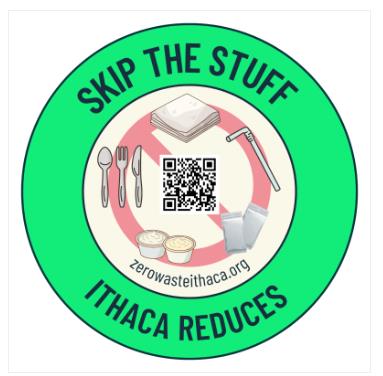
Welcome to the future; to the era of “Skip the Stuff,” a countywide minimalist initiative that the Enfield Town Board wants the Tompkins County Legislature to enact quickly. It probably won’t, at least not right away.
“There’s too much throwin’ away culture goin’ on,” Enfield Supervisor Stephanie Redmond observed October 14, invoking a hint of southern slang, as the town board debated Skip the Stuff that night.
By a four-to-nothing vote, with one abstention, the Enfield Town Board backed the Skip the Stuff crusade. It did so not knowing how many other local municipalities have already endorsed or will endorse the initiative or whether Tompkins County will ever make it law.
A few weeks later, advocates of Skip-the-Stuff revisited a county legislative committee. They got a lukewarm reception this past Thursday, even from a committee populated exclusively by progressive Democrats.
Enfield’s adopted Resolution, spoon-fed to it by an Ithaca environmental activist group, calls upon the Tompkins County Legislature “to develop and adopt a countywide ‘Skip the Stuff’ local law establishing a by-request-only policy for disposable foodware accessories provided with takeout and delivery orders.”
The Resolution recommends a new local law mandating that:
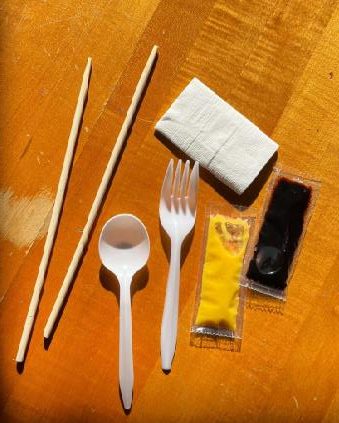
“Covered food service establishments shall not provide single-use utensils, including forks, spoons, sporks, knives, and chopsticks; beverage straws; beverage stirrers; or condiment packets with takeout or delivery orders unless the customer specifically requests them.”
“It seems very much like commonsense, but it really is a driver for economic and environmental care that we’re all concerned to improve on,” a Skip the Stuff advocate, Mary Cauchard, advised the town board August 12. It was the night that the crusade first traveled to Enfield.
Cauchard and her ally, Yayoi Koizumi, founder of the advocacy group “Zero Waste Ithaca.” spent nearly 20 minutes that August night briefing Enfield’s leaders on why foodware regulations would serve the community’s—and the planet’s—best interests.
According to Zero Waste Ithaca’s statistics, its conclusions based on a Cornell-aided study in 2023 and 2024, 54 million single-use foodware accessories are used in Tompkins County every year. They purportedly produce 350 tons of disposable waste.
“You can only imagine how much CO2 that is and how much that wastes in the hauling and the costs of garbage as well,” Cauchard told the Enfield Town Board.
But what the board’s majority finally adopted in October is far different from what Zero Waste Ithaca had initially pitched to the town two months earlier.
During their August briefing, advocates had pressed the Town of Enfield to enact a town-specific ordinance that would have banned unrequested foodware distribution within Enfield’s limits. There’d be local enforcement, and eventually, fines. Ignore the fact that Enfield has just one or two food establishments within its bounds. (Think, Dandy Mart.)
Ignore, too, the reality that policing the rules would likely have fallen to Enfield’s part-time Code Enforcement Officer, someone who has little time to double as a fast food traffic cop.

But the retooled resolution that Skip the Stuff promoters handed to Enfield leaders in September recommended only that the town lend its support to a countywide foodware-limiting law. Talk of a town ordinance had fallen away. The revised September endorsement is what the town board adopted a month later.
“Separate municipal requirements would create an unnecessary patchwork of rules for food service establishments, residents, third-party platforms, and enforcing agencies,” Zero Waste’s revised resolution draft explained away its change of mind.
“One countywide law would provide consistent requirements throughout Tompkins County, allow electronic ordering platforms to implement a uniform system, and ensure that residents and businesses in every municipality receive the benefits of waste prevention,” the revised and adopted resolution rationalized.
Resolution language makes clear that utensils, napkins and condiment packets could still be offered by take-out providers and with home-delivered meals. It’s just that purchasers would need to ask for them first.
In her presentation to the county legislative committee November 5, Cauchard advised that the Lansing Village Board had adopted a voluntary Skip the Stuff law in mid-August. Lansing may be the only local municipality to have done it so far.
The Skip the Stuff crusade isn’t exactly new. It’s been banging around Tompkins County government for a few years. Yayoi Koizumi first presented her proposal to a county legislative committee in June 2023. But in the three years hence, lawmakers have failed to advance legislation.
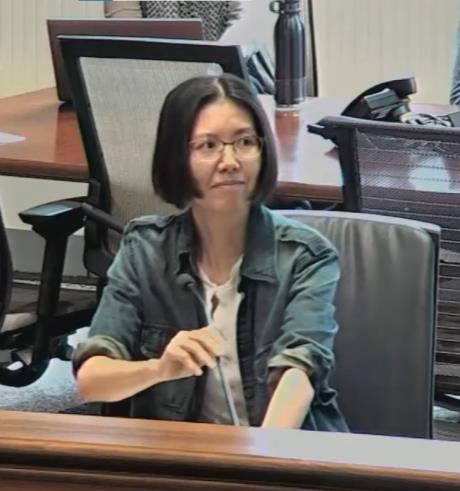
Nor did they do so this past week. That’s when Zero Waste’s true believers revisited the legislature’s Planning, Energy, and Environmental Quality Committee.
“Too often, disposable utensils, napkins, straws and condiments are provided automatically, whether customers want them or not,” Cauchard informed the county committee November 5. “It creates unnecessary waste and unnecessary cost… We’re asking for the next legislative step.”
That they were. And they were insistent about it. It peeved Koizumi.that the resolution Zero Waste had drafted and slipped onto the meeting’s agenda—apparently without its customary committee and administrative vetting— would not come to a vote that day.
“We’ve been working with this committee since 2023,” Koizumi reminded legislators. “Could the committee please clarify what remains to be done before this resolution can be brought to a vote? More importantly, can we agree today on the specific dates for that vote and identify who will be responsible for moving it forward?”
Committee Chair Irene Weiser answered Zero Waste’s founder:
“Firm date, probably not going to happen, simply because of how the government process works,” the chairwoman responded. And with that, Weiser’s reality check slammed head-first against Koizumi’s impatience. We write our own resolutions, the committee chair informed the activist. “Our process is deliberative.”
None of the six attending committee members—they include Enfield rep Rachel Ostlund—opposed the Skip the Stuff concept at last Thursday’s session. They just sought time to iron out the wrinkles, not the least of which is enforcement.
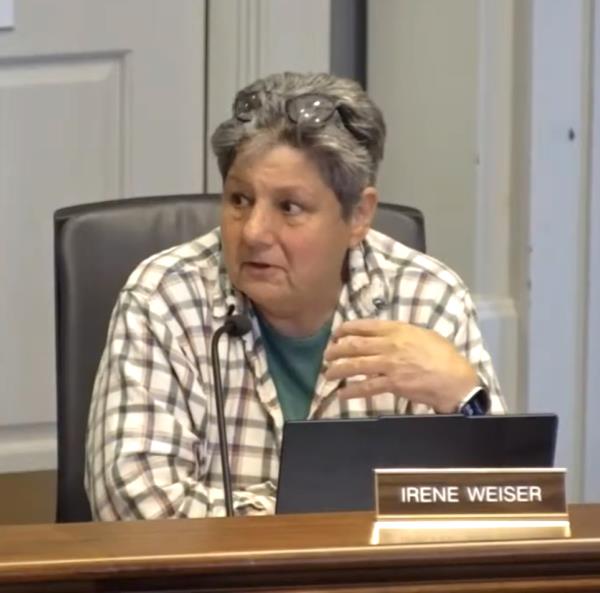
Cauchard conceives of a volunteer army of spies who’d surreptitiously buy fast food, see if the place threw in an unwanted straw, and then log onto a website to snitch. Weiser said law enforcement doesn’t work that way.
“It’s not just on a voluntary basis that people submit to a website and say, ‘Hey, I saw a kid buy a beer at the 7-Eleven.’ It actually has to be done in a rigorous way with people who have the authority to document it,” Weiser reminded the advocates.
Mind you, nobody on the committee objected to Skip the Stuff as an aspirational goal. Cauchard said a voluntary program’s been tried in Red Bank, New Jersey, and with purported success. Weiser believes Ulster County adopted the program as well. It’s just that it could take months before lawmakers and administrators come up with a plan that would work here.
“It sounds like a logical and reasonable thing to do,” committee member Judith Hubbard remarked. She said she’d tossed the idea around with other parents at the playground. But Hubbard cautioned there’d need to be behind the scenes, “non-public” discussions first before Zero Waste can get the law it wants.
“I will weigh in and say it’s a wonderful initiative,” committee colleague Christy Bianconi interjected. “There are so many upsides. I think what you run into is the complexity of government.”
Government complexity, yes; but perhaps public resistance as well. Not everybody wants government to micromanage every aspect of life, especially when it comes to eating. No doubt, take-out restaurants provide napkins, straws and sugar packets because their research proves customers enjoy those little extras. And customer satisfaction includes not having to ask for them. What’s more, time is money. An attendant’s posing the same question time after time prevents him or her from doing other tasks.
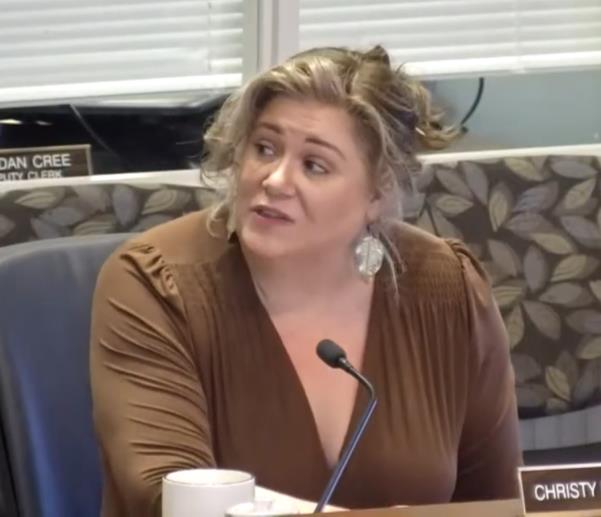
“So you’re telling me McDonald’s can’t give me a drink and a straw at the same time,” Councilperson Jude Lemke asked during the Enfield Board’s mid-October discussion.
“Well, you just have to say, ‘Hey, can I have a straw?’ That’s it,” Supervisor Redmond answered.
“I’d be interested in what the business community’s reaction is to this?” Lemke inquired.
Prior to the Enfield endorsement, this writer-councilperson reached out to the Tompkins County Chamber of Commerce to ascertain its position on Skip the Stuff. The chamber’s president has yet to reply.
“It’s going to be an added imposition on both the seller and the buyer to be discussing back and forth, do you want a straw with your coke,” this writer, Councilperson Robert Lynch, postulated. “They may say that’s an inconvenience for us to have to ask everybody: Do you want silverware with your (order): You want a coffee stirrer?”
“So Five Guys can’t put out ketchup?” Lemke asked.
“My kids are going to feel pretty freakin’ inconvenienced by the heat of the planet in a few years,” Redmond countered.
Of any member on the town board, Supervisor Redmond that night became the staunchest supporter of Skip the Stuff. Councilperson Lemke cast her vote of support only amid hesitation. Lynch abstained, saying he’d yet to learn how the business community would react.
Deputy Enfield Supervisor Terry Bloom, proprietor of the Stone Bend Farm event center, offered his cautious perspective. Bloom said his own business voluntarily abides by Skip the Stuff, but that many other bars, restaurants, and fast food places may object.
“You’re going to get a very wide spectrum of opinions one way or the other,” Bloom predicted. “Everything’s disposable” at many places, Bloom reported. Many establishments don’t have dishwashers. “You’re going to get a huge pushback on this,” Bloom forecast. “Some will say you’re trying to shut the restaurant or bar down.”
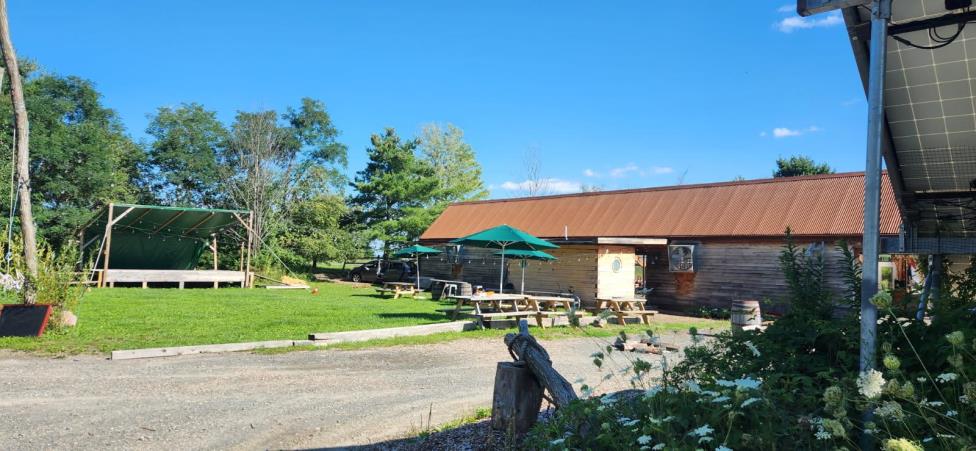
With his remarks, Stone Bend’s owner may have looked farther down the road, perhaps to some future Zero Waste initiative to limit use of disposable foodware at sit-down restaurants. Not too long ago, Yayoi Koizumi had appealed to the Ithaca Board of Education to bring dishwashers back into its schools and stop using disposable plates.
Stephanie Redmond fears the landfills, including the Finger Lakes’ Seneca Meadows, will close by 2028. And she implied that disposable foodware could make the difference, though likely its contribution holds negligible impact.
“Maybe we should think about it a little bit every time we like (say) everything needs to be thrown away,” Redmond leaned into her own environmental advocacy that night. “Maybe you should have to ask. That is an imposition. Maybe you should have to have that little bit of a thought process so our kids aren’t like (sigh), ‘Now what do we do?’ Like, here, have this planet, instead of like, here, have this size of coke.”
“Why don’t we think about handing our kids this planet?” Enfield’s Supervisor begged the universe.
“It all costs money,” Terry Bloom responded.
“It’s going to cost our kids a whole lot,” Redmond told Bloom.
###