

Company President builds case for pricey capital upgrade
by Robert Lynch; September 18, 2026
Quite frankly, some of the infractions were pure Mickey Mouse. In the equipment wash bay, the inspector found that “a spray bottle containing a pink substance was not labeled.” She called it a “serious” violation, potentially punishable by a fine. The alleged “container of hazardous chemicals” she’d found held only car wash soap.
But New York State will do as New York State chooses. The Enfield fire service must stoop to obey. And because of a sudden inspection early this summer by the New York State Department of Labor (DOL), the Enfield Volunteer Fire Company (EVFC) and the Fire District that oversees it must answer a ten-point citation, correct its misconduct, or face fines which could reach into the thousands of dollars per day.
Yet by mid-September, EVFC leadership had rolled one of those ten compliance mandates into the foundation for a $350,000 capital project that would remortgage the Enfield fire station just five years away from having its present, long-term mortgage paid off.
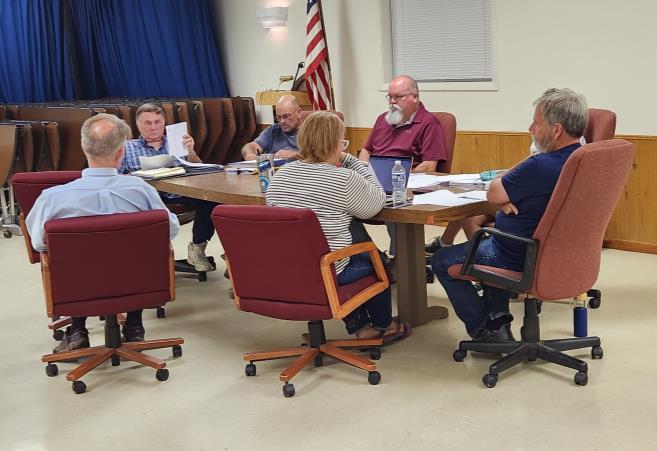
EVFC’s remortgaging plans came up at the September 15 meeting of the Enfield Board of Fire Commissioners. And at least one member of that five-person board didn’t like the idea one bit and made his point known publicly. The board took no action.
But let’s first step back to the inspection, and learn what the fire company may have to do to fall into line.
Kelly Otis, of the Department of Labor’s Public Employee Safety and Health Bureau, conducted her impromptu inspection of the Enfield Fire Station July 2nd. Otis’ supervisor, Luke Parga, issued the EVFC the department’s “Notice of Violation and Order to Comply” August 13. The Fire District and Fire Company had or have until various dates in August and September to “abate” each alleged violation.
Fire Company President Dennis Hubbell said it’s the first time the DOL has inspected the Enfield fire house since 2000. Fire officials believe the July inspection was prompted by an anonymous complaint, likely from someone within the Enfield fire service.
The state citations first surfaced publicly at Commissioners’ August 18 meeting. Commissioners’ Chair Greg Stevenson recited the allegations one by one. He did not welcome them. Stevenson was controlled, yet decidedly critical. In the chairman’s view, Kelly Otis and the DOL had overstepped their presumptive regulatory authority.
“A Department of Labor examiner doesn’t know his or her way around” a fire station, Stevenson asserted.
The chairman cited one of the alleged offenses; failure for the fire company to provide annual, training in the workplace use of standard-issue fire extinguishers, a rule far more applicable in an ordinary business than in a fire station.
“You can drag hose into a burning building, but don’t touch that fire extinguisher because you haven’t been trained,” Stevenson vented sarcastically. I guess we have to “dumb down the audience and treat volunteers like they’re kindergarteners,” he said.
Several of the violations alleged lack of training—or more properly stated, the lack of documented proof of that training.
“In my opinion, she (Otis) doesn’t have the authority to decide what training is,” the board chair insisted. “Training is training. It’s not within her purview.”
“The way she was conducting herself on her first visit, she was acting though the only training was that delivered by the State,” Stevenson complained. “If it wasn’t State training, it wasn’t any good.”
One citation faulted the EVFC for having “failed to provide annual pump operation training to all drivers.” That could lead to manpower shortages behind the wheel.
“Some of our drivers can’t drive if they don’t take the training,” Fire Chief Jamie Stevens warned.
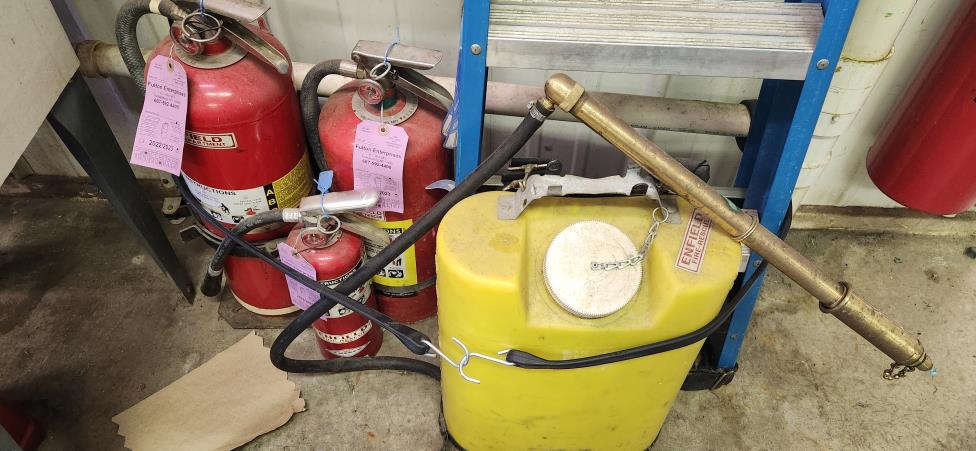
And there was another picayune violation inspector Otis found. In the Maintenance Bay, a few fire extinguishers were “placed on the floor and not properly mounted or identified.” No, they weren’t rolling around where somebody could stumble over them. They just weren’t in a rack.
Chief Stevens said they’ll build “a secure crate.” But until they do, the extinguishers have been strapped to the wall with bungie cord.
What raised Stevenson’s ire the most was what may physically tax firefighters the greatest. Violation One alleged—and properly so—that the EVFC had not provided “bailout ropes” for emergency escapes from high-rise buildings nor trained firefighters in the ropes’ use.
Bailout systems serve little purpose in Enfield, where few, if any, buildings stand more than three stories tall. But because Enfield offers mutual aid to Ithaca on rare occasions, DOL rules require volunteers train on the ropes and carry them attached to their gear.
At their September first meeting, Commissioners authorized spending $6,500—money probably better invested elsewhere—to buy 13 of the bailout sets at $500 apiece.
Stevenson, a retired Ithaca firefighter, one who’s trained on bailout ropes, implied that the state insistence stemmed from a New York City tragedy where firefighters got trapped on upper floors and in his words, “had to jump, and a lot of them were killed.” (Ironically, Stevenson reported, New York City stands exempt from the state bailout requirement.)
“How a firefighter gets in trouble is by doing dangerous things,” the commissioners’ chair asserted. And to him, training on ropes poses more risk of injury than does the outside risk of not having one during an Enfield fire. After the meeting, Stevenson related the experience of one firefighter who had varicose veins, trained on ropes, and bled profusely afterward.
If the DOL wanted to get picky, it could assess Enfield $200 per day for each of eight of the violations, that is, unless they’re corrected; $50 per day for the other two. Fire officials indicated that the “Serious” soap bottle infraction was remedied by tossing away the bottle, likely on the day of the inspection. A number of the other violations have also been abated. A few of them carried an August 30 or September 9 compliance date. Others among the ten must be corrected by September 30.
For infractions difficult to quickly remedy, deadline extensions are likely, EVFC President Dennis Hubbell indicated.
“Personally, I didn’t think it’s all that bad,’ Commissioner Barry Rollins, who also serves as Enfield’s Highway Superintendent, said of Kelly Otis’ ten-point laundry list. Rollins was the only commissioner to voice amy sort of optimism.
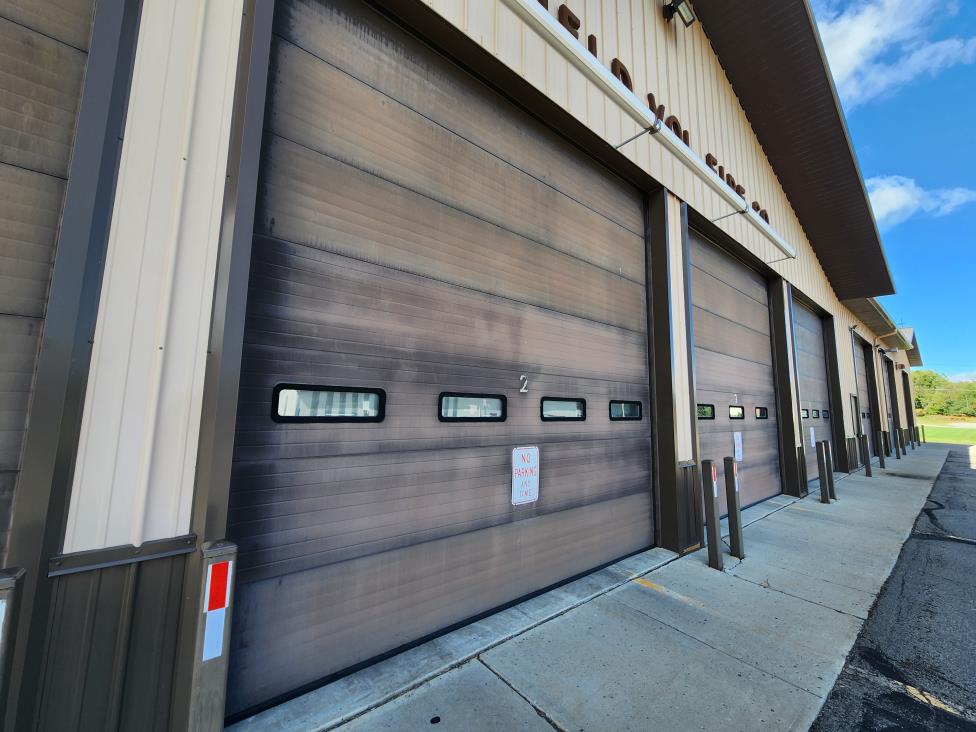
The infraction that will cost Enfield the most money—and may trigger the spending of a whole lot more cash—is the inspector’s finding that eight overhead doors on the fire station lack safety sensors that’ll kill the door’s motor when an obstruction—like a person—stands in its path. The fire station was built in 1988, well before sensors became common on overhead doors. At their mid-September meeting, Commissioners learned a safety retrofit would cost $30,000. In price, bailout ropes pales by comparison.
“I can’t see putting $30,000 in doors that are 40 years old,” Company President Hubbell told Commissioners September 15. “The doors are not efficient; the weather stripping’s ripped out.”
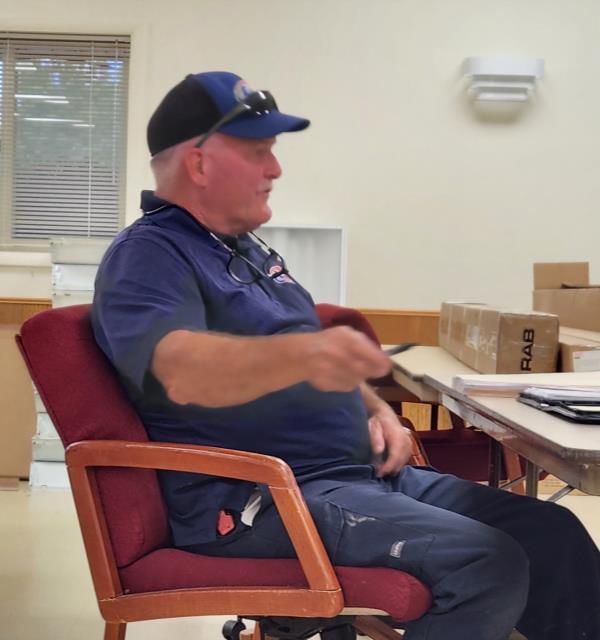
Hubbell would replace the old doors with new ones and spend the extra money to do so. As you’d expect, any sensors bought to retrofit existing doors wouldn’t work with any new ones. Should new doors be bought, the $30,000 becomes money wasted.
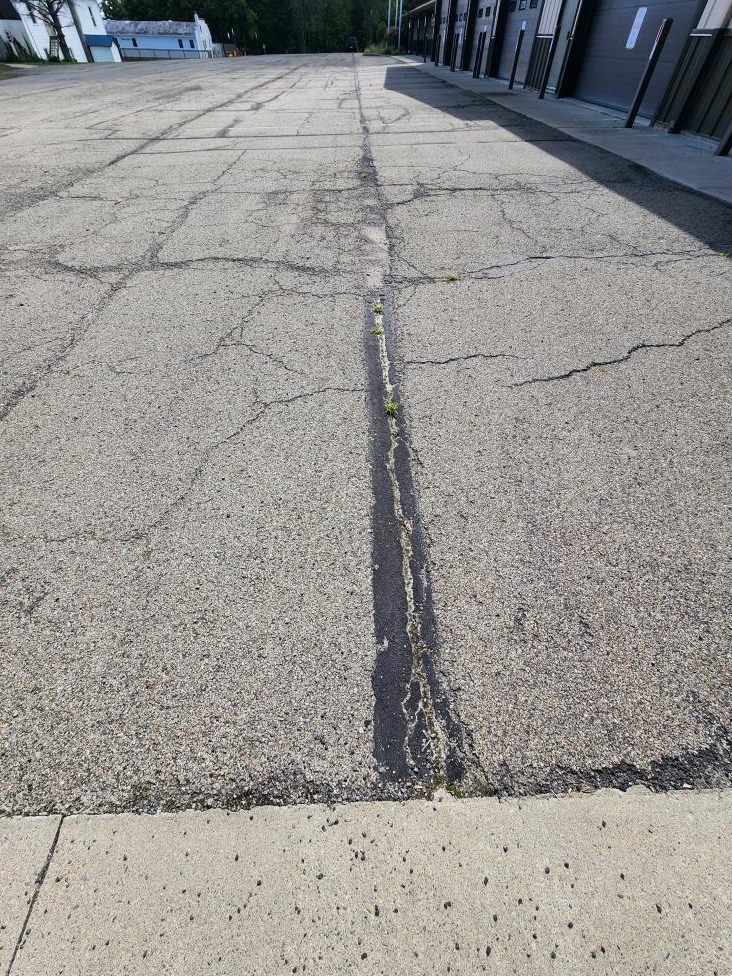
Yet the company president wasn’t through. Hubbell has for months complained about cracks in the fire station’s parking lot. He’d like the lot repaved, front and back. Two years ago, he’d priced new blacktop at $100,000. The cost has likely jumped since then.
Before Hubbell had finished his appeal at this most recent meeting, the doors, the blacktop, and some drain work in the apparatus bays had turned into a $350,000 capital project. And because the EVFC gave away its fire trucks and equipment to the Enfield Fire District—a separate legal entity—after the Fire District took over governance three years ago, the EVFC looks broke on paper and would need to secure a mortgage to perform the upgrades.
Any mortgaging costs would be passed on to Enfield taxpayers through increased lease payments to the EVFC-owned Enfield Fire Station. This year’s lease payment totaled just under $100,000. It’ll likely remain the same for 2027.
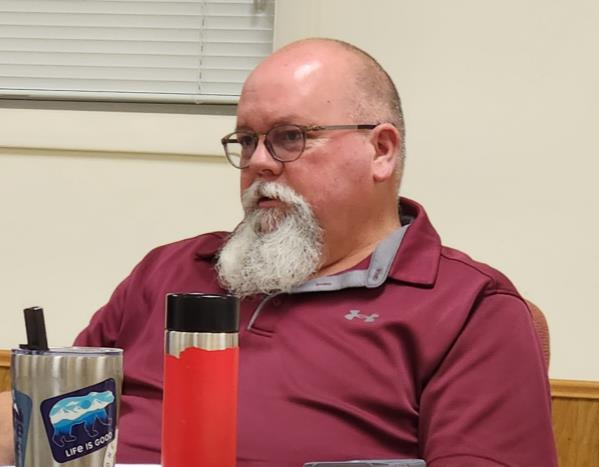
Donald Gunning, one of two fire commissioners—along with Rollins—who’s not a firefighter, pushed back hard on Hubbell’s capital agenda. He questioned the wisdom of mortgaging $350,000 of new money.
“We’re looking at want compared to need,” Gunning reproved the Fire Company president. “And the ‘want’ shouldn’t exceed the ‘need,’ because that’s what the taxpayers are disgusted with.”
The exchanges between Gunning and Hubbell got heated. Gunning questioned the need to replace all of the blacktop, particularly in the rear of the fire station where heavy trucks seldom go. Gunning offered that the rear lot, where the pavement is now the most broken, might more economically be covered with gravel.
“Are we going to drive through mud?” Hubbell questioned Gunning at one point.
After the meeting, Gunning qualified that the fire station’s front lot should remain blacktop. As for door replacement, Gunning said he hadn’t yet decided.
The EVFC remortgaged its building debt 15 years ago, Company President Hubbell explained after adjournment. It’s five years from closing it out. Were $350,000 added now, the outstanding total would swell to $595,000, according to estimates shared at the meeting. Hubbell said the EVFC’s favored bank would charge 4.30 percent interest (a figure given prior to the latest rate hike by the Federal Reserve).

Commissioner Robyn Wishna encouraged the EVFC to seek grant money to finance its capital improvements. “I’d like to see you look at that before you make a 15-year loan for 350,” she advised Hubbell.
Because of the way finances are structured, only the fire company can borrow the building improvement funds, not the quasi-governmental fire district—that is, unless the Fire District took ownership of the fire station, as it has with EVFC’s trucks. Experts advise against a building transfer.
During the course of the September 15 discussions, Dennis Hubbell took more than a passing swipe at past Enfield Town Boards, those that blocked any effort by the EVFC to save money for repairs and improvements. It was back when the Town Board contracted directly with the fire company rather than delegated oversight to a fire district.
“We were living paycheck to paycheck,” Hubbell complained about former times, those before most, if not all current Town Board members had taken their seats. “If we had $2,000 in money ending at year end, the Town reduced our budget by $2,000.”
“I was in favor of moving to a fire district,” Hubbell made clear, “so we got away from that bullcrap.”
“I want to be together with you people, and we want you to be together with us,” the company president told commissioners, urging some kind of meeting of the minds on money. Commissioners should treat the fire station in the same way as it respects apparatus, he said.
But “apparatus is the district’s responsibility, not the building,” Rollins reminded Hubbell.
****
Nothing really got settled at last Tuesday’s meeting regarding whether—if at all—the Enfield Volunteer Fire Company and Enfield Fire District would proceed toward cooperation on capital improvements. That matter was left for a later day, a later meeting.
Right now, there’s an issue more pressing. The district must answer, point by point, citation by citation, the Department of Labor’s suddenly-sprung complaint. Door sensor compliance will likely earn an extension, for now. The car wash bottle is gone, we’re assured. That’s the easiest of the ten.
###