
Administrator’s plan would hike taxes 12%, preserve programs and people, but delay expanded EMS
Reporting and Analysis by Robert Lynch; September 5, 2026
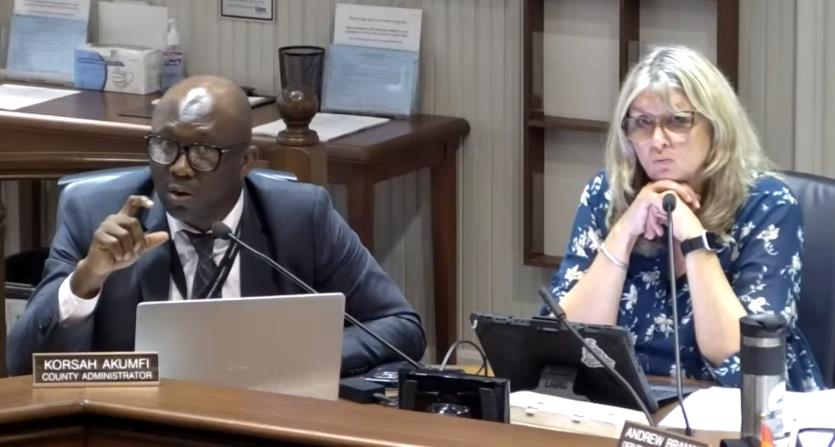
The document runs 592 pages. It begs for that “AI Assistant” to compose some kind of summary. One doubts artificial intelligence would do a very good job. Administrator Korsah Akumfi gave the task his best shot last Tuesday before the Tompkins County Legislature.
What Akumfi presented—and what legislators then scrutinized at length—was the County Administrator’s proposed $307.8 Million 2027 Tompkins County Budget.
For taxpayers, the news is good or bad, depending how you look at it.
The proposal, product of a half-year process that began last spring, includes the largest one-year property tax increase in recent memory, a levy hike of just under 12 percent. But it could have been worse. Without legislators having tapped $1.6 Million from a reserve fund later that night to help soften the blow, the levy would have risen by 14.78 percent.
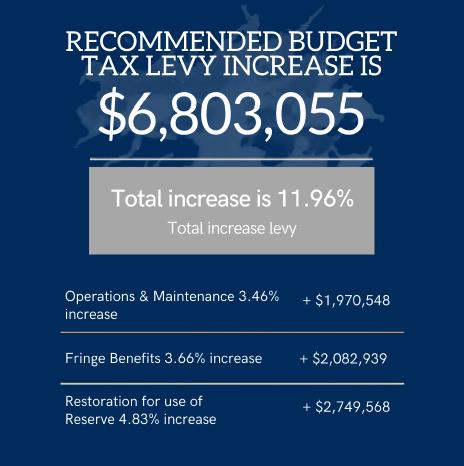
What’s more, had all departmental requests been blindly accepted by Administration, a rate increase of as high as 29 percent had been floated. Something as high as that is now clearly off the table. An increase of 11.96 percent stands high enough.
“This budget asks for a very difficult, but necessary course correction,” Akumfi began his presentation of the recommended budget to the Legislature September 1. “It preserves essential services, recognizes commitments already made, and begins restoring structural balance after several years of relying on one-year revenues to suppress the tax levy.”
And that restoration of “structural balance” stands at the heart of why Tompkins County’s tax levy under the Administrator’s budget would increase so much—assuming, of course, that lawmakers embrace Akumfi’s priorities.
In this, his second year on the job—and with this, his second budget—the administrator Tompkins hired away from Schoharie County in late-2024 shows himself as a deficit hawk. Tompkins County is far from broke, far from dangerously in debt. But Akumfi doesn’t want it to become that way.
Long before Korsah Akumfi arrived, the Legislature revised its fund balance policy. Under the December 2023 revision, legislators directed County Government to retain in unspent cash a full 25 percent of prior year’s expenditures. The previous policy had set aside 18 percent of past year’s revenues. Last year, Tompkins County fell short of its current goal. The Administrator wants to move toward reaching it.
In his written introduction to the budget document, Akumfi wrote, “Of the 11.96% levy increase, approximately 3.58 percentage points, or $2.4 million, are attributable to the elimination of the one-time fund balance subsidy used to support the 2026 budget.” He explained, “This portion of the increase represents a one-time ‘catch-up’ to the levy rather than an ongoing cost increase.”
Overall, as the Administrator recommended, the budget would raise $6.8 Million more in property taxes next year than in 2026. It would raise the total levy to $63.67 Million. Had legislators not drawn $1.6 Million from a reserved “Tax Stabilization Fund,” their government would have needed $65.27 Million in property taxes to support operations.
And while those $270.9 Million in projected general fund expenditures cut some departmental requests—a few of them severely—the outline the Administrator offered Tuesday was by no means an austerity budget. Payrolls would increase. Staffing levels would only slightly reduce from those at present. Akumfi gave no hint of any layoffs.
Still, never put too much stock in what a county administrator places before the Tompkins County Legislature this early in the budget cycle. Korsah Akumfi is not an elected county executive. And this is not a place like Syracuse. County legislators here do not acquiesce; they micromanage. They chip away and expand a budget. (More often they expand it.)
Here’s what’s ahead: Legislators, gathering collectively as a committee-of-the-whole, will convene as many as eleven budget review sessions—generally two per week—from now through mid-October. Two such meetings have already been held.
The Legislature plans to vote on a tentative budget October 20, hold a public hearing on it one week later, and then adopt a final budget in November. Speed always yields to contemplation. And in terms of tax rates imposed and pet projects supported, what finally emerges from those many meetings often looks far different from what the Administrator first envisioned.
On July 21, legislators authorized application to the New York State Dormitory Authority for a half-million dollar grant that, if approved, would upgrade the Tompkins County Rapid Medical Response (RMR) emergency medical service to a limited-schedule, paramedic-level, Advanced Life Support operation. Coupled with that application was a commitment to match the grant money with nearly another half-million in local funds to help staff the service.
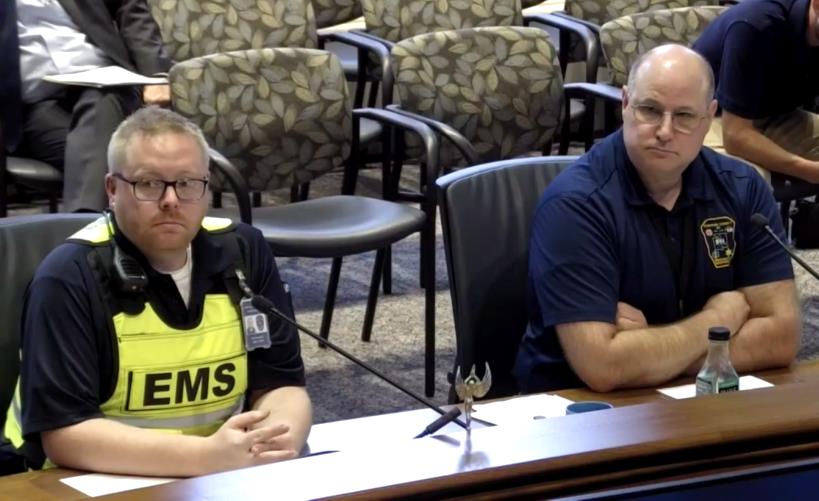
At the July meeting, Akumfi indicated the local matching money would be included, at least in part, within the 2027 budget. But under what he presented the legislature this past Tuesday, it won’t.
The Administrator hardly referenced RMR expansion in his presentation Tuesday. But in an online meeting with local municipal leaders two days later, Akumfi confirmed that the RMR funding was not included for now and most likely will be delayed until 2028. The money could be wrapped later into a more ambitious initiative to expand county EMS.
“At the point when the legislature decides which direction we want to go, we will then amend the budget,” Akumfi assured local officials on Thursday. “If it affects ’27, we will amend the budget to that effect. But if it doesn’t affect ’27, then we will be able to budget that for 2028,” he said.
Raising the tax levy by 11.96 percent “is not presented as an ideal outcome,” Akumfi admitted to the legislature September 1. Rather, he said, “It is presented as a starting point after substantial administrative reductions.”
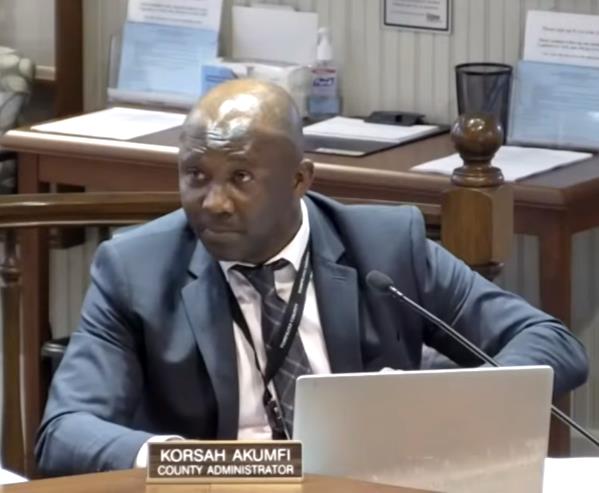
“The recommendation is built around three commitments,” the Administrator stated: “Preserve our progress and core services; restore fiscal stewardship by aligning occurring expense with recurring revenue; and protect people who rely on County services and employees who deliver them.”
“Preserving Our Progress, Protecting Our People” earned itself bold italicized text in the Administration’s budget document. Its treatment resembled that of a campaign slogan. But notice that nowhere in that alliterative bumper sticker is serving the taxpayer credited.
Korsah Akumfi is a journeyman. No one will ever vote him out of office. Our 16 legislators face the electorate every few years. They who survive only at the ballot box’s mercy tend to balance program survival and fiscal frugality differently. Last Tuesday, some did.
Newfield-Enfield legislator Randy Brown has argued that Tompkins County government’s employment roster is too fat. Brown noted that the current workforce of 857 full-time-equivalent employees is 110 more than it was in 2022.
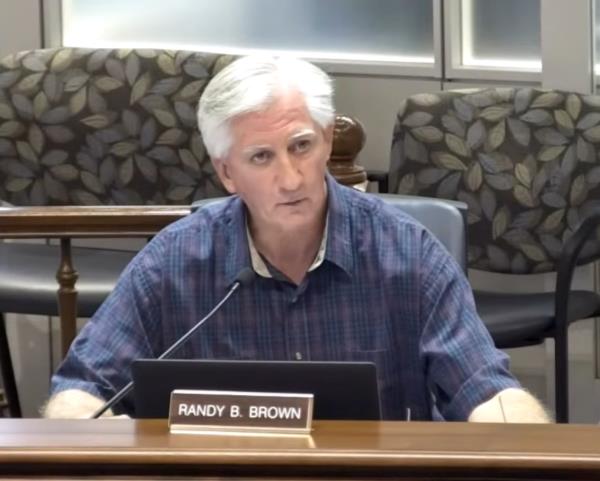
“That just seems like a lot,” Brown told Akumfi at the legislature meeting, “and it’s why we are where we are today.”
And a couple of other workforce issues plague the County Administrator’s budget draft.
Customarily, the budget tamps down payroll costs by assuming that some positions will go for a time—perhaps all year—unfilled. But whereas Akumfi acknowledged there’ll likely be a “vacancy rate” of about three percent as employees come and go, his budget assumes all jobs would be filled and compensated all year. The vacancy adjustment saved nearly $1.9 Million in the current year’s budget.
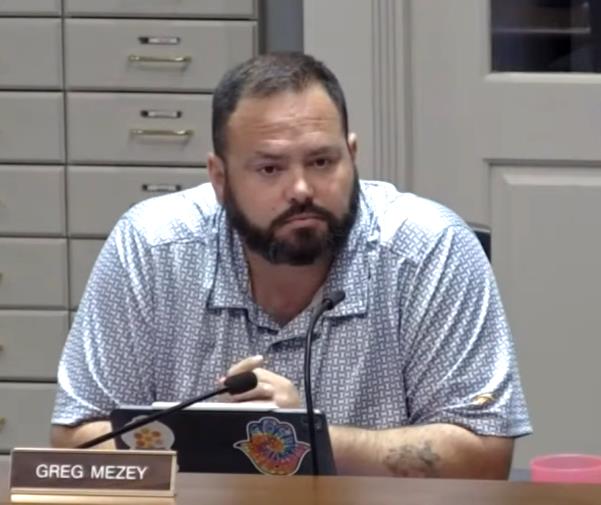
Greg Mezey, a legislator skeptical of raising excessive revenue just to warehouse it in government coffers, weighed in.
“I guess I’m a little disappointed that we look to growing something that we don’t necessarily need to grow this year and not utilizing a vacancy factor which actually is a more accurate way to budget what we really will be spending on our personnel costs,” Mezey said. He said the budget should not artificially inflate expenses “in a time when it’s so difficult for the average resident of Tompkins County to afford living here.”
And there’s also the issue of fringe benefits. The Administrator’s budget projects a 16 percent, or $4.4 Million, rise in fringe benefit expenses. Driving that increase is an expected 17.6 percent rise in state-mandated retirement costs and what is forecast as a 16-18 percent rise in health insurance premiums.
But the insurance number may rely on old data. The County’s immediate provider, the Greater Tompkins County Municipal Health Insurance Consortium, (upon one of whose committees this Enfield Councilperson sits) has in recent weeks advanced a higher premium boost, 19.5 percent, as a more likely increase. It’ll likely go before the Consortium’s Board of Directors later this month. If the higher number gets approved, Akumfi has budgeted too little for health costs.
On another matter, the Administrator’s budget assumes that Tompkins County will pick up $740,000 in heightened administrative costs for the Supplemental Nutrition Assistance Program (SNAP)—once referred to as “food stamps”—that’ve been offloaded to states and localities by the federal government. Congress’ “One Big Beautiful Bill Act,” adopted last year, cut federal reimbursement for SNAP administration in half. Akumfi’s budget would “backfill” that cost, rather than cut staff expenses within the Department of Social Services.
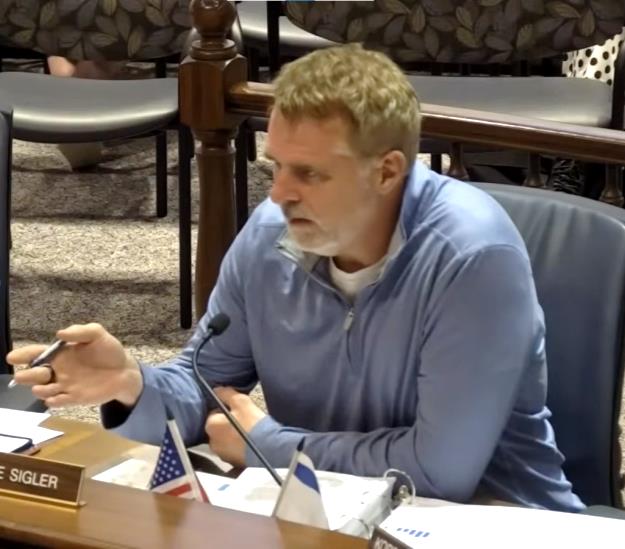
Not all like that idea. “I’m not prepared to have county taxpayers backfill for the federal government,’ Republican Mike Sigler reacted. “That’s an incredible amount of money that I don’t think our people have it to pay for it.”
Ulysses-Enfield legislator Rachel Ostlund reminded Sigler that the heightened SNAP costs came through federal legislation and that New York is among ten states that pass the program’s administration down to counties. Sigler challenged the enforceability of the mandate and questioned what would happen should his county simply refuse to shoulder the burden. Legislature Chair Shawna Black intervened to block what could have become an inter-party, multi-legislator squabble.
Some county departments asked for more money than Akumfi recommended they receive. With little explanation, the Administrator’s budget cut the Tompkins County Public Library’s request from $538 Million to $269 Million. Fleet purchases of $1.36 Million were sliced nearly in half. And Airport operating expenses were reduced by more than $245,000. Expect those rejected requests to make their way back to the Legislature in review meetings to come.
Tompkins County’s proposed Downtown Center of Government doubts to become an issue in this year’s budget. The project may top $50 Million. But most obligations will fall in later years. Only about $200,000 would be budgeted for 2027.
But it’s the fund balance issue whose resolution will likely pit tax-conscious legislators against a deficit-wary Administration that fears Tompkins County’s eight-figure rainy day reserve may someday run dry.
“Fund balance can bridge temporary disruption. It cannot permanently fund wages, benefits, or continuing programs,” Akumfi advised the Legislature last Tuesday.
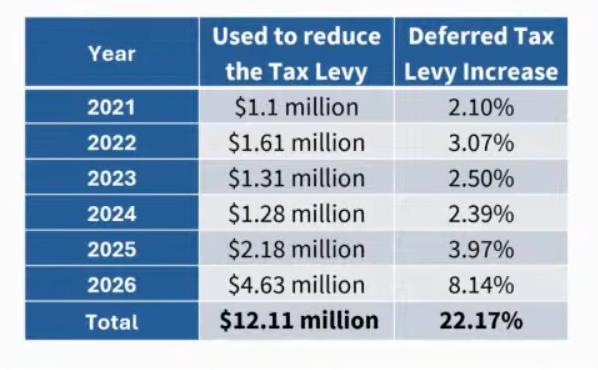
The Administrator asserted that from 2021 through the current year, lawmakers tapped over $12 Million in fund balance to “defer” otherwise-required tax increases. The fund balance currently stands at just over $44 Million. Under a 25 percent fund balance policy, the total should stand at $59.8 Million.
“Using additional unassigned fund balance for recurring operations,” Akumfi warned, “will widen that gap and weaken our ability to respond to emergencies, revenue disruptions, and ratings’ concerns.”
It’s true that a fatter fund balance helps Tompkins County snag lower rates on whatever debt it bonds. But is it wise to leave a full $59 Million of taxpayer money lying idle, unspent, in Tompkins County’s checking account, some might ask? Isn’t $44 Million sufficient? And barring another Great Depression, what kind of emergency would require that plush a fiscal cushion?
In the end, money is fungible. And one could argue Administration’s dogged devotion to fund balance compliance is pursuit of a policy for policy’s sake. The December 2023 fund balance policy was only a policy, not state law. If today’s Legislature thinks a 25 percent reserve is too lofty, it can ratchet it back. And Randy Brown maintains that if the fund balance target returned to 18 percent, Tompkins County would come close to meeting it right now.
What’s more, Greg Mezey questioned Akumfi’s multi-year analysis. In three of the recent years cited by the Administrator, Tompkins County actually collected more money than it spent, Mezey claimed. Fiscal shortfalls were illusory. Mezey said Akumfi had used budgeted estimates, not real revenues. He analogized the discrepancy to setting aside $10,000 for car expenses but only spending $7,000 of it.
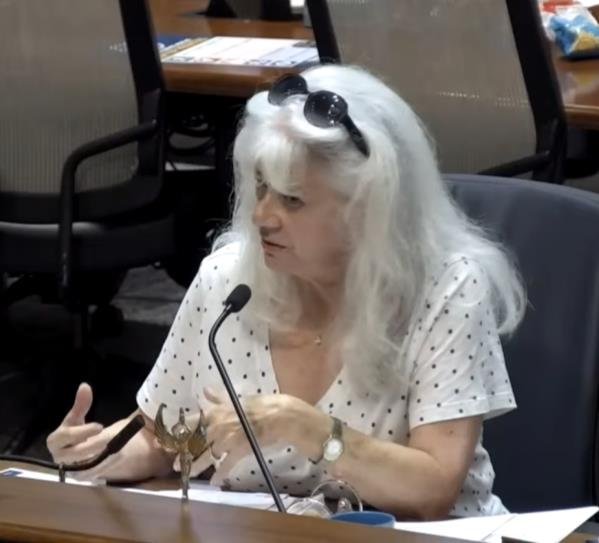
“I understand we used it (fund balance) to balance a budget, but did we actually write the check out of fund balance to pay for operations?” Mezey asked.
Yet some on the Legislature like accumulating rainy-day savings just in case.
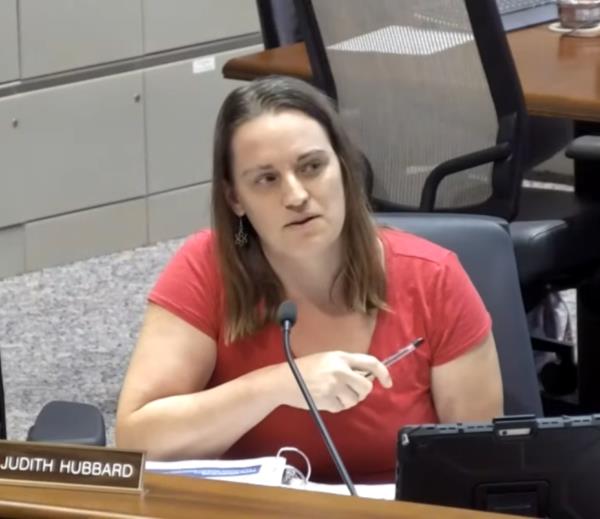
“You can’t draw reliably from savings forever,” legislator Judith Hubbard informed colleagues. “You run out and they leave you in a worse situation than you were in the first place.”
“We’re all freaking out” about the tax increase, Budget Committee Chair Deborah Dawson observed of the projected 11.96 percent levy rise. She said it computes to $168 annually for the median ($290,000 house) Tompkins County homeowner. That’s $14 a month; “which is a couple coffees at Starbucks, not your first born,” she said. [Memo to Deborah: Starbucks moved out of town years ago.]
After the more than hour-long Administrator’s presentation and legislative back-and-forth had ended, lawmakers got to work. They drew down the $2.8 Million Tax Stabilization Fund by $1.6 Million to prevent the Administrator’s recommended tax increase from creeping any higher. Using $1.6 Million leaves less than half of the fund’s total for future years.
Mike Sigler would have used all of it right now. Sigler proposed an amendment to drain the fund completely. The amendment failed. Only fellow Republican Lee Shurtleff of Groton joined Sigler in his effort.
“We’re just too early in the process to pull this lever,” Mezey said of drawing down the fund to zero.
“If we need it, we can do it later in the year,” Randy Brown said of Sigler’s go-for-broke initiative.
###