

Organizational meeting brings surprise, sudden move to revisit cell phone policy
Reporting and analysis by Robert Lynch; July 17, 2026
Think Supreme Court. A six-three supermajority dominates America’s highest judicial tribunal these days. In the coming year, the same math may also dictate decisions of a lesser sort, matters coming before Ithaca’s Board of Education.
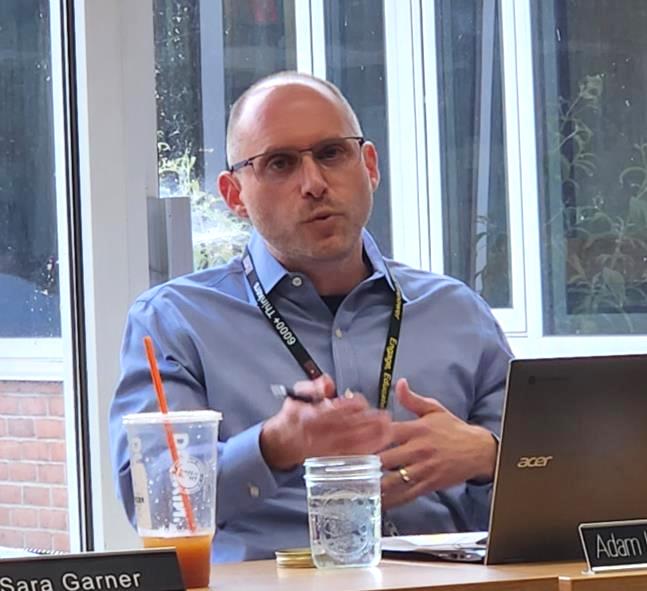
At least that’s how things shook out Friday morning as the Ithaca school board reorganized for the new academic year. It may have been mere coincidence, or it may signal a trend. Nevertheless, on that one day, the levers of power shifted.
By a vote of six-to-three, Ithaca’s elected overseers of education July 17 chose two-term incumbent Adam Krantweiss over Garrick Blalock as the next Board of Education President. Krantweiss succeeds Dr. Sean Eversley Bradwell, who ended 17 years on the school board in June, the last four as its President.
Then, on their next vote, the same six and three members lined up on the Vice President’s selection.
Jacob Shiffrin, who joined the board one year ago, was the only candidate nominated for second-in-leadership. All of Krantweiss’ supporters voted for Shiffrin. All of Blalock’s supporters abstained.
And then near meeting’s end, when the agenda appeared exhausted, a surprise got sprung. The board moved, debated for a bit, and then fast-tracked to a snap, special meeting within days the reexamination of the district’s year-old, problem-plagued student cell phone policy. The board will reconvene to discuss that policy Monday, July 20, just three days from when it organized.
And yes, the decision to hold the special meeting again passed by a six-to-three margin. The same people who’d decided leadership voted the same way again.
The Friday leadership votes were not pretty. Civility strained. Old wounds reopened. And the deepest wound of all was Adam Krantweiss’ abstention April 14 on the board’s decision to send to Ithaca City School District (ICSD) voters for their later ratification a $177.6 Million budget.
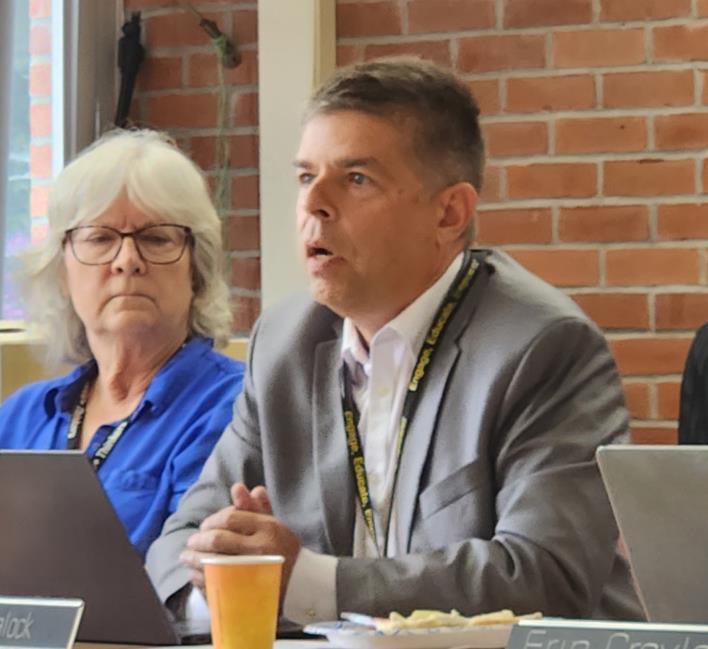
Krantweiss had argued at the time that the budget process was flawed. It was too much dominated by Administration, too shielded from individual board members, he’d said. At the budget meeting he’d read from a prepared text. It stated, in part, “I feel like we as a collective board have not had substantive public discussions at the full board meetings to provide collective input.”
Colleagues Jacob Shiffrin and Emily Workman had joined Krantweiss in his abstention that April night. As such, the budget barely cleared the board. In this Friday’s leadership election, Shiffrin and Workman each backed Krantweiss. Member Todd Fox did as well. In April, Fox had opposed the budget outright.
“I have a concern,” Karen Yearwood said, raising Krantweiss’ abstention as a likely disqualification. She reminded Krantweiss that he had attended several Finance Committee sessions, meetings that Blalock, by the way, had chaired. Yet Krantweiss had still seen fit to abstain.
“It would be concerning to me having a board president who doesn’t understand the budget process,” Erin Croyle, Krantweiss’ most passionate critic, observed.
Krantweiss defended himself. “It was the way the budget was formed in the first place,” he said. “I didn’t have much agency in the process.”
“It was definitely not a lack of understanding. It was a protest of the process,” Krantweiss stressed.
“You had an opportunity to ask questions; to dive in,” Croyle insisted. “I did not see it through the year.” Instead, said Croyle, Krantweiss chose to “throw a stick of dynamite in there,” with his April statement.
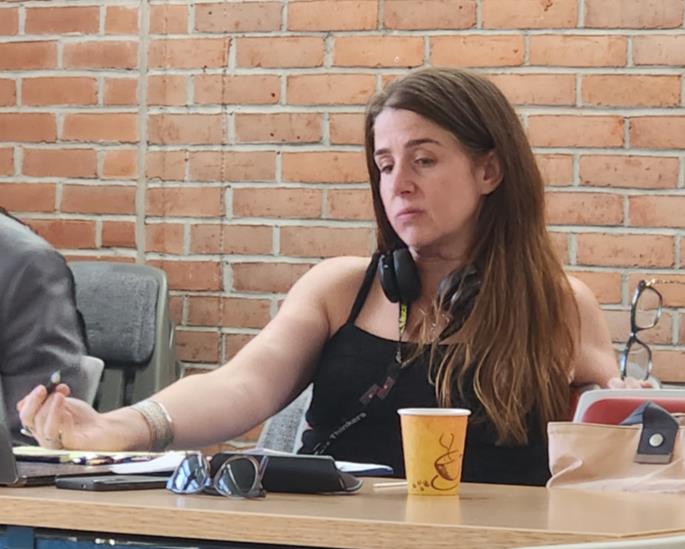
Yearwood said she was “flabbergasted” that Krantweiss had abstained that night by written statement.
Quite predictably, given the course of discussion, Yearwood, Croyle—and expectedly, Garrick Blalock—voted to elevate Blalock as President. All others supported Krantweiss.
Whereas the Supreme Court’s splits along political and ideological lines, what divided the ICSD governing board Friday grounded itself in operational preference. Raise the question this way: How much should each of the school board’s nine members defer to highly-paid administrators or to powerful committee chairs, colleagues who appear to have some special knowledge, an inside track, and exceptional clout?
And the upcoming revisit to the operationally challenged cell phone policy reflects that frustration and discontent among the six who, at least for the moment, have fused into a new, governing majority.
“We were not able to get this onto the agenda last year,” Jacob Shiffrin stated at the tail of Friday’s meeting as to the cell phone policy The unstated subtext behind the new vice-president’s remark may be that the issue wasn’t revisited because one or more people didn’t want it to be—or at least slow-walked it.
“We’ve seen two camps around cell phone policy,” Shiffrin posed to membership. “Is there a majority of board members who’d like to discuss this next Monday or Tuesday?” he asked.
There was. Monday, 4 PM was picked as the preferred date and time.
The policy to comply with Governor Kathy Hochul’s heralded 2025 bell-to-bell, ban on student smartphone use, ratified last year by the New York State Legislature, hasn’t worked very well in Ithaca.
One year ago, acting even before the school board had set its compliance policy in place, District Administration had expended about $20,000 to purchase signal-canceling, Velcro-sealed pouches to give to every upper-class student. The District viewed the pouches at the time as a minimum compliance tool.
Other districts went further. Some employed the “Yondr” pouches, those that sealed phones behind a lock from a student’s arrival until dismissal. Ithaca rejected outright phone confiscation as too invasive. Consider, too, Ithaca School Superintendent Dr. Luvelle Brown’s comment last August describing the Empire State’s mandate as “a paternalistic and oppressive law.”
“This is the least anxiety pouch,” one district administrator described Ithaca’s approach at a school board meeting late last September. She reported that student cell phone usage had dropped.
But student school board members offered a different take that night. “Honestly, I don’t think I know a single person who actually uses those cyber pouches,’ one high schooler said. “Pretty much all students communicated the fact that they’re kind of a joke,” remarked another.
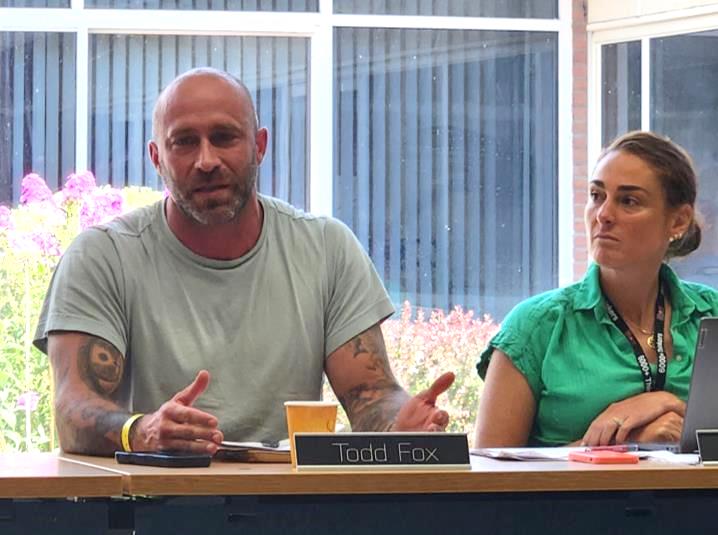
“We’re not meeting the mandate,” board member Todd Fox, a repeated advocate for a tougher phone policy, told colleagues at this week’s organizational meeting. “I don’t want our teachers to have to police the kids,” he said. “Get the phones out” of the classroom, Fox directed.

What Todd Fox, himself an admitted digital device addict, would like to see are lockers where each student could secure his or her phone, bell to bell. But Superintendent Brown has declined to pursue that route to date. Friday, he repeated his reluctance to make a quick policy change.
“I would like to alert policy folks,” Dr. Brown said. Yet some are away. It’s July. School’s on break.
“It’s a significant shift in the way we approach cell phones,” Brown said of ideas like Todd Fox’s. And with the start of the school year only a month-and-a-half away, “It’s too late to get something done,” the Superintendent maintained.
“I’d like the resolution to be done properly,” Karen Yearwood stated. She was among the three who’d opposed the special meeting. “Next week is too soon,” she said.
Yet expect Todd Fox—and others—to press for action in time for September. “We have the opportunity to get phones out of kids’ hands,” Fox said. “There’s no benefit to having phones.”
Adam Krantweiss joined the Ithaca Board of Education in mid-2023, elected to complete a resigned member’s unfinished term. He was elected to a full term in the traumatic budget year of 2024, when voters ousted two other incumbents and initially rejected the district budget by a 7-3 margin. Krantweiss will face reelection again one year from now.

Adam Krantweiss’ ICSD biography states that the new Board President has worked “as a clinical psychologist in inpatient and outpatient settings.” He has taught psychology classes at SUNY Binghamton and Cornell. A native of the Metropolitan New York City area, Krantweiss and his wife, an Ithaca native, moved into the district in 2017. Their two children attend the ICSD.
Krantweiss and the two newcomers who joined the school board in 2024, Todd Fox and Emily Workman, formed three of the six members who allied in leadership selection and the phone ban’s revisit Friday. Jacob Shiffrin, the board’s new Vice-President, was the fourth. The final two members, Dr. Jill Tripp and Sara Garner, were added to the board in this past May’s elections.
Jill Tripp, viewed by many as a fiscal watchdog, was earlier elected to the board in 2022, but lost her seat in 2025. This year, she ran again and won.
What that cobbled-together new majority may hold in common is a willingness to challenge the status-quo; to question what’s always been just because … well, it’s always been that way.
Evidence of that “question authority” attitude came during the organizational meeting’s attempt to establish committees. The annual ritual is usually routine. But this time it was not.
The agenda called for the seating of six committees, each often assigned three board members. But members Friday could not agree on how many committees—or which ones—to establish. Committees may be seen by some as centers of power, barriers to full engagement by board membership in matters like curriculum planning and budgeting. (Remember Krantweiss’ April abstention.)
“Maybe curriculum should be discussed at a committee-of-the-whole,” Jill Tripp posited.
Committee construction brought impasse. First the board rejected, four votes to five, routine formation of the six-committee list. Then it tied (and thus, rejected) a pared-down number. In the end, only the Audit Committee, a state-mandated panel, survived that day. The board will sort out the remaining five committees come August.
“It seems like a puppet show at the moment,” a frustrated Karen Yearwood quipped at one point.
###