
by Robert Lynch, July 20, 2021; updated at 10:57 PM
Rich John would shore up food pantries. Shawna Black would give each of a half-dozen key administrators Ten Grand bonuses. Dan Klein would grant each legislator a tenth of a Million just to fund pet projects. And Mike Sigler would cut tuition at TC3 and “fill every pothole; every… single… one.”
But far more likely—and after a key committee vote Monday, a virtual certainty—Tompkins County legislators will plop three-quarters of Uncle Sam’s nearly $19.9 Million of local post-pandemic aid into a colorless category called “cash for capital,” spiriting it away to subsidize future brick-and-mortar projects, not the least of which could be a new downtown office building.
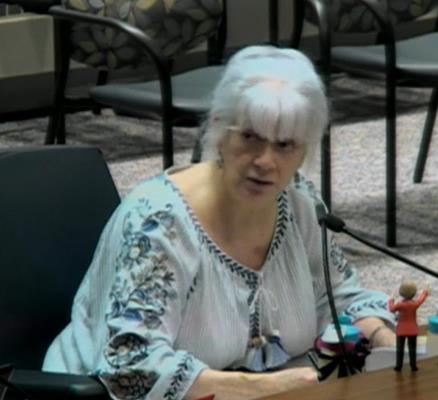
Indeed, one night later (Tuesday, July 20th), the full Legislature—its membership almost the same as 24 hours earlier—ratified the Budget Committee’s action, eleven votes to one.
“We’re so far from being out of the woods… we don’t know what we’ll be facing down the road,” said Budget, Capital, and Personnel Committee Chair Deborah Dawson Monday, as she urged fiscal frugality in the face of whatever COVID-19 has yet to hurl at her community.
Grasping at accounting straws that federal officials have yet to fully explain, Dawson’s Budget group—joined by most other legislators meeting as a committee-of-the-whole— adopted a pair of recommendations to allocate all of the County’s expected proceeds from the American Rescue Plan (ARP). The first of the motions, now official, dedicates all moneys to “fund government operations.” The second, more controversial, recommendation assigns three-quarters of that operational total to fund “cash for capital.”
By spiriting 75% of the ARP into the capital fund, the County might save money long-term on its bonding costs. But the assignment would also make it easier to dip into the capital account to support favored projects—like the office building—with lawmakers knowing they’d not be asking taxpayers to shoulder the expense directly.
Nonetheless, in locking away all of the proceeds under the title of “operations,”—effectively, compensating for theoretical revenue shortfalls that in some respects never really occurred—legislators would lose a level of flexibility in how they can spend the funds. For example, if filtered through local coffers, the County could not easily and directly subsidize private parties. But if the money were left non-operational, the county could funnel checks directly to people and businesses.
“We’re setting ourselves up so we can’t go back,” cautioned Ulysses-Enfield legislator Anne Koreman, who voted against the full-funding to operations, but later supported the cash for capital assignment.
Only Ithaca legislators Henry Granison and Leslie Schill voted against both the operational assignment and the cash for capital option Monday. (By attending remotely, Schill’s vote couldn’t count. Legislature Chair Leslyn McBean-Clairborne had been excused.)
With both Schill and McBean-Clairborne excused when the Legislature met again Tuesday, only Granison dissented on the 75 per cent capital set-aside.
Indeed, during Monday’s discussions, Schill proved the meeting’s most powerful critic of both Budget Committee recommendations, the Ithaca Democrat stressing the need for helping people recover in a way that’s consistent with the ARP’s true purpose.
“We are not getting to the pain places,” complained Schill.
“There is an immediate and an acute need which is the reason the funding is coming our way because of the pandemic,” Schill continued. “And I think we have an obligation to respond to that at the human level and not thinking necessarily only about the long term fiscal health of the County.”
Schill, who lost a recent primary and will be leaving her brief stint on the Legislature at year’s end, urged the more-flexible use of ARP funds to aid households, individuals, businesses, and what she termed “potentially transformational projects.”
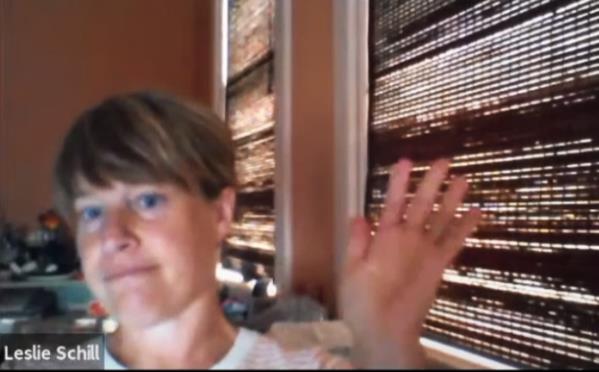
“I am concerned that we will not be helping some folks that are in real need,” the Ithaca legislator maintained. “We will not be supporting economic revitalization of the county, and that would be a big loss. It will come back to roost.”
Schill’s priorities Monday placed her squarely at odds with Budget Committee Chair Dawson, who sets spending priorities with the discipline of a green-eyeshade taskmaster, and who lives her life in continual fear of the COVID-19 Delta Variant.
“To me, throwing money at an economy with the idea that we’re going to resuscitate it just so that we can shut everything down again… makes no sense, whatsoever,” Dawson said.
There’s a reason Dawson is called “Debbie Downer.”
Though it was by no means scientific, a recently-conducted, County-sponsored opinion poll put local residents on Schill’s side, with 57 per cent of the survey’s nearly 2000 respondents having ranked compensation for COVID-affected households as among their top three spending priorities for ARP funds. Helping struggling businesses and non-profit agencies came in second.
Newfield-Enfield legislator Dave McKenna told the committee he’d favor throwing all of the ARP money into the capital account, so long as the County could tap other resources—perhaps from its Fund Balance—to put as much as $3 Million toward expanded broadband.
After their two key votes Monday, legislators spent the rest of the meeting discussing how they might tap their admittedly bloated Fund Balance to support, as much as they can, those human needs lawmakers like Schill want addressed. Wanting firmer Fund Balance figures first, they delayed any recommendation that would carry a dollar figure.
****
When Monday rolled into Tuesday and the County Legislature readied for its final vote, Legislator Koreman tossed in a surprise. Rather than direct all of the ARP funds to “government operations,” Koreman proposed a meager five per cent of the total—just over $992,000—be shunted aside for “non-County spending,” funding to satisfy those household, individual, and business subsidies the County might find itself otherwise barred from spending.
But in part because some legislators feared it could impose what Shawna Black termed a “reporting nightmare,” Koreman’s amendment failed, eight votes to four.
“God, people, can’t we just make a decision and stick to it?” a petulant Dawson implored her colleagues.
“Not everybody decided this last night,” Koreman reminded the Budget Chair. Many, like Schill, she said, had wanted at least 25 per cent set aside. And should County Government become the program’s lone recipient, the only recourse might require “some convoluted way to wash the money… to give it back to the community; to buy kids shoes so they can go back to school.”
Tuesday’s resolution, while committing three-quarters of Rescue Plan funds to the capital program, also diverted money a second way, carving from the remaining amount an estimated $100 thousand to hire a full-time budget analyst to manage the ARP.
****
The agenda for Monday’s meeting had called for members to each discuss their “ARPA Vision Statements,” which 11 of the 14 legislators had drafted and which staff had posted online. For reasons unexplained, Dawson never called for that discussion. But the printed answers revealed a wide range of divergence.
Leslie Schill would prioritize food security funding, provide premium pay to essential workers, abate property taxes, and dabble in Ithaca’s Waterfront Development. Koreman would expand operations at the ReUse Center. Perhaps the most creative, Lansing’s Mike Sigler would convert the 13 foot dam on Six-Mile Creek into a power generation station. He’d also fill every pothole, restore swimming to Stewart Park and plant 100,000 trees, if not a million.
Danby’s Dan Klein would divide $1.4 Million of the total 14 ways, giving each legislator $100,000 to “allocate as they wish.” Klein would also like to improve cell phone coverage. Klein said he hears from constituents “that do not have sufficient cell phone reception to reliably hold a conversation.” He notably added, “My house is such a spot.”
###