

by Robert Lynch; April 11, 2026
Off-camera and defying certain identification, an Ithaca Board of Education member asked, “Has there been local press about what happened at Heights?”
No there hadn’t been. Of course, teachers knew. Students and parents knew. The neighborhood likely knew. But we in the broader community did not. Yet thanks to what was said at a media-ignored committee meeting nine days after the catastrophe, we now know. At least, we know a little bit.
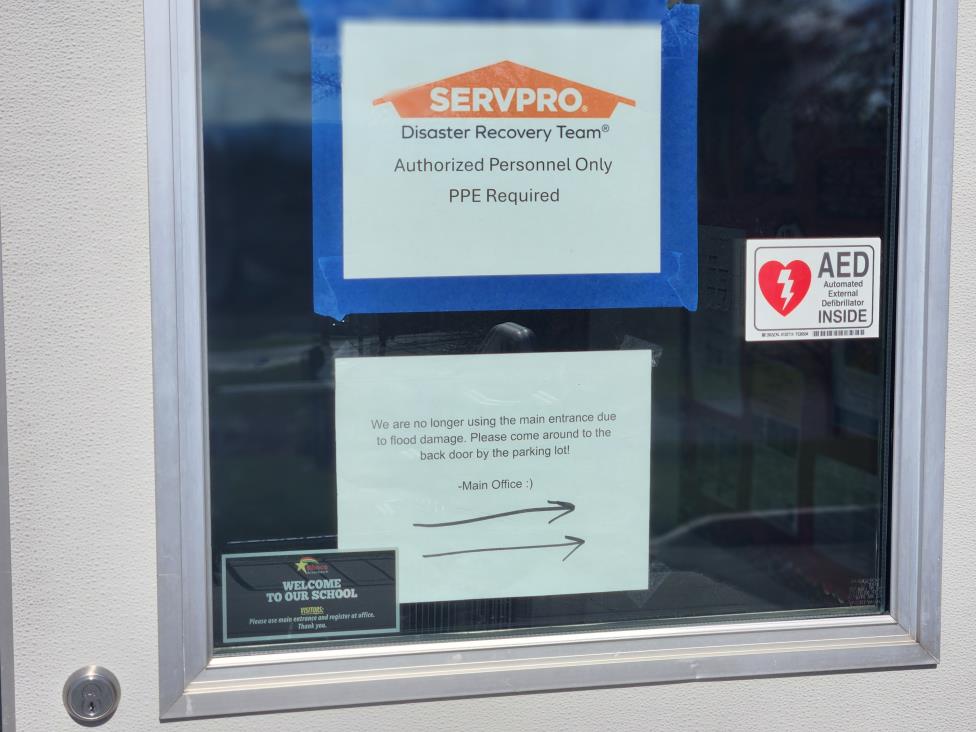
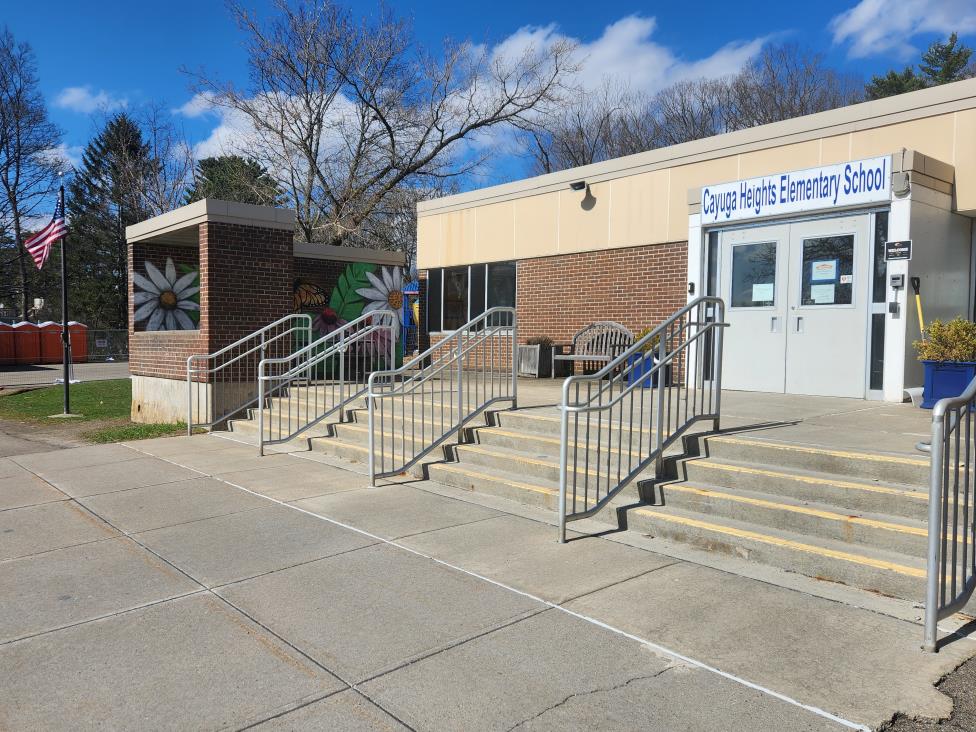
The out-like-a-lion March 31 torrential rainstorm that inundated greater Ithaca during the late-afternoon rush hour and poured inches of water down upon us within minutes caused major flood damage at Cayuga Heights Elementary School. Preliminary reports price the damage at more than $500,000. And officials haven’t ruled out repairs topping One Million.
The Tuesday, March 31 storm occurred during the Ithaca City School District (ICSD) spring break, so pupils and teachers weren’t around. Students didn’t return to classes at the Heights school until the following Monday. We’re told the school reopened on schedule.
But the physical and financial impacts of the flood remain with us and are yet to be fully tallied. Administrators could not put a final dollar figure on the damage when they first disclosed the flooding publicly at the school board’s Facilities and Finance Committee meeting Thursday, April 9. Those administrators hope to have better estimates when the full Board of Education next convenes Tuesday, April 14.
The ripple effects of the flood have already extended to the 2026-27 ICSD proposed budget, now in its final stages of preparation. Administrators and board members have conceded that the repairs at Cayuga Heights Elementary could nudge the proposed $177.6 Million budget’s tax levy upward, at least slightly.
“So we’re in the process of determining the full scope of work, Dominick Lisi, ICSD’s Assistant Superintendent for Business and Finance, informed the committee. “Right now our first order of business is the resolution to declare it an emergency so that we can use funding to serve that purpose,” Lisi said.
Lisi advised the committee that Cayuga Heights Elementary is insured for $500,000 in damages. But he stood confident that the insurance money wouldn’t cover all the cleanup.
“Do we have an order of magnitude of what it might cost?” school board and committee member Todd Fox asked.
“Hope to have that soon,” Lisi answered.
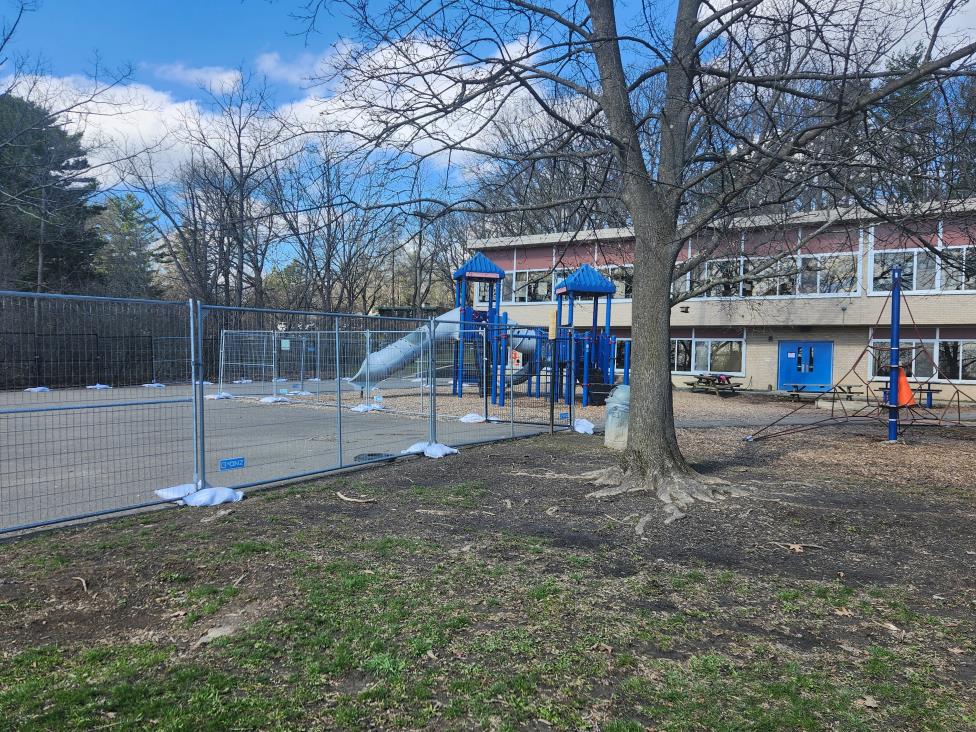
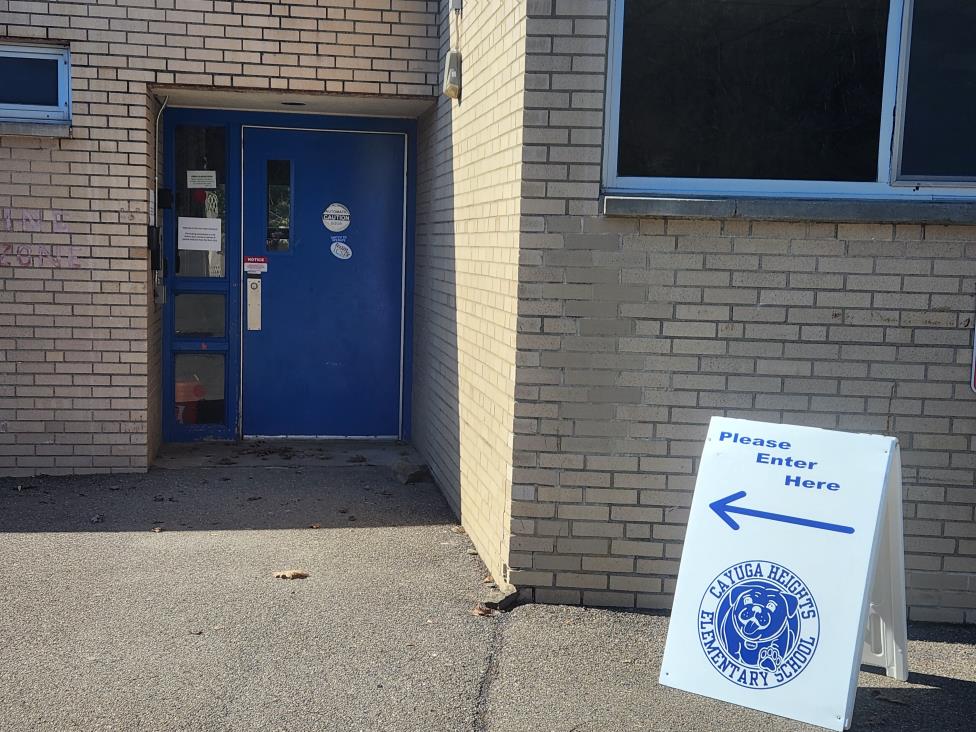
A walk around Cayuga Height Elementary School this Saturday would fail to alert the observer to their having been a flood. Of course, you’d need to overlook the contractor fencing, the signs on doors closing off entrances, and a little mud here and there.
The National Weather Service reports that more than two inches of rain fell during the 24-hour period that included the afternoon of March 31. Most of that rain fell during a brief afternoon cloudburst that caused the flash floods in Cayuga Heights, Ithaca, Enfield and elsewhere.
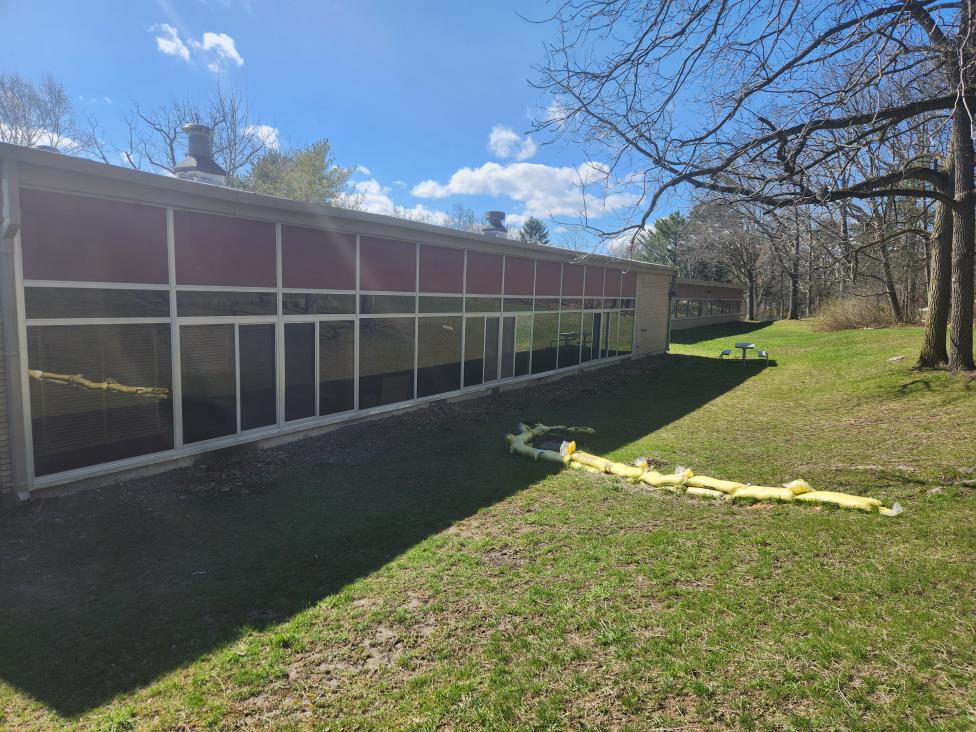
The storm is long gone, but the Cayuga Heights School’s first floor got soaked. Peering through windows at ground-level reveals naked floors and materials packed in boxes. One hears ventilation fans running.
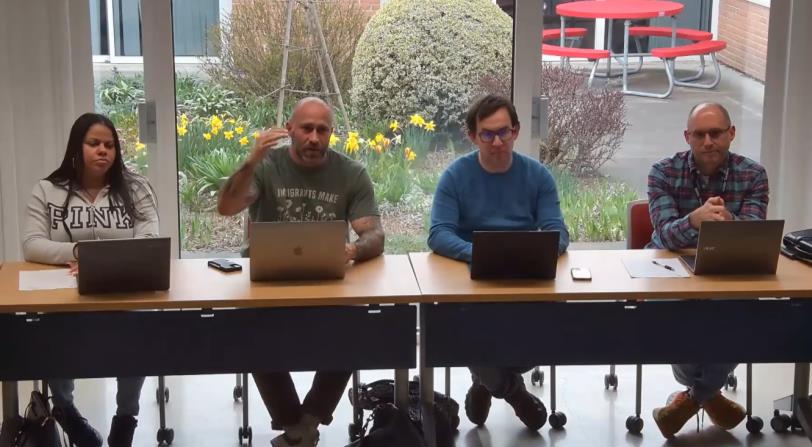
“Is this like correlated to the ongoing issue we’ve had with water runoff coming off the hill and kind of percolating under the building?” Todd Fox asked committee chair Garrick Blalock.
“It is, precisely,” Blalock answered.
A wooded lot stands behind Cayuga Heights Elementary. One can easily envision how a rushing torrent could slam against the school, go beneath it, and come up from under the floors.
Blalock said he’d toured the school the prior Tuesday. The committee made efforts to encourage every member to tour the building before the upcoming April 14 meeting.
Neither administrators nor board members described specific interior damage during the committee session. But a post-meeting summary, released Friday by district staff, referenced “mold and mildew concerns.”
Blalock urged that “modernization” of the building be considered, specifically to address the hillside runoff problem.
An ICSD profile states that Cayuga Heights Elementary School was built in 1956, closed briefly, and then reopened in 1989. The profile describes the school as “well equipped and maintained.”
In January, the school board received a Cornell professor’s report that cited Cayuga Heights Elementary, along with Enfield Elementary, as among three facilities the board could consider closing to address declining enrollment. The Facilities and Finance Committee never discussed possible closure during its Thursday meeting. Any decision on closing buildings stands months, if not years away.
****
The Facilities and Finance Committee had intended its April 9 meeting to be one to button down its next year’s budget. Spending within the more than $177 Million proposal is essentially set. Spending would rise by about five percent. Yet members have yet to decide the tax levy, and they’d planned to do so that day. They’d expanded the meeting to a committee-of-the-whole work session and encouraged all nine board members to attend. Seven did.
Back on March 24, when the full board last convened, administrators had offered three alternative tax scenarios. The levy could rise by 2.18 percent, 3.18 percent, or 4.18 percent, they said. The 4.18 percent number would fall just under the state-calculated tax cap for next year. Board members earlier couldn’t decide which number to pick, although Board President Dr. Sean Eversley Bradwell expressed a preference toward the middle number.
But that was before the Cayuga Heights flood.
“So capital has changed since the last time we met,” School Superintendent Dr. Luvelle Brown stated when discussion turned to budget planning. “We had a flood that’s cost a lot of money that needs to be replaced immediately,” Brown said. So from my perspective, yes, we have a fund balance for a reason. And the fund balance is going to be dipped into in a way that we didn’t think about two weeks ago.”
ICSD budget planners had used simple math to calculate their tax scenarios. Programs wouldn’t be touched, nor would payrolls. To reduce tax increases, the district would just dip deeper into its “fund balance,” its pot of accumulated savings. For each one-percent drop in the tax levy, about $1.15 Million in fund balance would need to be withdrawn.
But unforeseen flood repairs would need to come out of that fund balance. And money diverted to fixing a school can’t be used to cut taxes.
“Doctor Brown’s right; we did have a flood, and we don’t have the final bill yet. But we do know that it’s going to be substantial,” Blalock, chair of the committee, affirmed. “And so I have been, myself, looking at somewhere in the middle, but then we have to update, and now we know that we have this actual expense and we don’t have a number for it set.”
“I’m kind of tempted to hold off until we have that number,” Blalock hedged.
Contrary to what may have been its original plan, the committee never reached consensus on a tax recommendation Thursday. Board President Eversley Bradwell’s absence may have contributed to the drifting indecision. (Board member Emily Workman was also excused.)
Blalock said he had “a number in the back of my head” that might come close to what the ICSD would need to spend out-of-pocket for repairs at Cayuga Heights, but he declined to reveal it publicly. A figure of $322,000 was bandied around a bit, yet never stated definitively. The $322,000, of course, would stand on top of any insurance reimbursement. (There’s apparently no deductible.)

The most likely levy increase emerging from Thursday’s meeting was one between 3.4 and 3.9 percent.
“I’m recommending we do three-nine, and you can say I don’t like your recommendation, or I do,” Superintendent Brown initially advised the committee. “I don’t think we need to go above four (percent), and I like the three-nine number.”
“I think we need the three-nine based on what’s just happened and to keep our trajectory and fund balances healthy for the next three years according to my formula,” Brown stated.
That said, before the committee had adjourned, Brown had amended his recommendation downward to a 3.4 percent increase. And it reflects the fact that Ithaca’s tax increase has become very much a moving target. It’ll likely come to rest somewhere between 3.4 and 3.9 percent. But just where it falls may depend on the flood damage estimates yet to be received.
What the increase will certainly not do—barring a monumental change in thought—is to stray above the 4.18 per cent tax cap. If it did, the budget would require 60 percent approval at the polls.
“I’m absolutely committed to tax relief,” Blalock stated. “I’m absolutely committed to coming under the tax cap. It’s just a question of how much.”
Todd Fox was elected to the Board of Education two years ago in a taxpayer revolt against high budgets. Seventy percent of voters turned down the ICSD budget that year.
“I feel like we could go closer to three percent this year,” Fox told Thursday’s meeting. “I think we reevaluate next year, and I think there’s enough of a fund balance,” Fox said.
Todd Fox’s drive for frugal taxation likely led the Superintendent to amend his recommendation downward; that is, to 3.4 percent.
Whatever budget the Ithaca Board of Education eventually recommends this coming week must still win voter approval in the May 19 referendum.
Cayuga Heights Elementary School’s teachers and staff made miracles happen to open their school little more than five days after the flash flood had soaked it. Maybe their stories get told another time. But Garrick Blalock has already credited Principal Aileen Grainger and her instructors for a job well done
“I just wanted to acknowledge the really heroic efforts of staff of Cayuga Heights in getting that school up and running,” Blalock told committee members. They worked over spring break and “they gave up their weekend so that school was ready to open on Monday morning,” he said. “I want to shout out to her team. That was really a commendable effort.”
###