

Lawmakers stick with a close-to-the-Courthouse Center of Government, yet split on size and cost

Reporting and Analysis by Robert Lynch; March 9, 2026
“It’s striking to me that we could buy a house for each person that’s going to be working in this building for the cost of this project.”
Tompkins Co. legislator Judith Hubbard; Center of Government discussion, March 3.
A newly-sworn and radically overhauled Tompkins County Legislature took its first turn these recent days toward changing course in building a downtown-based, ever-more-expensive Center of Government. The Legislature didn’t alter that course. Members failed in their attempts to do so, yet still took forever that night to acknowledge their deadlock.
What legislators circled back to at their March 3 meeting, but only after nearly three hours of endless, exhaustive debate, was the default reaffirmation of a June 2025 resolution that commits county government and us taxpayers to construct the Courthouse-adjacent building. Last year’s blueprint may prove outdated, however. Price increases and revised operational demands may render last year’s design concept either ill-advised or impossible to build.
The marathon meeting’s most telling take-away, however, may involve those paths no longer considered.
Lawmakers last Tuesday signaled zero interest in replacing their preferred downtown vision with something else, someplace maybe cheaper. Virtually ignored were frugal alternatives like vacant office space at Harold’s Square on the Commons, the modern, minimally-occupied buildings at the Cornell Business Park near the airport, or the now-deserted retail wasteland that once comprised at the Shops at Ithaca Mall.
Back on June 3, by a nine-to-four vote, the Legislature approved a resolution expressing intent to fund “up to $50 million… for the development of the Center of Government (COG) project to be located on the 300 block of North Tioga Street.” That was the last significant public direction given architects and administrators. The resolution called for a new building of 45,000 to 48,000 square feet.
Yet by the time Holt Architects presented their schematic drawings to the public last December 8, what had emerged was a 59,000-square foot, four-story edifice for the corner of Buffalo and Tioga Streets, a structure significantly larger and more costly than the building conceived and authorized six months earlier.
“There was a vision that was set,” County Administrator Korsah Akumfi sought to explain to quizzical legislators at this more recent March meeting. “So the size and scope of the building has increased over time based on that vision,” Akumfi continued. “That’s the reason why there’s been some degree of cost increases and size expansion.”
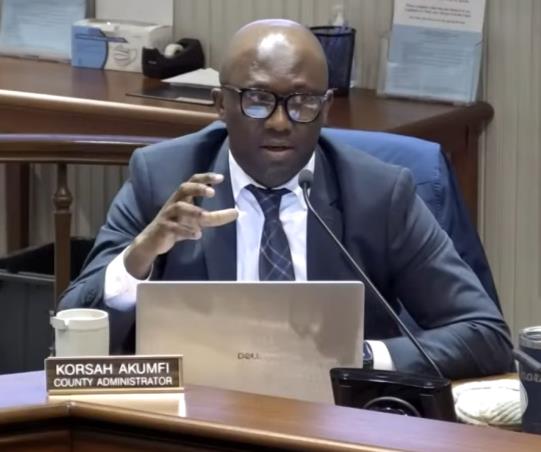
It may be Administrator Akumfi’s way of explaining away the unexplainable; of justifying why rules that were set were not later followed. Korsah Akumfi wants a new, fully-sized Downtown Center of Government. He wants to make the vision reality.
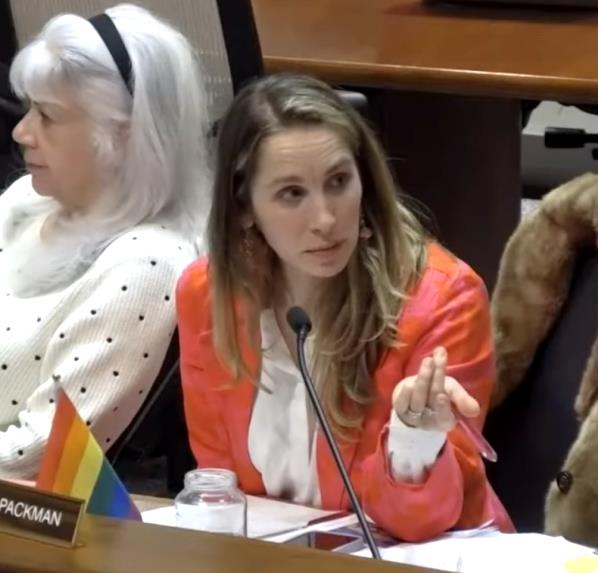
“So can we build a 48,000 square foot building for $50 Million?” Iris Packman, who only joined the Legislature in January, asked project planners.
“I can’t do that math in my head,” Holt Architects’ lead designer Quay Thompson answered. (True, he should have anticipated Packman’s question.)
“I think that even Holt sort of put this a little bit naïve number of 48,000 square feet and $50 Million on the table; like that’s on my shoulders,” Thompson admitted, somewhat sheepishly. “As we got in deeper in the real moment, it wasn’t a 48,000-square foot building to solve the problem,” the architect explained. “So the problem that we were trying to solve that we thought was a 48,000 square foot building and a $50 Million budget turned out to be a 57,000-square foot building and a $60 Million budget.
Over the course of the fall and early-winter, a County-sponsored webpage that tracks the project had quietly crept the project’s price tag upwards to its presently-estimated $64 Million.
Still, it could have been worse, much worse. “I don’t want to freak people out,” Thompson revealed, perhaps publicly for the first time, “but the first estimate we got back was like $74 Million, and we weren’t going to present that building to you,” the architect assured. Extras, he said, were cut.
As with so much of the Center of Government’s tortured travels these past months—indeed, past years—the public becomes the last to know of what’s being decided. The March 3 meeting proved no exception.
The night’s agenda had listed only a “Special Topical Presentation and/or Discussion;” on the project, namely the County Administrator’s “Center of Government Project Update.” A multi-page compilation of PowerPoint slides was included in the agenda packet posted online about a week earlier. It offered no resolutions listed nor indications given that action that night would be taken.
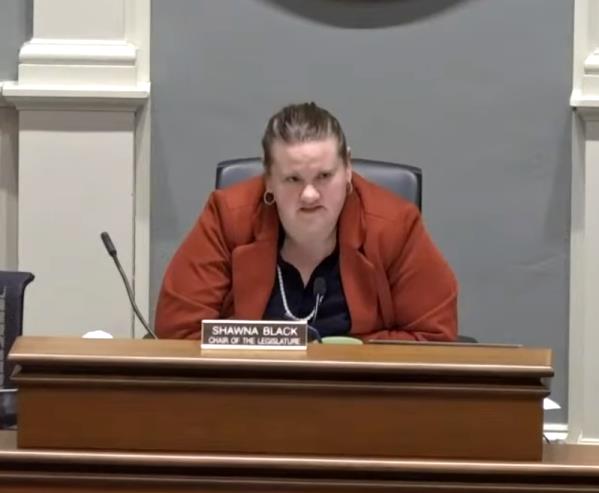
Yet midway through the marathon discussion, Legislature Chair Shawna Black sprung two competing resolutions on colleagues. By their reactions, legislators knew they’d be asked to vote. It was only those of us on the outside that hadn’t a clue.
This past January, the Legislature’s membership had turned over by 50 percent, Black would later explain. “If I were a new person, I wouldn’t support what the people before me supported,” the Chair insisted.
Shawna Black’s parliamentary initiative pushed to the limits the dictates of New York’s Open Meetings Law. That law is supposed to require “to the extent practicable” that action items get publicized 24 hours in advance. There was no emergency here, just a legislature chair’s preference. “Practicable” necessity regularly gets stretched in legislative chambers (just as it does, for that matter, by the Enfield Town Board). No matter. Legislators accepted the agenda’s additions willingly. No one bothered to seek the County Attorney’s opinion.
The resolutions, we were told, were drafted by County Administration at Shawna Black’s request. One of them would pay deference to reality, acknowledging that costs and departmental needs had grown, and would enlarge the Downtown Center of Government’s size to the Administration’s recommended 57,000 square feet and inflate project cost to as much as $60 Million.
A second, scaled-back alternative would contain the new building to a maximum 40,000 (originally 37,000) square feet and limit maximum cost to $45 Million. Rough calculations that night projected the property tax levy would rise by three percent for the leaner option, by 4.5 percent for the more expensive choice.
Battle lines were drawn; strategies plotted; votes taken. But decisions came only after debate; much, much debate.
Both resolutions would fail in the end. First, the 57,000-sqiuare foot option lost, seven votes to nine. Then, the scaled-back alternative failed as well, six votes to ten. Many of those who supported one resolution opposed the other. After their second vote, legislators, bewildered, exasperated, and woefully deadlocked, retreated to a half-hour’s worth of other business, then to an executive session, and then went home.
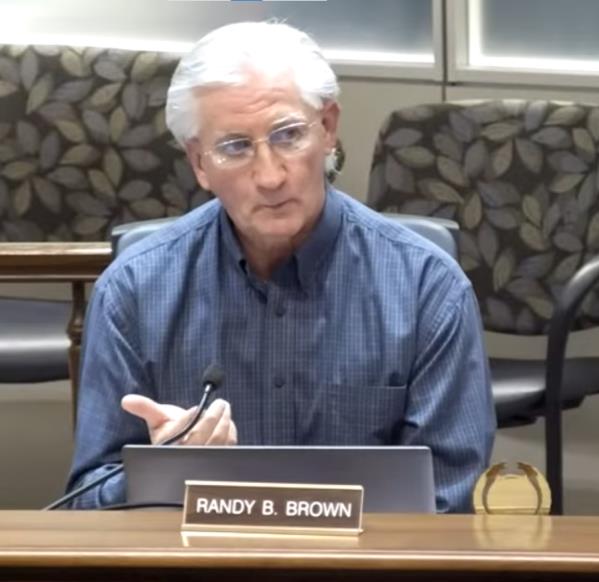
Among lawmakers representing Enfield, Democrat Rachel Ostlund supported the more expensive choice, but opposed the scaled-back alternative. Republican Randy Brown first signaled he’d endorse the 37,000-square foot scale-back, but ended up opposing both resolutions.
“My constituents, by the way, are not for this—any of it.” Brown said of the Center of Government. “I think we need to measure ourselves,” Brown continued. “You need to meet people where they are, and they’re not at this building,” Newfield-Enfield’s legislator observed. Brown would prefer Tompkins County seek out unused “public-facing” space at local schools.
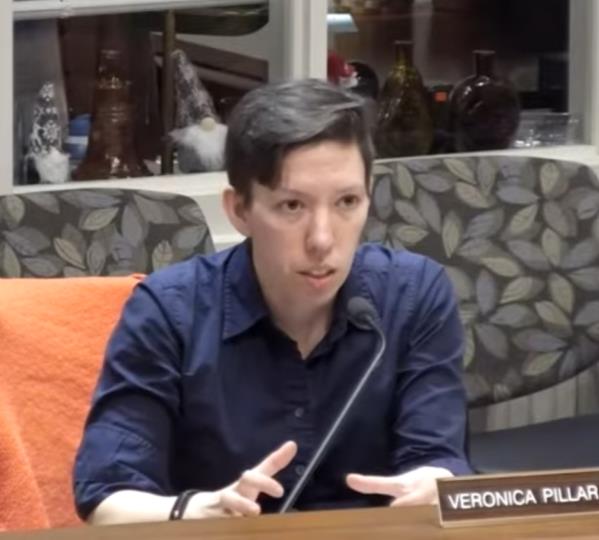
Ithaca’s Veronica Pillar emerged as a leading proponent of the big building option.
“I think the question is, are we going all in with—we are going to give our employees what they need to do their jobs… or are we going to continue to squeeze for the goal of saving tax money from our constituents?” Pillar questioned.
“It’s not nothing to raise property taxes,” Pillar acknowledged, “but no one’s going to be like, ‘My gosh, I’m so glad the county tax levy was like kind-of low; I’m so glad they made that building smaller.’ They’re going to be like, ‘My school taxes are high,’ or whatever it is.”
A newer legislator, Ithaca’s Judith Hubbard, drew a different comparison, one that raised a number to remember.
“If I take the construction cost of the buildings and I divide them by the number of people who are going to be working in the building, those costs… are between 325 and 380 thousand dollars per person, which is the cost of a median house in the county,” Hubbard pointed out. “It’s startling to me that we could buy a house for each person that’s going to be working in this building for the cost of this project,” she said. “I just don’t know how to wrap my head around that fact.”
Korsah Akumfi pushed back on Hubbard’s comparison.
“This is a public building,” the Administrator countered. “So we cannot quantify the cost by the number of people who will be working there, but we need to look at the intrinsic value of the building (to) the community as well and the number of residents that will be accessing services and issues of that nature.”
Akumfi compared the COG to the Tompkins County Public Library, renovated for government use decades ago at a cost of $10 Million. It employs just 20 people.
“I don’t think that’s a reasonable comparison,” Hubbard responded. She noted that the library lends books.
Judith Hubbard, like Randy Brown, opposed both resolutions.
The Center of Government design that Holt architects unveiled last December would stand four stories tall. To pare down size and cost, designers would likely delete its planned fourth floor, yet provision the building to accept one or two more stories later, should government grow to demand added space.
Departmental relocations for any downsized project never drew much discussion at the March 3 session.
“We’re not going to be putting departments into rooms,” Shawna Black told lawmakers that night, admonishing them not to get too granular. Nevertheless, if the building’s top floor is lopped off, the resulting departmental musical chairs would likely retain Workforce Development in rented space, rather than move it to the Old Jail.
Under Administration’s calculations, a 37,000-square foot building could accommodate 105 full-time equivalent employees. The larger option would accommodate 165. The half-measured option would keep several departments in leased space indefinitely.
“So on a 50-100-year building, 20-24 extra work spaces isn’t rally that absurd, and a 37,000-square foot (building) is really underbuilt and not sufficient from day one,” Dryden legislator Greg Mezey concluded.
During the evening’s discussion the inadequacy of on-site (or even available off-site) downtown parking was carefully glossed over. It never got mentioned. Nor were the other detractors of downtown construction seriously examined, problems like limited expansion opportunities, heightened building costs, and recent increases in downtown crime.
Instead, a footprint firmly anchored in downtown Ithaca soil emerged as a foregone conclusion.
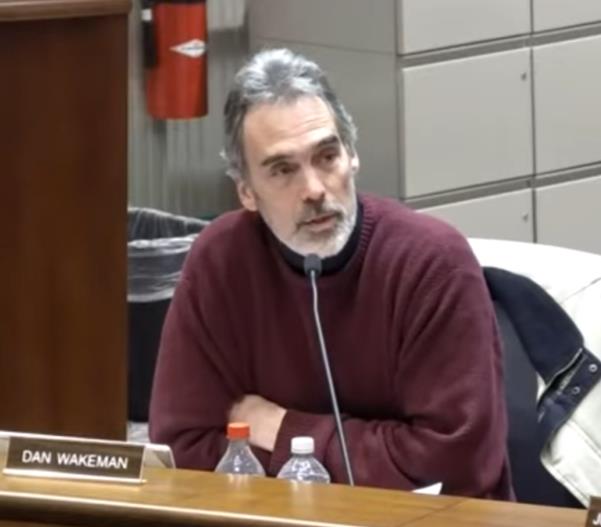
“We have accomplished a lot already,” Dryden’s new legislator, Dan Wakeman, observed. “We have determined that we are not doing several different things, and we want a building downtown. Remember that everybody,” Wakeman established.
During January and early-February, as new legislators were christened and veteran lawmakers commenced their fresh terms, the Tompkins County Legislature convened a trio of closed-door executive sessions, meetings totally apart from their public gatherings. One can infer that alternatives like Harold’s Square and the Cornell Business Park were considered, and then discarded during those closed conclaves. meetings that none of us could attend.
About the time the June 2025 resolution gained passage, the business park option and its cornucopia offering of as many as 18 foreclosed buildings came to light. Administrator Akumfi was cool to the business park idea and recommended against it. Then, last September, Harold’s Square owners approached the Legislature in near desperation, asking Tompkins County to buy or lease long-unrentable office space. Again, Administration proved reticent. Administration wanted, and still does want a downtown, stand-alone structure. They want it to the point of twisting arms.
“I was not for Downtown originally,” Greg Mezey reminded colleagues. “I encouraged us to look at alternate spaces.” But now, he said, “I feel very confident that I can go back to my constituents and say we have turned over every rock, we have looked in every corner of the county… and this really in the long-term health of the county is the best possible solution.
Greg Mezey’s departure from “what-else” alternatives likely seals the deal for a downtown choice.
“Of course, you’ve got to look at Harold’s Square. It’s right there, for goodness sakes,” Lansing’s Mike Sigler, a frequent skeptic of downtown construction, reasoned. “It would be ridiculous for us not to look at foreclosed properties up at the airport,” Sigler likewise reasoned. “And that didn’t work out, either,” he lamented. “And of course, we’re always going to look at the mall, because we always look at the mall.”
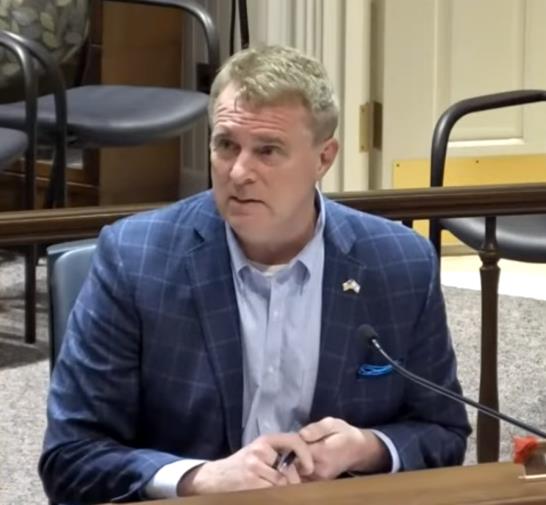
But Sigler was more than a touch annoyed March 3; upset that legislative directives were not followed, that the Legislature last June instructed one thing, and administrators and architects did something else.
“Why wasn’t this directive followed?” Sigler asked anyone who would listen. “So you’re asking me for mission creep, all the way up to beyond $65 Million. I just couldn’t get there,” he said, adding, “But now I’m looking at this eight months later and I’m going why don’t we just like follow the resolution that was there?”
Shawna Black and legislator Deborah Dawson usually stand allied. That recent Tuesday night they departed, throwing a verbal jab or two.
“I’m astonished to hear people say we don’t want to put constraints on this project,” Dawson spoke out. “It’s our job to put constraints on things. It’s our job to put constraints on spending.”
And pushing back on Black’s desire to offer new legislators an opportunity to shift direction or even reverse course, Dawson stated, “If there’s anything I hate it’s wasting time. I hate it when people waste my time. And I agree with Mike (Sigler), if we’re going to end up with what we passed eight months ago, we have just wasted a colossal amount of time.”
And that’s just about all that’s been done so far, other than to unveil an oversized, overpriced, arguably ugly building. One legislator on meeting night tried to calculate how much member compensation got wasted because debate had dragged for three hours. Of course, members get paid a salary, not by the hour.
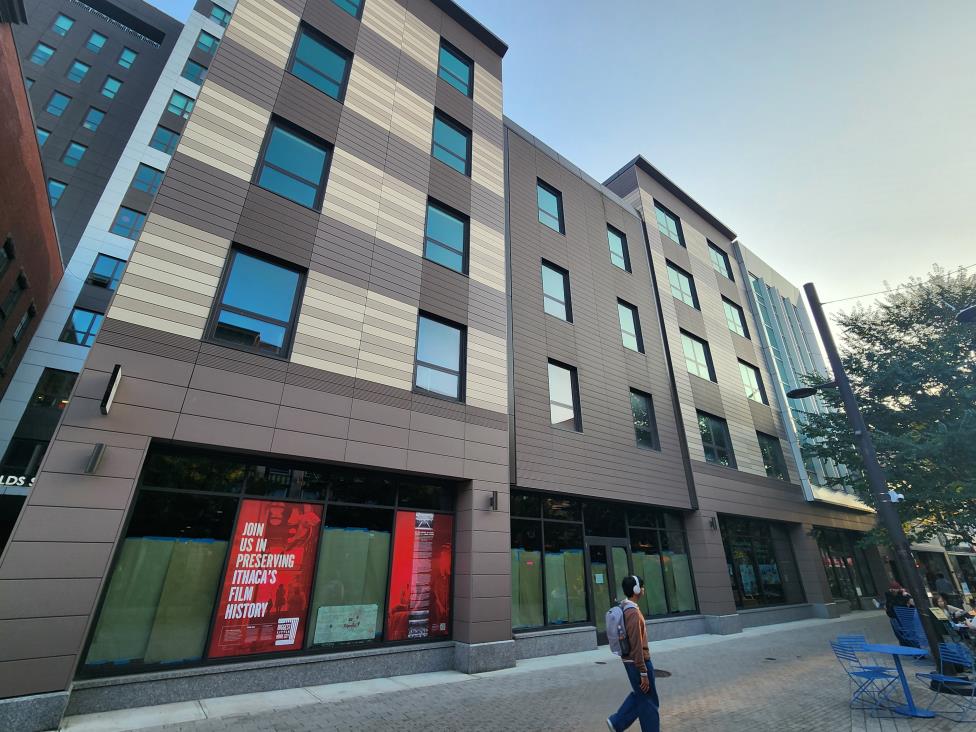
And for now, the resolution of last June remains the Center of Government’s guiding directive. A 48,000-square foot building size and a $50 Million cost ceiling remain the standard. Designers must return to their drawing boards. And maybe administrators must curb their appetites as well. Maybe.
Groton’s Lee Shurtleff recalled last June’s building promises. He opposed the project then. He’d support it now.
“One of the guiding points that night was this was not a commitment to a contract, but a commitment to the project, to the tune of $50 Million” Shurtleff recalled. As for the present, “I know that we have to move forward and that significant construction has to occur,” Shurtleff said.
There’s a futility in all of this, of course. Shawna Black warned that the absolute moment of truth won’t arrive until construction bids get opened, weighed, and then accepted or rejected; that is, presuming that the Center of Government ever advances that far.
“It doesn’t matter because the numbers are really going to come in where they come in,” Black cautioned, “and we’re going to have to make that decision at that point.” In other words, do or die.
“I think the idea of compromise is an interesting sort of political solution,” architect Quay Thompson remarked at one point in the discussion. Read into that what you may.
Then, again, as Mike Sigler suggested, presumably in jest, yet perhaps carrying a grain of truth, maybe we should just buy each County employee a house. They could all work from home. It would be cheaper.
###