
Enfield Board suggests first-ever Sign Law; advances senior tax “sweetener”

by Councilperson Robert Lynch; February 16, 2026
It grew out of a single, fleeting call to Enfield’s Codes Officer. “Alan (Teeter) was approached by someone who had questions about billboards,” Town Supervisor Stephanie Redmond first informed Town Board members when they met January 14. One month later, Teeter would describe the inquiry as only “kind of general.”
That said, Redmond got worried. And other Board members have grown to share her concern. As a result, the Enfield Town Board at its February 11 meeting instructed the Planning Board to begin drafting a first-ever sign law. It would be a law to regulate off-premises outdoor signage, if not ban new billboards altogether.
Mind you, it’s not that billboards are proliferating wildly in Enfield. The only ones the town has right now are those adorning two sides of a metal storage shed at 1683 Mecklenburg Road (NY Route 79). The boards beg for business. They currently have no takers. They’re just naked sheets of weathered plywood.
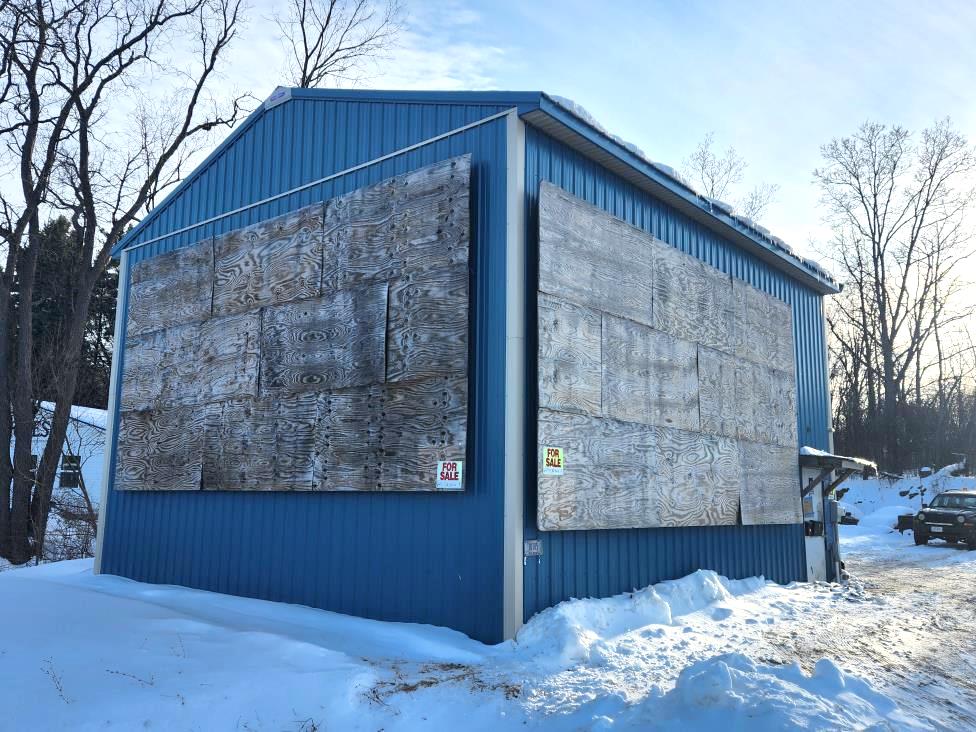
“I don’t worry about that,” Redmond said of the Mecklenburg Road boards at February’s meeting. “I just don’t want to be going down Hayts or 79 and seeing billboards all the way through.”
Banning new billboards—if that’s what Enfield wants—is a tricky thing to do, Planning Board Chair Dan Walker told the Town Board this month. Any billboard regulation has to find its place within a more comprehensive sign law, Walker advised. And you can’t just tuck the regulations within the Town’s Site Plan review Law, he cautioned, because putting the rules there would imply that billboards are normally allowed.
“I just don’t see that there’s going to be big demand because we just don’t have that much traffic,” Walker told the Town Board concerning billboard proliferation.
The Planning Board Chair offered as fact a statistic that outdoor advertisers purportedly want to see 20,000 vehicles traveling a highway each day to make a billboard cost-effective. One may think Route 79 carries a lot of traffic, but apparently not 20 thousand cars a day.
“I’d rather be protective about it,” Redmond responded. “I don’t want ‘Billboard Enfield.’”
The Supervisor found no objections from others at the table that night. The Town Board weighed the potentially overstated billboard threat for a brief ten minutes during its two-hour February meeting.
“I am along with the Supervisor on this one because Enfield has its rural character,” Councilperson Robert Lynch (this writer) affirmed, the only Town Board member to extensively address the issue other than Redmond.
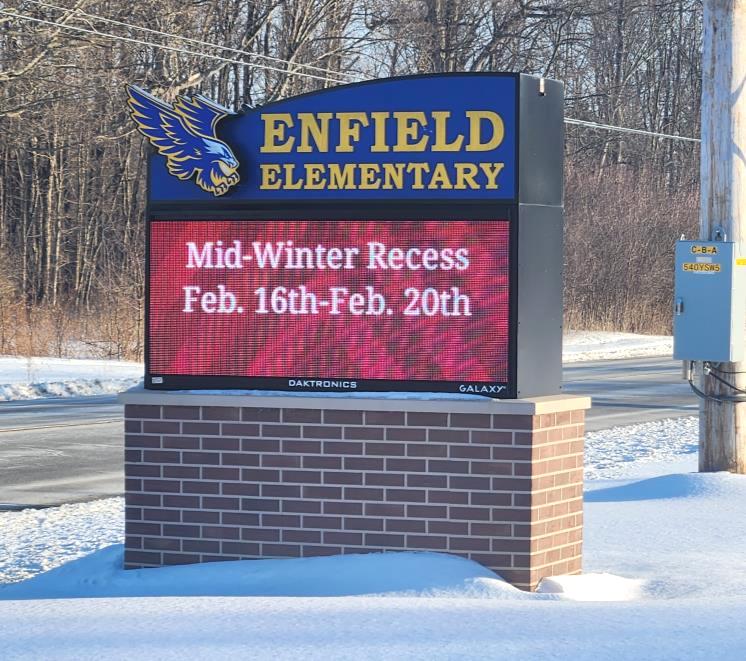
“Old-fashioned” fixed billboards aren’t too bad, Lynch said. Neither are those smaller, lighted signs outside the Enfield Community Council and the Enfield School. “But you get those lighted billboards with moving graphics, and it really commercializes; it makes little Enfield into Times Square,” Lynch observed. “And I think that’s a situation where sometimes libertarianism has to take a back seat to responsible recognition of the nature of the community we are, which is a rural community.”
Neighboring Newfield has its own sign law. It was adopted in 1989, and then amended in 2003. The initial law ran 16 pages; the later amendment added a few pages more. The 1989 law provided that all billboards not conforming to the new regulations had to be removed by 1996 or else brought into conformance with the law. The 1989 law had banned billboards outright. The 2003 amendment implied some signs greater than four-by-eight feet could be allowed, but only when given landowner consent.
The Town of Ithaca’s sign regulations stand far more complex. They occupy a separate, 19-section chapter of the Town’s exhaustingly-complex Zoning Law. The Ithaca law explicitly prohibits “off-premises signs, as well as “animated signs and all electronic message centers… including signs with blinking, flashing, strobe, chasing or alternating color lights or moving parts or messages.”
“The sign law from Newfield is really long,” Walker advised the Enfield Board. “I don’t think it needs to be that extensive,” he said. (Of course, Ithaca’s law is much longer.) Based on Walker’s assessment, envision the Enfield Planning Board handing up something that might run two or three pages. “I don’t think we want to overdo it,” Walker cautioned. “I don’t think the Town wants to regulate every sign.”
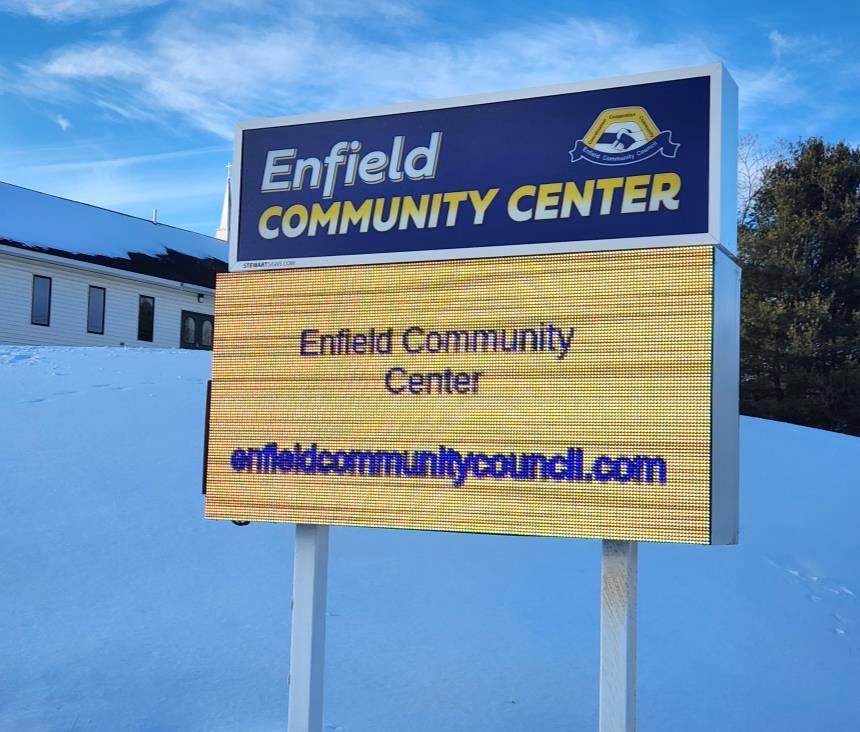
Whatever the Enfield Planning Board comes up with in the months ahead, don’t expect it to force removal of those plywood sheets facing Mecklenburg Road; or for that matter, the front-yard markers at Enfield Elementary or the Community Center. Each would likely be “grandfathered” into any new law, if not permitted outright given the yard markers’ modest size.
Had the Enfield Fire District secured a major, federally-sponsored recruitment grant last year, some of the proceeds might have been spent erecting yet a third electronic sign along Enfield Main Road, one to promote the Enfield Volunteer Fire Company and to invite new members.
But in late-December, Board of Fire Commissioners’ Chair Greg Stevenson announced that the “Staffing for Adequate Fire and Emergency Response (‘SAFER’)” grant had been lost to others. There’ll likely be no money for any new sign.
“I think what we’ve got right now in Enfield is OK,” this Councilperson, Lynch, advised the Town Board February 11. “But what is going to happen in the future? That’s what we have to think about.”
On another matter, the Town of Enfield will need to move fast. But if completed quickly enough to satisfy Albany, a few of Enfield’s older adults may qualify for an enhanced property tax benefit next year.
By unanimous vote, the Board February 11 scheduled a legally-required public hearing for two weeks thereafter. The February 25 hearing will take comment on a proposed local law to expand the senior citizens tax exemption for those with the lowest incomes, raising the exemption to as much as 65 percent. The current maximum exemption is 50 percent.
The enhanced exemption results from state legislation signed last year. But to apply to property owners’ bills next January, the local law must be adopted and filed with the Secretary of State before March 1. Counting the days required for posting and notification, the Town will just barely meet the deadline.
The extra benefit was defined as an “additional sweetener” during Board discussion. It would affect only those seniors—and just seniors, not disabled persons—whose adjusted annual incomes, calculated under state criteria, fall below $34,000. Those earning less than $32,000 would receive the full 65 percent exemption. Those with incomes between $32,000 and $34,000 would gain benefit on a sliding scale.
Enfield action followed a similar move by Tompkins County legislators, who earlier in the month scheduled a February 17 public hearing to address their own exemption that would apply to the county portion of January tax bills.
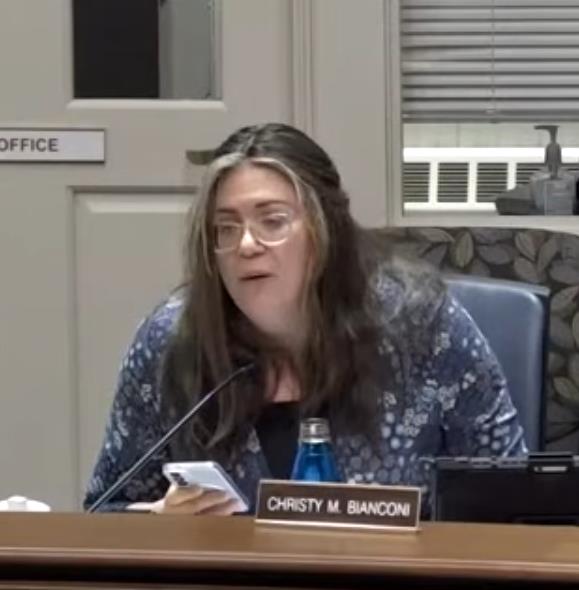
“My parents had to leave Tompkins County because property taxes on a fixed income became unaffordable,” newly-elected county legislator Christy Bianconi said February 3 when she advanced her own version of Enfield’s newly-proposed exemption. This law, Bianconi said, “helps seniors stay in the homes that they have, and this also helps those who live with seniors to stay in their homes as well.”
Tompkins County Director of Assessment Jay Franklin, in an email of Enfield the day of its Board’s meeting, estimated the local change would for the rest of us raise Enfield’s tax on the median house by between four and five dollars, but save the fully-qualifying senior $100.
Among other Enfield Town Board action February 11:
- The Board authorized a new one-year lease agreement with the Tompkins County Sheriff’s Department for the department’s rent-free use of a portion of the former Highway Garage at the Town Hall as a satellite station for law enforcement. The station’s been in use since 2020. Supervisor Redmond indicated the Sheriff would like to employ a second bay in the five-bay garage for parking. But members left that revision for future negotiations.
- The Board discussed, but did not resolve, an issue which could cost Enfield dearly in the years ahead. The problem stems from the Ithaca Area Wastewater Treatment Facility’s (IAWWTF’s) decision late last year to no longer accept stored drain wastewater from the Enfield Highway Facility, effluent that it’s accepted by truck for years, but without a permit. The Town is proceeding on parallel tracks. It’s seeking bids for more expensive, long-distance trucking to treatment plants elsewhere, and also taking steps to secure a valid IAWWTF permit.
- The Town Board accepted Codes Officer Alan Teeter’s recommendation to slightly raise building permit fees to adjust for inflation. Under the revised schedule, permits for improvements of between $1 and $5,000 in value would rise from $50 to $75.
- And proceeding steadily, albeit cautiously, toward revising Enfield’s 2012 Site Plan Review Law, and weighing revisions recommended more than a year ago by its Planning Board, Town Board members agreed to one significant change. They recommended that when site plan reviews call for a public hearing, the radius of neighborhood notifications expand outwards from the current 600 feet to approximately one-half mile. The change followed complaints voiced by some who said they weren’t notified when they should have been.
###