ICSD Board weighs three tax options in low-key fiscal rollout
by Robert Lynch; April 4, 2026
Memories of the Ithaca City School District’s taxpayer tea party trauma of 2024 are not lost on anyone, certainly not on current members of the Ithaca Board of Education and the administrators they employ.
In case you hadn’t noticed—and most people, including reporters with the Ithaca media, haven’t noticed—the Ithaca City School District (ICSD) is close to finalizing its next year’s budget. In fact, the spending plan is almost set in place, pending, of course, the required voter ratification in May. All that the board has yet to do is to agree on a tax levy. And judging from discussions at the most recent school board meeting, there may not be much for voters to complain about this time around.
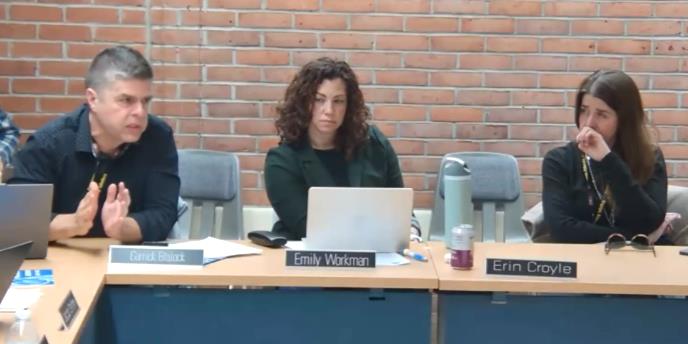
“In terms of expenditures, I’m solid with what we have,” Garrick Blalock, chair of the school board’s Facilities and Finance Committee, said as he described the proposed $177.6 Million Dollar budget’s spending tally during the board’s March 24 meeting. ”I think that’s a lock.”
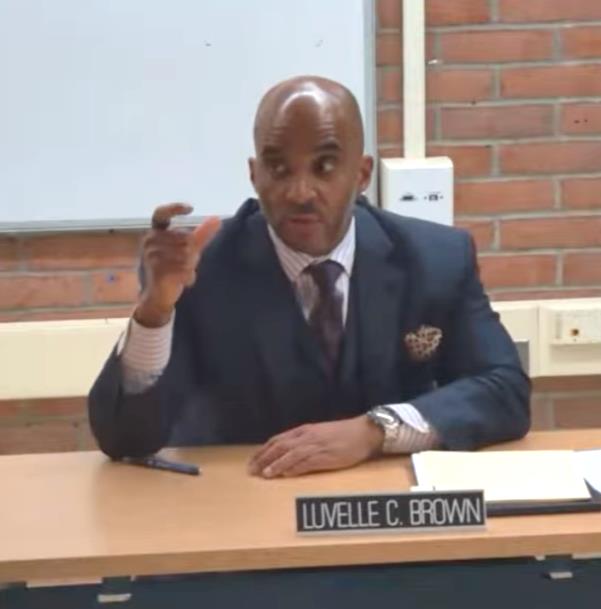
“We think we’ve put together a funding request that will meet the needs of our learners,” School Superintendent Dr. Luvelle Brown stated. There are “no significantly new initiatives,” Brown stated, “and no significant cuts to anything we’re doing currently.”
Proposed spending would rise by just over five percent from that of the current year’s $169 Million budget.
What’s not yet a” lock,” to employ Blalock’s terminology, is the tax levy. In response to an earlier school board directive, Dominick Lisi, Assistant Superintendent for Business and Finance, provided three alternate taxing scenarios at the March 24 meeting. Each of the three would keep the tax increase to within New York State’s calculated “tax cap.” The highest of the three would fall just under the cap. That option would raise property tax revenues by 4.18 percent.
The two lower-tax options would raise the levy by 3.18 percent and 2.18 percent, respectively. And because each alternative would be tax-cap compliant, the budget would require only a simple majority—not a 60 percent supermajority—to pass.
To make the lower-percentage choices work, the district would tap accumulated savings—defined in school parlance as “fund balances”—to cover the shortfall. The 2.18 percent option would drain nearly $2.3 Million from fund balances. The middle-ground 3.18 percent choice would use about $1.15 Million of the savings. The 4.18 percent option would tap none of the savings at all.
“I am as one board member of the belief that we have a fund balance for a reason,” Board President Dr. Sean Eversley Bradwell, told those at the meeting. And there are times, Eversley Bradwell said, “in which it is necessary to mitigate the costs to the taxpayers.”
“I would be much more inclined to be thinking about a 3.18 (percent) increase to the levy as opposed to a 4.18,” Eversley Bradwell said.
And as for taxpayer recognition, no board member at the March meeting challenged the lesson painfully learned in 2024.
Just two years ago, in the early spring of ’24, administrators first brought forth a proposal that would have raised the tax levy by more than 12 percent. The school board wisely cut the increase to 8.43 percent.. But in that year’s May referendum, the board-revised budget lost. It lost badly. Whereas ICSD budgets generally sail to approval in a calm sea of school-friendly voters and benefit from apathy and a light turnout, the initial 2024-25 budget referendum saw seven out of every ten voters reject what the board had handed them to decide.
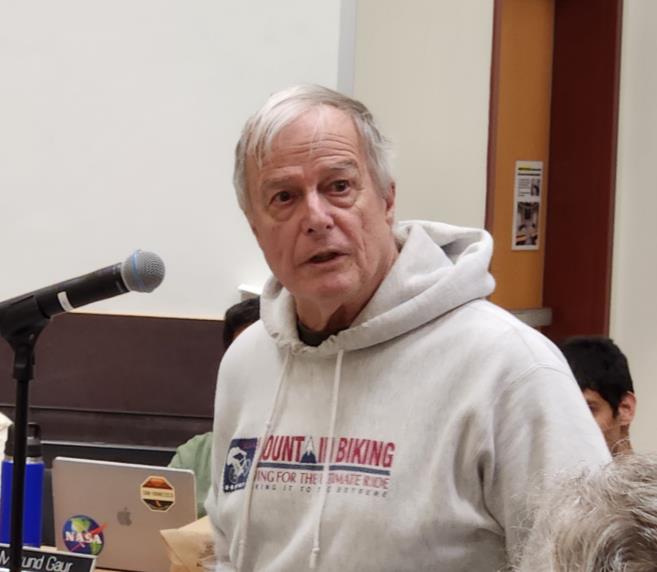
Turnout in that May ’24 election was heavy. A capital spending proposition was also rejected, and two incumbent board members were turned out of office. For the ICSD, it may have been an election anomaly, but it was still a traumatic ordeal.
The Board of Education regrouped. A trimmed-down budget passed one month later, with nearly three in every four voters supporting it, the revote election’s turnout much smaller. The revised 2024-25 budget kept the tax levy increase to less than three percent.
Last spring, school board members took pains not to make the same mistake twice. They advanced what quickly earned the now-despised nickname of a “rollover budget.” It launched no big initiatives and took no unnecessary risks. It raised the tax levy by 3.76 percent. Seventy-seven percent of district voters supported it. ICSD’s annual elections had returned to their predictable path.
“We won’t use that term ‘rollover budget’ ever again,” Superintendent Brown assured his audience on March 24. “But I hope folks do understand we are maintaining our programmatic offerings for the most part.”
“I’m the one that made the mistake and used the term rollover budget,” Eversley Bradwell apologized, “and realizing how inappropriate that was.”
Yet, two observations deserve clarity here. First, what’s likely to be placed before Ithaca voters in this coming May’s election will, indeed, likely be a ‘rollover’ budget in its impact, if only not in its name. And second, more significantly, the $177,638,041 proposed budget now on the table is still some $6.7 Million higher than was the $170.9 Million budget that Dr. Brown first proposed in 2024, the one that never even got to the electorate, the one that carried the infamous 12 percent tax hike.
School budget planning has a way of proving the old “boiling the frog” apologue. A series of little tax hikes wins greater acceptance than does just a single big increase all at once. Yet little by little, year by year, one gets to the same place. The frog boils.
“The cost of living has gone up a bit, energy costs and so on,” Dominick Lisi explained to the board as to why totals have crept up. And, he acknowledged, “Our contract obligations certainly play a role in that.”
Influential among those contract obligations are those newly-negotiated with Ithaca teachers. One budget line, labeled “Instructional Salaries,” states a 7.38 percent rise in the new budget, an increase about in line with the annual raises negotiated last fall.
“We’re probably in a four or five percent world when we think about all the inflationary costs, everything that’s coming at us,” Superintendent Brown observed. ”And I think we have a budget and a funding request that represents the kind of fiscal reality we’re in,” Brown reflected.
The Board of Education spent only about a half-hour of a much longer meeting March 24 listening and talking about the budget. And almost a third of that allotted time got eaten up in merely deciding when to talk about the budget again. Members informally repurposed a previously-scheduled Thursday, April 9 committee meeting to become a board work session. Expect those few dangling details to be tied up that night. The school board expects to formally adopt the budget April 14.
School district voters will pass final judgment in a May 19 referendum.
But budgets can only be best-guess predictors of what lies ahead. What if there’s a surprise?
“There are always things that we don’t foresee. So particularly oil prices skyrocketing came out of what felt like nowhere,” Board member Erin Croyle, a program-friendly, fiscal progressive, cautioned during the late-March session. “So when we’re thinking about how unpredictable things are right now, I think about safety,” Croyle said.
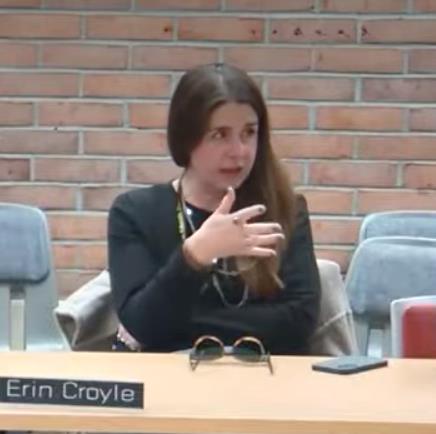
Lisi and Brown attempted to assure Croyle that uncertainty has been addressed.
“So energy has traditionally cycled, and we have to take that into consideration when we plan the budget,” Lisi answered.
“We’re talking about a 170-some Million (budget). You should be expecting your superintendent, your business official and the team to manage those kinds of spikes in any particular area with that kind of money and the kind of fund balances that we have,” the Superintendent assured Croyle.
Dr. Brown posited it’s actually easier to manage uncertainty with larger budgets like his because an unexpected increase in one area can more easily be compensated elsewhere.
Aside from the board president’s preference for the mid-point option, none of the eight school board members present March 24 (Madeline Cardona was excused) expressed a clear opinion as to which tax percentage would best meet their comfort level. Nevertheless, Finance Committee chair Blalock did say he’d like a better forecast as to where future fund balances and budgets may go.
But judging from the general, understated consensus evident that night, don’t expect any additions or subtractions from expenditures before the $177.6 Million budget goes to voters in a month.
Never spoken about during the March meeting were school buses. But a glance at the ICSD budget page indicates that the school board has already decided, apparently quietly during a past meeting, about how many and what kind of buses to buy.
The district would buy ten buses in all, the page states, most of the vehicles full-size and none of them electric. Each would be powered by “ultra-low emission propane” fuel.
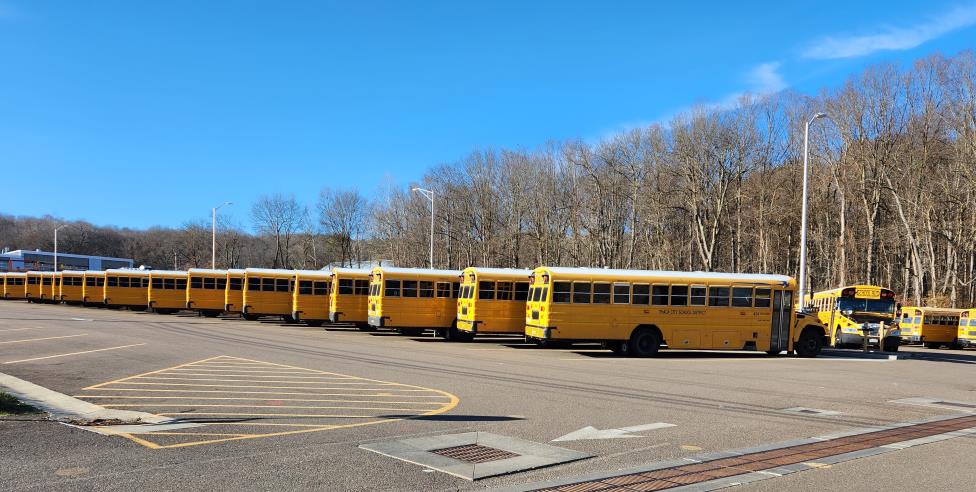
True, New York State, in a legislative decision reaffirmed in the State Senate only days ago, has mandated that all new school buses purchased beginning in 2027 be powered only by electricity. But Governor Hochul is granting districts two-year waivers on the mandate, and the ICSD clearly intends to employ that delay. More than a year ago, ICSD officials put the brakes on electric bus buying, arguing that the Bostwick Road transportation facility lacks the grid capacity to keep electric buses running.
And recall that in that May 2024 rout of a referendum, voters also rejected a mammoth $125 Million capital spending initiative. Never did the board resubmit that proposal, or any one similar to it.
Not, that is, until now. A far more modest, $43.9 Million capital package awaits voter approval in this May’s ICSD election. Gone is any talk of building a new bus garage. Most proposed items in the revamped capital package involve such things as rebuilt roofs, new bathrooms and updated heating systems.
Three seats on the Ithaca Board of Education will be decided in the election. Candidacies won’t be confirmed until the end of April.
###