
Fewer than 25% “very interested” in public water; 45% very opposed
“I’m pretty sure at this point we’ve decided that we’re not looking into this any further because clearly it’s not affordable.”
Enfield Supervisor Stephanie Redmond, on prospects for municipal water, Sept. 17, 2025

by Robert Lynch; January 4, 2026
If those who conducted a limited-reach survey of Enfield residents last year were looking for public consensus toward building a municipal water or sewer system within the town, they didn’t find it.
True the sample size was tiny; small enough to make a statistician wince. That said, only 24.7 percent of respondents to a Town-authorized, geographically-targeted survey last summer in Enfield said they’d be “very interested” in changing to a municipal drinking water supply. Another 15.1 percent said they’d be “somewhat interested.” By contrast, a full 45.2 percent said they were “very disinterested” in making the change. An additional nearly ten percent said they were “somewhat disinterested.” That’s more than half the respondents turning thumbs-down.
“Opinions on municipal services are somewhat polarized,” former Town Board member Becky Sims, now New York State Manager of the water consulting group RCAP Solutions, advised the Town Board, at its special meeting September 17th. The consultant clearly stated the obvious.. Sims’ presentation got eclipsed that night by budget talks covering matters ranging from new tractors to health insurance rates to an administrative aide requested by the highway superintendent. Sims’ data got lost in the clutter.
And for months afterward, just about everything else in Enfield politics seemed more important to chronicle than the prospects for a town water district that’ll likely never happen. Still, before we launch headlong into the business of 2026, best we discuss the water survey’s findings and do it now.
By design, the Enfield Water Protection Committee, a semi-public advisory group with no real power, identified five sections of the town where it inferred public water was most in demand and concluded a municipal system was most affordable to build. The Town Board then commissioned Sims’ consultancy study. The only out-of-pocket cost, Board members were told, was the postage.
Any Enfield household stood eligible to participate. Prompts were posted on the Town website and paper copies were available at the Town Hall. But a select 368—and only 368—households were also mailed postcards alerting them of the survey’s existence. Ninety-three (93) responses came back during the survey period that ran in July and August. That’s a 25 percent response rate. “I would say it’s pretty great given the methods of outreach and the way that the survey was conducted,” Sims told the Town Board.
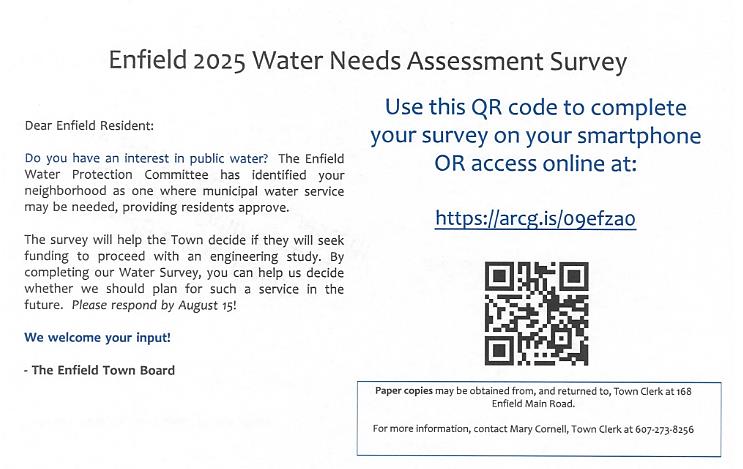
Yet the U.S. Census reports as many as 1,293 households exist in Enfield. So most people never got notified by mail. Fewer than three in ten of us received the cards.
The survey asked more than a score of questions. They dealt with homeowner water quality and quantity, resident interest in municipal water and/or sewer service, and the degree to which residents would be willing to pay for those services.
More than nine in ten respondents said their primary water supply comes from a drilled well. Five in six said their well never runs dry, even during droughts. Yet 65 of the 93 respondents (70%) reported hard water problems. Over 35 percent indicated orange or red staining. Twenty-eight percent said their water has sulfur.
“Water quality problems and treatment for those problems are widespread throughout this community,” Sims concluded. “Two-thirds of people report having at least one treatment system in place even if they’re not drinking the water,” the consultant stated. Forty-four percent of respondents say they drink their tap water untreated, but another 24 percent purchase their drinking water. (30% drink their own water, but treat it first.)
Nevertheless, while many in Enfield may agree their well water stands less than perfect, tapping into some future municipal system, and more importantly, paying for the privilege to do so, remains a reach too far for many.
Forty-two of 92 respondents (45.2%) said they’d be “unwilling” to pay anything to tap into a municipal water line, a number closely in parallel with the percentage opposed to municipal water in any instance. Another five percent said they were “unable to pay.” Thirty-three percent said they’d be willing to spend only less than $500 per year. Just 15 percent were willing to pay a greater amount.
“Willingness to pay is limited,” Sims conceded, “and I think that presents a real challenge for the Town if you were to want to pursue the development of a new water service area in earnest,” she said. “I think you’d be hard-pressed to get a new system built.”
Sims said that if more potential customers were willing to pay $500 to $1,000 per year for water—the survey said only 8.6% would do that—“I think your chances would be better.”
Sims speculated that had more people responded to the survey, the willing-to-pay percentages could have improved. Councilperson Jude Lemke also pointed out a potential survey flaw: If given a range of choices, people are apt to choose the lower-cost option.
But Enfield’s top elected leader has already made up her mind; resolved that given the results, any thought of setting up an Enfield water district now or in the near future has become a non-starter.
“I’m pretty sure at this point we’ve decided that we’re not looking into this any further because clearly it’s not affordable,” Redmond told a questioner from the meeting room’s gallery that night, the Supervisor, again—as she has the (unfortunate) tendency to do—imparting her own opinion and also assigning it to her four Board colleagues. “I think that was the point of the survey,” Redmond continued, “to see if it was going to be something that people really wanted and we should look into it farther, but clearly not only is there maybe not enough interest in it, but there’s not enough interest in paying for it.”
“That’s the value in doing these surveys,” Sims played off of Redmond’s conclusion. The alternative, Sims said, would be for Enfield to invest $30-50,000 on an engineering study; more technical, perhaps, yet still money wasted if a water district is something that neither the public nor the Town Board wants.
“For the Town being the size that it is, I’m not seeing that,” Sims weighed the prospect of advancing to an engineering probe.
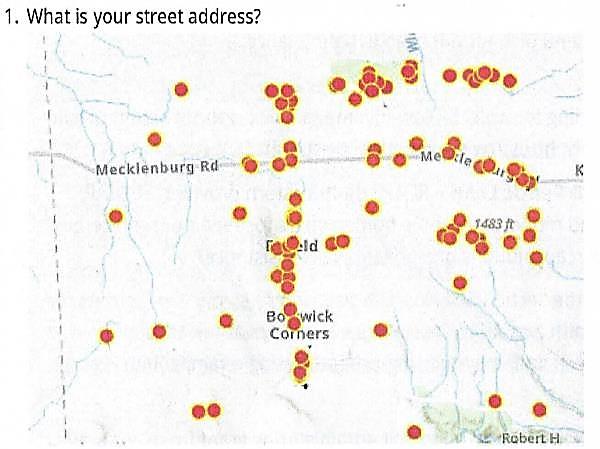
But the reliability of a 93-respondent survey holds only the value of its underlying methodology. The Water Committee confined postcard distribution to just five Enfield roadways, most notably to Enfield Main Road (NY 327) from Route 79 south to the current Highway Garage, running through the heart of Enfield Center. Hayts Road (from Sheffield to Halseyville Road) was also carded. A large, eastern and central stretch of Route 79 was polled, as was at least a block of Van Dorn Road South.
“We can’t cover every house in Enfield,” Redmond stated, explaining why neither the entire town could be considered for water service or not every household polled. “So we targeted spots,” the Supervisor explained, where if a water district were built it would be “most likely to be built.”
That said, well-populated—and water-needy—Enfield neighborhoods remained inexplicably excluded.
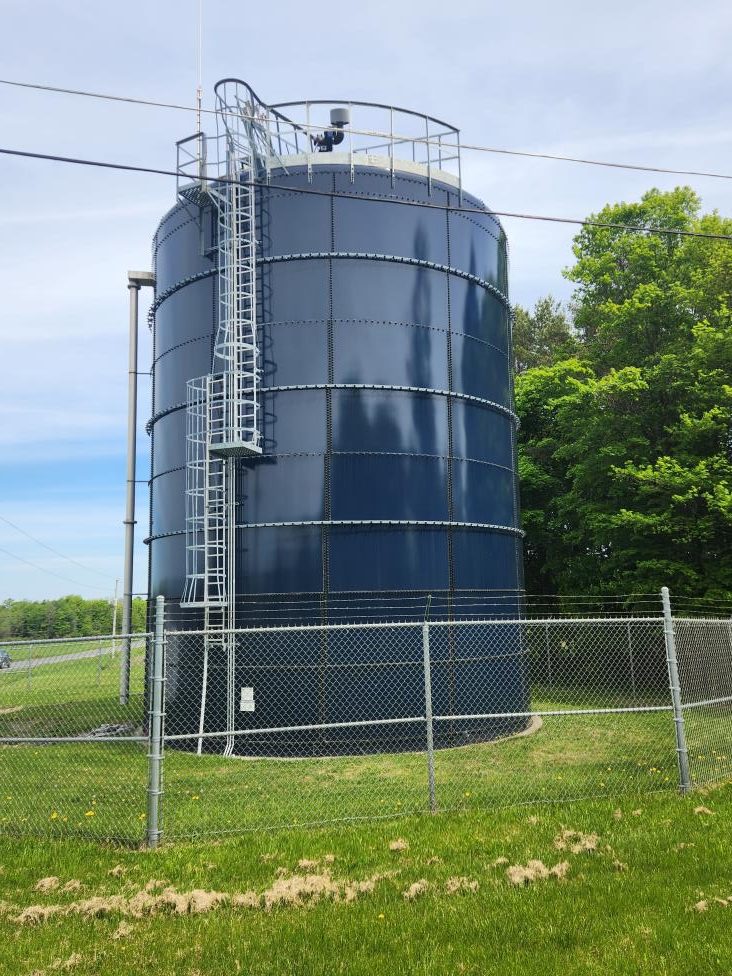
“When I first looked at this map, what struck me most pronounced was there wasn’t a single response from Iradell Road,” this writer, Councilperson Robert Lynch, told Sims and fellow Board members, “and that’s in the shadow of the big blue tank,” reference made to the standpipe at Iradell and Van Dorn Roads. The standpipe is used by Ulysses to hold water it purchases from the intermunicipal Bolton Point system. Ulysses says the tank holds excess capacity that Enfield could access, should it build a pump house there.
True, Iradell is a town line road demarking Enfield from Ulysses. But Ulysses’ Supervisor has said that multi-town water districts can be created. Still, Enfield residents living along Iradell were never asked.
Moreover, long stretches is Halseyville Road were similarly ignored, leading to a minimal response.
“The water up there is downright terrible,” this Councilperson informed the Town Board. Shale rock limits well output there, the taste is bad, and wells run dry. Halseyville also borders the 33-lot Breezy Meadows subdivision. Breezy Meadows remains largely unbuilt, yet it’s destined for development—and the need for plentiful water—in the years ahead.
“People are concerned that their wells will run dry there when Breezy Meadows gets fully developed,” the Councilperson conveyed their worries. As for Halseyville Road, “I wish it had been surveyed. Too late now, but you might have gotten some responses up there.”
The relative demand for municipal water becomes “a self-fulfilling prophesy,” the argument held. And it does so when only select portions of the town receive postcards. “If people were not aware of it… they might not have known the survey was going to be taking place,” this Councilperson posited.
“Those are irrelevant to the survey,” Redmond countered as to the excluded neighborhoods, “because we were not considering putting any municipal water in their area because we can’t afford to,” she said.
Redmond’s argument may hold for sparsely-populated places such as uphill from Enfield Center. But what about Iradell and Halseyville Roads? What excluded them apart from arbitrariness?
Most discussion to date involving municipal water in Enfield has focused on drilling wells into the plentiful aquifer somewhere near Enfield Center. But a virgin water source like that would require a treatment plant and the staff to run it. An alternative would be to purchase already-treated Bolton Point water and then extend pipes down Iradell and/or Hayts Roads to Enfield Center, tapping Van Dorn, Rt. 79, Applegate and Halseyville Roads along the way. The idea earns nary a mention. Perhaps it should.
While the RCAP Solutions study focused mostly on water service, it also asked about municipal sewers. Sewage treatment would become a far heavier lift for a community Enfield’s size. Resident response about sewers paralleled that for water. Slightly more than one in five respondents expressed great interest in public sewers. Forty-three percent were very disinterested.
“Did anything surprise you,” a Board member asked Becky Sims as her 35-minute presentation wound to a close.
“I actually was a little bit surprised how many people were potentially interested in service,” the consultant responded, referring to the near 40 percent supportive of public water.
But it’s still a minority viewpoint. And perhaps more importantly, only a much-smaller minority would be willing to pay as much as it would likely cost to get public water to their homes. The polling showed that a quarter of Enfield residents buy the water they drink. Given survey results and the political lay of the land, expect that 25 percent to keep schlepping their water bottles for some time to come.
###