

County’s downtown building design fails to impress
Reporting and commentary by Robert Lynch; December 15, 2025
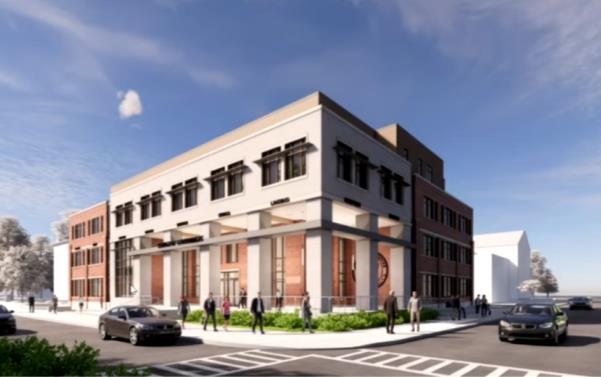
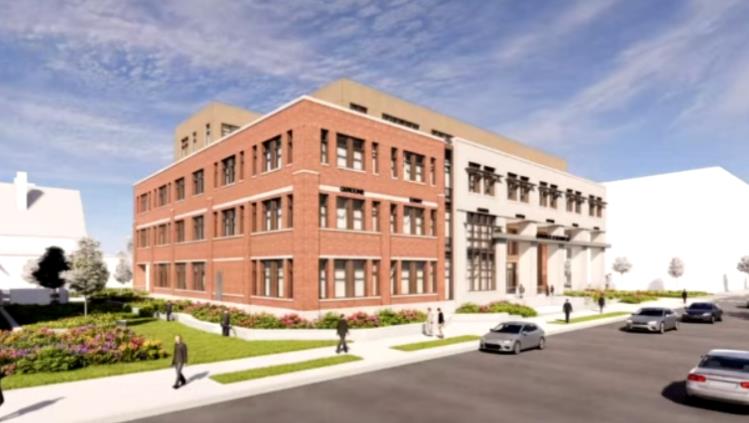
Around these parts these days every new building needs a catchy name. So if we want to assign a trendy title to Tompkins County’s proposed new Downtown Center of Government, let’s call it “The Lashes.” Because if built the way architects presented building plans to the public December 8, that’s what would catch every passerby’s attention as they approached the Buffalo and Tioga Street corner for decades to come.
Whatever those horizontal thingamabobs are cutting across each third-floor window on the eight-figure building’s corner facade—sun shades, ice shields, or just plain decoration—they resemble long, fake eyelashes and create the impression of prying peepers staring down upon all of us at street level. That’s scary.
Last Monday night’s county-sponsored Public Engagement Session, the third and final one of its kind, marked the first opportunity architects had to show off their handiwork, to present what they’d have us construct and pay for to consolidate many—although not all—Tompkins County government departments in a central location.
Beauty, of course, always rests in the eyes of the beholder. You may admire the initial design. I do not. To me, it should never have left the drawing table at Holt Architects’ West State Street offices or wherever it was sketched.
That said, you can erase a design easier than you can erase an attitude.
What happened one week ago in legislative chambers was not so much a demonstration of appearances as one of presumed outcomes. In certain places, and by certain people, it’s become gospel: The Center of Government must be built. It must be built in Downtown Ithaca. And it must be built the way County Administration wants it built.
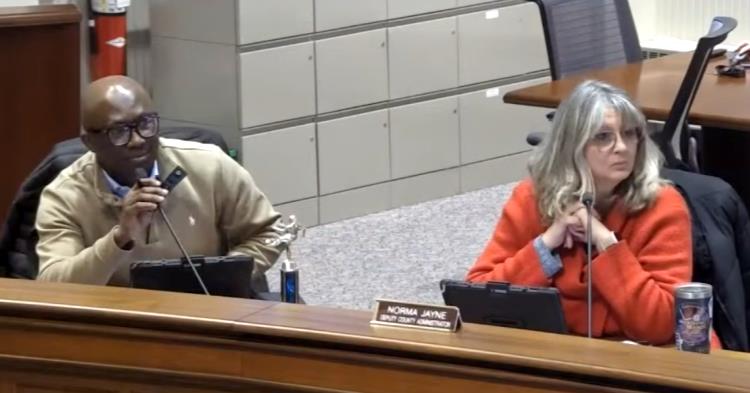
Monday night was a cold one. The presentation played to a nearly empty gallery. Yet with the help of online visitors, it stretched to 90 minutes. County Administrator Korsah Akumfi introduced the event:
“Tonight represents an important milestone in a vision that has been more than twenty years in the making,” the Administrator proclaimed. “This meeting is an opportunity to gather your final comment, build qualitative endorsement, and make minor adjustments needed to move confidently towards a final design,” Akumfi added.
Minor adjustments? Final comment? A milestone vision? That may be County Administration’s view of where things stand. But it’s an opinion not shared by everyone.
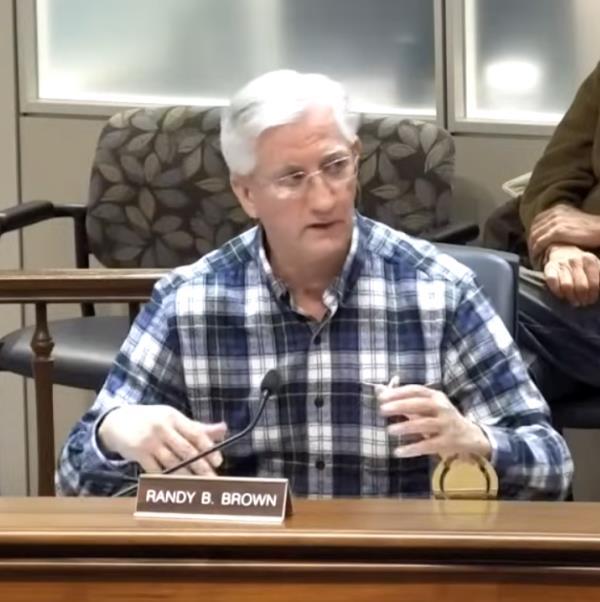
“I will not vote for it; it’s a luxury” Newfield-Enfield’s legislator, Randy Brown, stated bluntly as he updated the Enfield Town Board on the Center of Government two nights later. “I think the project should be smaller and other locations can meet our needs efficiently with better access for the public and at a lower cost,” Brown wrote Enfield in a statement that accompanied his December 10 report.
What they’re proposing, “they’ll be living with for a long time,” Brown forewarned Newfield’s Town Board the next night, Thursday. “The County received various cost estimates for the Center of Government Building… and the cost estimates were above previously budgeted numbers,” the Newfield Legislator cautioned Enfield. “I am not surprised, and the Legislature is looking at all options before committing to this project,” Brown promised the Enfield Board.
Mind you, Randy Brown is not some contrarian, rogue back-bencher. Brown chairs the Legislature’s Downtown Facilities Special Committee, the panel actually charged with building the Center of Government.
So juxtapose Korsah Akumfi’s visionary optimism with Randy Brown’s gut check. We’ve got a problem here. Nevertheless, the divergence would have eluded most casual observers at the rollout. You would have needed to slog through many months of legislative deliberations to gain true perspective and refused to accept County Administration’s gloss at face value. As much as money-sponging architects and overly-assertive bureaucratic brass would have you believe otherwise, the Downtown Center of Government is not necessarily going to happen.
Alternatives abound. Most recently, developers of Downtown Ithaca’s imperiled Harold’s Square have begged the Legislature at more than one meeting to lease or buy long-vacant office space in Harold Square’s 12-story high rise. They’ve pleaded to the point of desperation.
Before that, Tompkins Bank approached the County about its purchasing one or more buildings in the Cornell Business Park near the airport, ground leases upon which the bank had foreclosed. And then there’s always the Shops at Ithaca Mall, a place that’s fallen so far from grace these past 50 years that its south wing may convert into cubicles for you to store an old couch.
But as administrators see it, those alternative choices are now off the table.
“The new construction has the highest capital investment, but it also provides a purpose-built facility designed specifically for County functions,” Deputy County Administrator Norma Jayne began Administration’s supposedly objective comparison of a more expensive new building versus its three competing retrofits. New construction, she said, “ensures full accessibility and compliance with modern standards and it allows consolidation of operations in a true, one-stop governmental center.”
Please don’t fault Norma Jayne for any of this. Jayne’s halting, diffident delivery that night laid bare the truth that she was just reading a script. She hadn’t written it. And what Jayne read reflected not so much a study in search of a conclusion as a mind made-up in quest of a rationale.
Harold’s Square, Jayne recited, has “public accessibility” concerns, and parking there can’t be assured. Either the Cornell Business Park or the mall would “pull the government activity from the civic center and away from the existing county campus,” she said. (Yes, “civic center” has blossomed as a new buzzword phrase; one envisions a gymnasium.)
“It still is the overall conclusion that the new construction provides the strongest long-term value and the most predictable outcomes,” the Deputy Administrator’s hesitant, conclusory comparison ended. (Of course, a critic might counter that the “most predictable outcome” of a new building for you or for me would be higher taxes.)
Just eleven minutes into that evening’s hour-and-a-half rollout, Administration on its own accord had tossed aside any thought of going elsewhere. No, it insisted, we should move full speed ahead toward a new building. Administration’s overarching opening narrative tarnished whatever of the meeting remained.
Quay Thompson leads Holt Architects’ design team. Bernard Best is Holt’s project manager. Holt has good reason for making “The Lashes” happen. Last December legislators authorized a nearly $4 Million contract with Holt for “the planning, design and development of the Center of Government project.”
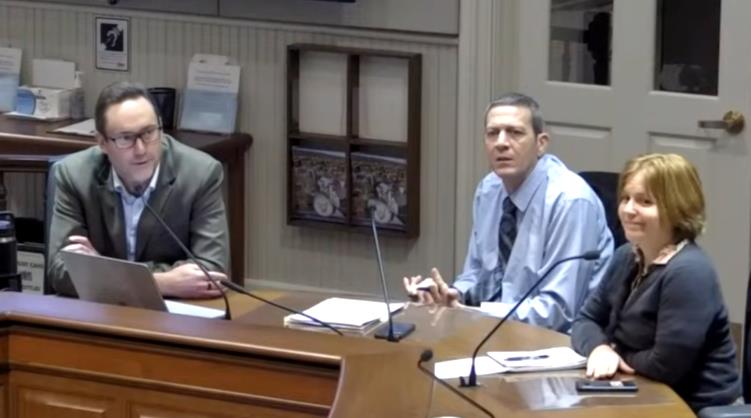
“We’re about halfway through the design in terms of the big schedule,” Thompson led off his presentation. “As we design more, things get harder and more expensive to change,” he cautioned. Yet “there’s still an opportunity to make adjustments and fine-tuning of the design,” Thompson assured.
Those words provide reassurance. Some of us would welcome many a change.
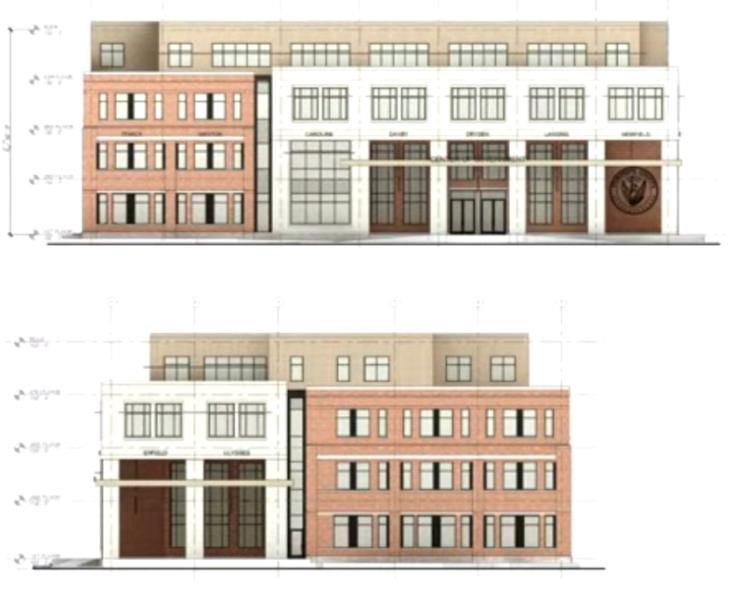
For starters there’s the façade. Plans call for stone of some sort at the corner entrance where Buffalo meets Tioga. But there’d then be a transition to brick on both sides. The aim, we were told, is for the appearance to blend in with the courthouse on Tioga and with the historic, 1865 Boardman House bordering DeWitt Park.
But brick and stone (or its synthetic substitute) can fight when put side by side. It looks like either you ran out of money or that a design committee couldn’t make up its mind. The latter explanation wouldn’t be far from the truth. Bernard Best drew guidance for the stone-to-brick merger from an online survey. Respondents liked one facing or the other, sometimes both.
“They liked the brick; they liked a little bit of the limestone at the entry ,” Best reported, “and that attractive mix that comes between that; breaking down the scale of the building.”
For those who might have expected something dramatic or award-winning, this ain’t it. Architects had once toyed with a gabled façade to complement the courthouse.. They rejected it. What’s before us now is just another flat-roofed box. It could have emerged from a Cornell second-year architecture class.
The Center of Government would stand four stories tall. Why there’d be no basement, no one’s adequately explained. But the Center’s top floor would be pulled back from the floors beneath it “so from street viewpoint it scales the building down much closer so it isn’t overpowering the Boardman House,” Best explained.
Still, withdrawing that top floor wastes a valuable ground footprint. Across DeWitt Park, developers of the Library Place apartments did the same thing, forced into it by historic preservationists. Library Place owners would later say the restriction impaired profitability.
Another thing: Designers would place the names of Tompkins County’s nine towns—in strict alphabetical order— atop each Center of Government window that faces a street. Some may call that creative; others tacky. But there’s already controversy. Someone emailed in to point out there’s both a Town and City of Ithaca. Sorry, the critic was told. The two “Ithaca’s” will have to share.
Administration’s vaunted PowerPoint had claimed that a (now) 59,000 square foot new Center of Government “meets all Legislative criteria.” No, it does not. One of those key criteria is parking availability. And a downtown center would meet the commuter test only if one expects employees and the public to keep plugging those increasingly costly City of Ithaca parking machines forever or trudge four or five blocks in every day from residential side streets.
“Employees are (to use) street parking, and we have a couple other lots that we’re looking at, someplace,” Thompson conceded, feebly attempting to tiptoe around the downtown building’s Achilles’ heel. The architect would later acknowledge that those “other lots” include City-managed garages, the ones that are often filled-up by hotel patrons.
And in the meeting’s most embarrassing moment, landscape architect Laura Seib of Fisher Associates found her homework absently undone when legislator Mike Lane quizzed her as to how many courthouse-adjacent employee parking slots the project would consume. Seib couldn’t say.
“I don’t have a set difference here and that is something that we can continue to refine,” the landscaper said, groping for an unknown answer. But one thing she knew: “Because of the increase in the number of people who would be on campus, even retaining all of the existing spaces wouldn’t come close to providing adequate parking for the employees who’d be in the new building,” Seib said.
Administrator Akumfi stepped in: “At the moment, the County doesn’t provide parking for visitors to any of the offices,” he sought to clarify. But Akumfi missed the point. It’s not so much about visitors as it is about employees. Already, the State Court’s system pre-empts many of the courthouse spaces.
And nothing may frustrate a county worker more than having to pay for the privilege to earn a paycheck. Legislator Shawna Black, attending remotely, gave voice to that frustration.
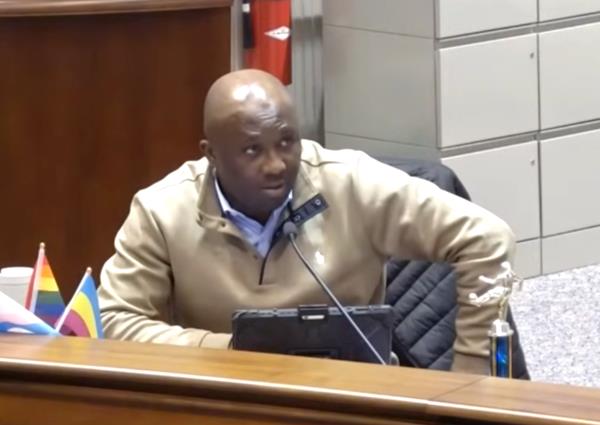
“I continue to have concerns about the parking situation for our employees,” Black advised the Administrator and the design team. “And I would ask that if and when we decide to pursue this location and this building, that we have a plan moving forward, because we have employees that come to work every day, and they shouldn’t have to walk halfway across town in order to get to work.”
In some ways, building architects have tripped over good sense to be dutiful stewards of a Green New Deal. The Center of Government would be framed in “heavy timber,” not structural steel. Crews would finish the building in that timber as well. The argument goes that trees capture and contain carbon, steel mills spew it out smokestacks. And cement plants do too. Toward a green goal, designers would build with wood and confine concrete only to the foundation.
Yet one wonders if any fire chief was ever consulted. Timbers burn. Steel and concrete do not. And one cannot forget the bedtime story piglet who built his house with sticks only to become a wolf’s ham sandwich.
Only about half of the Legislature’s 14 members attended the rollout meeting. Questions by them and from online visitors often drifted to minor stuff, straying from the bigger picture. Will the building have public bathrooms and a public water fountain bordering DeWitt Park, one legislator asked? Can Gadabout buses easily drop off their riders? Could the Boardman House tap into the planned geothermal heating system?
“I have a concern with too much white,” legislator Greg Mezey, remarked at one point. It can get “fading and dull and kind of grimy-looking over time,” he said. Mezey also requested a local artist paint a mural near the entrance. He also requested washable outside walls to more easily cleanse away graffiti. (Yes, it’s downtown.)
To some, the Tompkins County Downtown Center of Government has become a runaway train without brakes. Little by little, a point of no return creeps upon us. In November, legislators, but only after a long executive session, authorized spending $2.6 Million to remove the three buildings now resting on the Center of Government site. In early-June, those same legislators agreed in principle to fund up to $50 Million for the Center of Government project. At the time, some said what they had done stopped short of an irrevocable promise. Randy Brown was among last June’s four dissenters.
Over the decades, the Tompkins County Legislature has prided itself as sitting in government’s driver’s seat. Our county has no independently-elected County Executive, a top boss drawing power from a separately-defined constituency. In Tompkins County, in both tradition and by law, the County Administrator and his deputies are mere employees of the Legislature. They serve at the Legislature’s will.
But since he arrived here in January, imported from Schoharie County, a place where he may have managed a more deferential Board of Supervisors, Korsah Akumfi has exercised what some may see as an inordinate degree of executive authority when it comes to the Center of Government. Akumfi wants progress, not procrastination. The new Administrator’s driven resolve is why old buildings will soon be tumbling down and that new “Civic Center” may soon be rising.
Holt Architects’ timeline would put the Center of Government out to bid in September 2026. Construction would be finished by early 2029. The clock ticks.
If anyone—aside from legislator Randy Brown—pushes back on this $50 Million perilous venture, it’s the public at large. Zach Winn, a frequent speaker at Legislature meetings, voiced his criticism that cold December night.
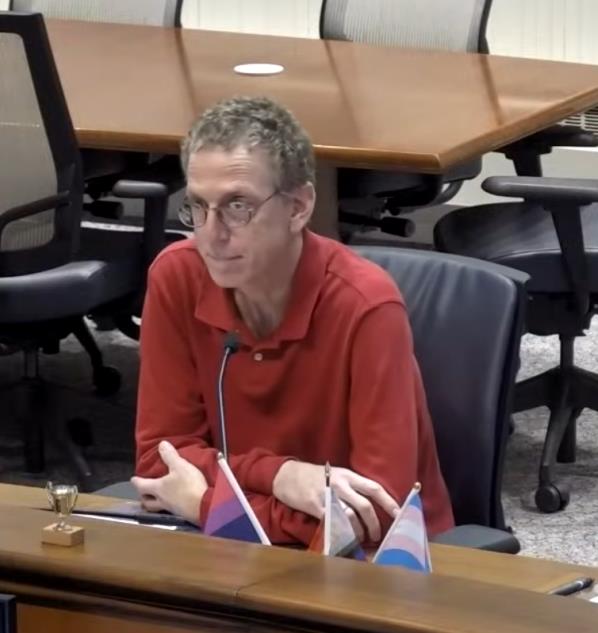
“I don’t think it’s a good idea to spend $50 Million on a new building,” Winn spoke from the gallery. “Who knows what that could balloon to by the time the project’s over,” he warned. Winn would prefer using Harold’s Square instead.
Ten minutes before everyone went home, Norma Jayne relayed another question from the chat box. “Shawna (Black) said if and when we do this option,” the questioner inquired. “I thought this was a done deal?”
Legislature Chair Dan Klein was handed this toughest-of-all questions to address.
“So we have authorized the project to continue forward,” Klein admitted. “And it is, but we have not put the money on the table yet.”
Greg Mezey interjected and Klein clarified. There’s $9 Million “in the bank” so far. The rest would need bonding.
And if the Randy Browns of Tompkins have their way, any more money will never reach the table. Unlike in some other places perhaps, Tompkins County’s legislators, not the Administrator, still run the show.
###